Amps to kW Calculator
Enter amps, voltage and power factor to get kilowatts and kVA for a single phase, three phase or DC load.
Free · runs in your browser · nothing is uploaded
Recent
Your last 10 settings, saved only in this browser. Nothing is uploaded.
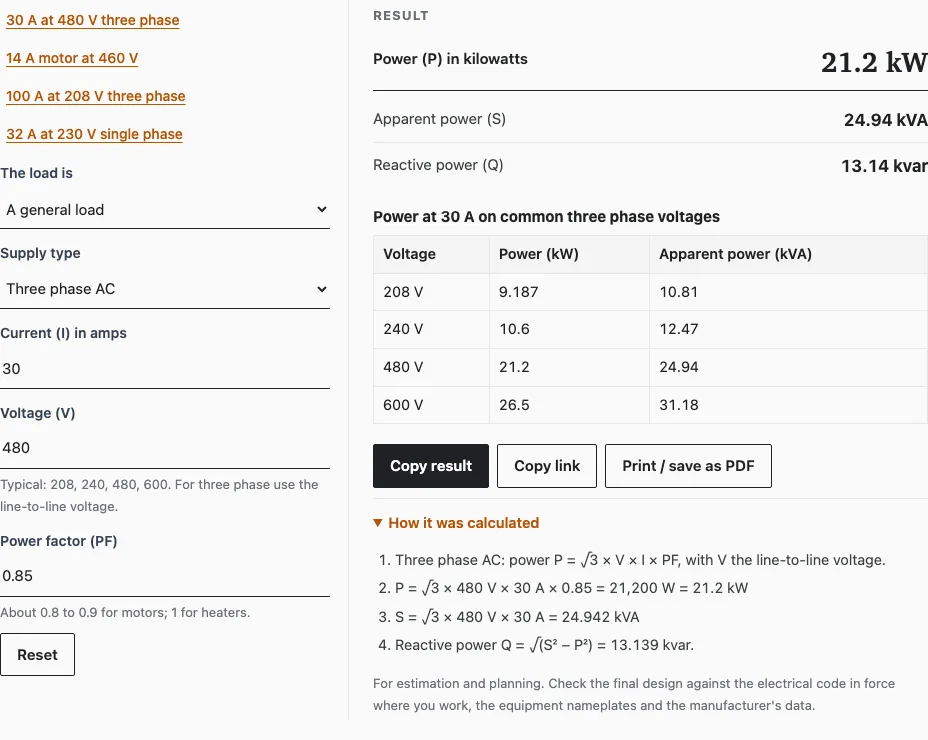
How to use the Amps to kW Calculator
- In The load is, keep “A general load”, or choose “A motor (show shaft output)” to see the mechanical output too.
- Pick the Supply type. The list starts with “Three phase AC”; “Single phase AC” and “DC” follow.
- Enter Current (I) in amps, for example a measured current or a nameplate value.
- Enter the Voltage (V). Typical values are 208, 240, 480 and 600, and three phase always takes the line-to-line voltage.
- Set the Power factor (PF): about 0.8 to 0.9 for motors and 1 for heaters. DC hides this box.
- In motor mode, enter Motor efficiency (%) from the nameplate, typically 85 to 95 % for industrial motors.
- Read Power (P) in kilowatts, then Apparent power (S) and Reactive power (Q). A motor also gets Motor shaft output and Motor shaft output in horsepower, plus a note that both are estimates.
Four example buttons cover common cases, from “30 A at 480 V three phase” to “32 A at 230 V single phase”. “Copy result” copies the numbers, “Copy link” copies a link that reopens your inputs, “Print / save as PDF” prints them, and Reset brings back the defaults.
Changing any field updates the result rows, the steps and the tables straight away, and Copy link keeps your exact inputs in the address so you can share or reopen the calculation.
How do you convert amps to kW?
Multiply amps by volts and by the power factor, then divide by 1,000. For single phase AC that is kW = A × V × PF ÷ 1,000, and for DC the power factor drops out. An EV charger drawing 32 A on 230 V single phase with PF 1 works out to 7.36 kW, the same figure the tool returns.
- Multiply the current by the voltage: 32 A × 230 V = 7,360 VA.
- Multiply by the power factor: 7,360 × 1 = 7,360 W.
- Divide by 1,000: 7.36 kW.
On DC, 100 A at 48 V is simply 4.8 kW. With a power factor below 1 the kW is lower than the kVA, and the gap shows up as reactive power.
What is the amps to kW formula for three-phase?
For three phase, kW = √3 × A × V × PF ÷ 1,000, with V the line-to-line voltage and √3 about 1.732. A load of 30 A at 480 V and PF 0.85 is 21.2 kW, with 24.94 kVA of apparent power and 13.14 kvar of reactive power. The tool uses this formula by default.
| Current and voltage | PF | Power (kW) | Apparent power (kVA) |
|---|---|---|---|
| 30 A, 480 V | 0.85 | 21.2 | 24.94 |
| 14 A, 460 V | 0.84 | 9.37 | 11.15 |
| 100 A, 208 V | 0.95 | 34.23 | 36.03 |
| 200 A, 480 V | 0.9 | 149.65 | 166.28 |
The 30 A row at the other standard voltages gives 9.19 kW at 208 V, 10.6 kW at 240 V and 26.5 kW at 600 V.
How do I get motor shaft output from amps?
Calculate the electrical input in kW, then multiply by the motor efficiency. A motor drawing 14 A at 460 V three phase with PF 0.84 takes 9.37 kW; at 91 % efficiency its shaft delivers about 8.53 kW, or 11.43 mechanical horsepower. Both values are estimates, because efficiency changes with load.
- Choose “A motor (show shaft output)” in The load is.
- Enter the measured or nameplate current, the voltage and the power factor.
- Type the efficiency from the nameplate into Motor efficiency (%).
- Read Motor shaft output in kW and Motor shaft output in horsepower.
Worked examples
| Input | Result |
|---|---|
| 30 A, 480 V, three phase, PF 0.85 | 21.2 kW, 24.94 kVA |
| 14 A, 460 V, three phase, PF 0.84 | 9.37 kW, 11.15 kVA |
| 100 A, 208 V, three phase, PF 0.95 | 34.23 kW, 36.03 kVA |
| 32 A, 230 V, single phase, PF 1 | 7.36 kW, 7.36 kVA |
Calculated by the tool above; open it with the same values to see each step.
Questions, briefly answered
What is 200 amps in kW?
At 240 V single phase with PF 1, 200 A is 48 kW. On a 208 V three phase supply with PF 1 it is 72.05 kW, and at 480 V with PF 0.9 it is 149.65 kW.
How many amps is 1 kW?
At 240 V with a power factor of 1, one amp carries 0.24 kW, so 1 kW is about 4.17 A. Use the kW to Amps Calculator to work in that direction.
What is the difference between kW and kWh?
A kW is power, the rate of energy use at a moment. A kWh is energy: power multiplied by time, so a 2 kW load for 3 hours uses 6 kWh.
How do I calculate electricity cost from amps?
Convert the amps to kW, multiply by the hours of use for kWh, then multiply by the price per kWh on your bill. The Amps to Watts Calculator does those steps when you enter hours and your price.
Why is kW lower than kVA?
kVA is volts times amps, and kW is the part of it that does real work. With a power factor of 0.85, 24.94 kVA delivers 21.2 kW.
What power factor should I enter?
Use the value from the nameplate or a measurement when you have one. Otherwise the help text suggests about 0.8 to 0.9 for motors and 1 for heaters and other resistive loads.
Related tools
- kW to Amps Calculator: go from kilowatts back to current and breaker size.
- Amps to Watts Calculator: add hours of use and your price per kWh.
- kVA to kW Calculator: convert apparent power at a chosen power factor.
- kVA to Amps Calculator: find current from kVA, including transformers.
- HP to Amps Calculator: estimate motor current from horsepower.
- Three Phase Power Calculator: look at a three phase load in more detail.
- Power Factor Calculator: find the power factor from kW and kVA.
- Power conversion calculators: every power and current converter on the site.