Amps to Watts Calculator
Enter amps, voltage and power factor to get watts, kilowatts and VA, then the kWh and cost for the hours you run it.
Free · runs in your browser · nothing is uploaded
Recent
Your last 10 settings, saved only in this browser. Nothing is uploaded.
How to use the Amps to Watts Calculator
- Pick the Supply type: “Single phase AC”, “Three phase AC” or “DC”.
- Enter the Current (I) in amps, for example the measured current or the amps printed on the device label.
- Enter the Voltage (V). Common values are 120, 208, 240, 277 and 480; for three phase, type the line-to-line voltage.
- Set the Power factor (PF): 1 for heaters, roughly 0.8 to 0.9 for motors. This box is hidden for DC.
- Fill in Hours of use per day (0 to 24). It changes only the energy figures, never the watts.
- Replace the example 0.15 in Price per kWh (your own rate) with the rate on your bill, in your own currency. Clear the box to hide both cost rows.
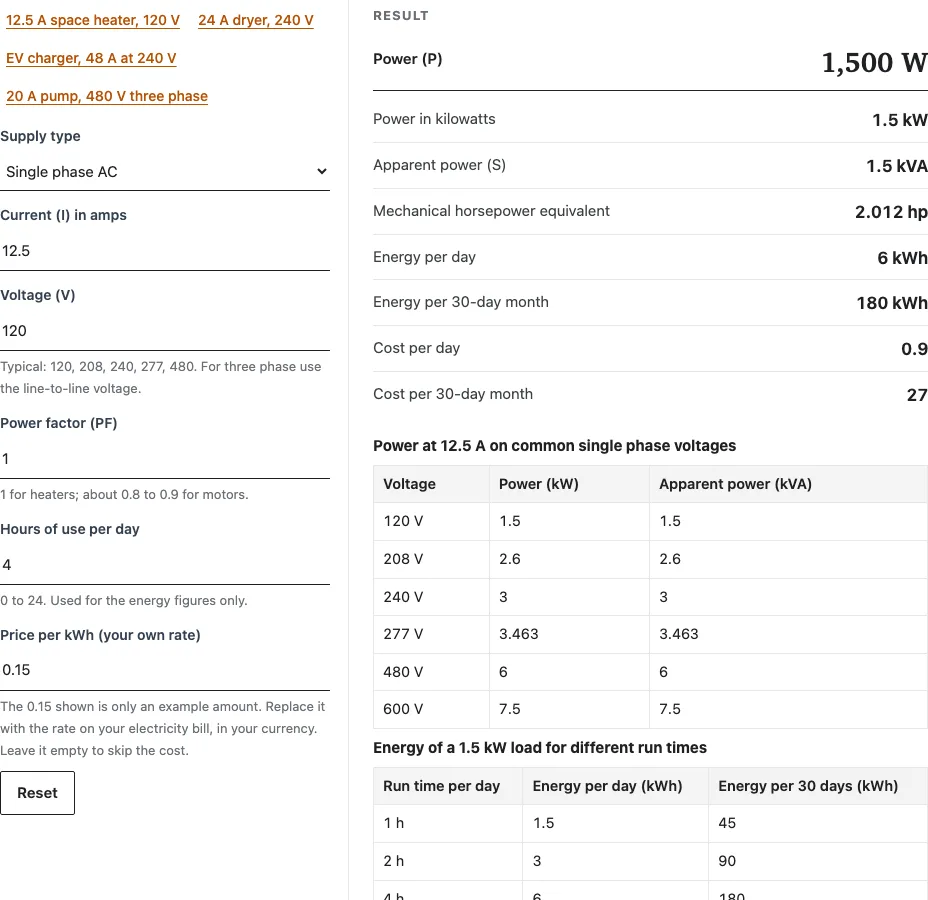
- Read Power (P) in watts, then Energy per day, Energy per 30-day month and the cost rows. “How it was calculated” lists every step.
Example buttons such as “24 A dryer, 240 V” and “EV charger, 48 A at 240 V” load a full set of inputs. “Copy result” copies the figures, “Copy link” copies a link that reopens these inputs, and “Print / save as PDF” prints them. Reset brings back the defaults.
Changing any field updates the result rows, the steps and the tables straight away, and Copy link keeps your exact inputs in the address so you can share or reopen the calculation.
How do you convert amps to watts?
Multiply the current by the voltage. For single phase AC, also multiply by the power factor: P = V × I × PF. Three phase AC adds a factor of √3 (about 1.732) and uses the line-to-line voltage. DC has no power factor, so 10 A on a 12 V battery circuit is simply 120 W.
| Supply | Formula | Example from the tool |
|---|---|---|
| DC | P = V × I | 1 A at 12 V = 12 W |
| Single phase AC | P = V × I × PF | 50 A at 240 V, PF 0.85 = 10,200 W |
| Three phase AC | P = √3 × V × I × PF | 20 A at 480 V, PF 0.85 = 14,134 W |
The apparent power row is the same multiplication without the power factor. For the 50 A example it reads 12 kVA, while the real power is 10.2 kW.
What is 20 amps in watts?
At 120 V and a power factor of 1, 20 amps is 2,400 watts. At 240 V the same 20 A carries 4,800 watts, twice as much, because power rises in step with voltage. A motor drawing 20 A delivers less real power, since its power factor is below 1.
The tool’s table for 20 A single phase gives these values:
| Voltage | Power (kW) |
|---|---|
| 120 V | 2.4 |
| 208 V | 4.16 |
| 240 V | 4.8 |
| 277 V | 5.54 |
| 480 V | 9.6 |
How do I estimate kWh and cost from amps?
Multiply the kilowatts by the hours of use per day to get kWh per day, then by 30 for a month. Multiply the kWh by your price per kWh for the cost. A 48 A EV charger at 240 V draws 11.52 kW, so 8 hours a day gives 92.16 kWh per day.
- The tool converts amps to kW first, as above.
- It multiplies by Hours of use per day: 11.52 kW × 8 h = 92.16 kWh.
- It multiplies by 30 days: 2,764.8 kWh per month.
- With a price entered, it multiplies the monthly kWh by that price.
A label or breaker current is a maximum. Thermostats and compressors switch on and off, so real energy use is often lower than these figures.
Worked examples
| Input | Result |
|---|---|
| 12.5 A, 120 V, single phase, PF 1, 4 h/day | 1,500 W (1.5 kW), 180 kWh/month |
| 20 A, 240 V, single phase, PF 1, 3 h/day | 4,800 W (4.8 kW), 432 kWh/month |
| 48 A, 240 V, single phase, PF 1, 8 h/day | 11,520 W (11.52 kW), 2,765 kWh/month |
| 20 A, 480 V, three phase, PF 0.85, 10 h/day | 14,130 W (14.13 kW), 4,240 kWh/month |
| 10 A, 12 V, DC, 2 h/day | 120 W (0.12 kW), 7.2 kWh/month |
Calculated by the tool above; open it with the same values to see each step.
Questions, briefly answered
How many watts is 1 amp?
One amp is 120 W at 120 V and 240 W at 240 V with a power factor of 1. On a 12 V DC supply, 1 A is 12 W.
What is 50 amps in watts?
At 120 V, 50 A is 6,000 W; at 240 V it is 12,000 W, both at a power factor of 1. A motor load at 240 V with PF 0.85 gives 10,200 W.
How many amps equal a watt?
The current for one watt is 1 divided by the voltage, at a power factor of 1. That is about 0.0083 A at 120 V and about 0.0042 A at 240 V.
Why does a motor give fewer watts than volts times amps?
Part of a motor’s current builds its magnetic field and does no real work, which the power factor accounts for. The tool shows this as the gap between Power (P) and Apparent power (S).
What does the horsepower row mean?
It divides the watts by 745.7 W per mechanical horsepower. For 1,500 W the result is 2.0115 hp; it is the electrical power expressed in hp, not a motor’s shaft output.
Why is no cost shown?
Cost rows appear only when Price per kWh (your own rate) has a value. If the box is empty and hours are above zero, the tool shows a note that no price was entered.
Related tools
- Watts to Amps Calculator: go the other way and get the breaker size too.
- Amps to kW Calculator: get kW, kVA and kvar, with a motor shaft option.
- Volts to Watts Calculator: find power from volts and ohms instead of amps.
- kW to Amps Calculator: turn a kilowatt rating back into current.
- Three Phase Power Calculator: work through a three phase load in more detail.
- kVA to kW Calculator: convert apparent power to real power at a given power factor.
- Ohm’s Law Calculator: solve for voltage, current, resistance or power.
- Generator Size Calculator: add up loads to choose a generator.
- Power conversion calculators: every power and current converter on the site.