AWG to mm2 Converter
Convert AWG or kcmil to mm2, or mm2 to the nearest AWG, and see the next standard metric size up and down.
Free · runs in your browser · nothing is uploaded
Recent
Your last 10 settings, saved only in this browser. Nothing is uploaded.
How to use the AWG to mm² converter
- Open Convert and choose “AWG / kcmil to mm²” to start from a gauge, or “mm² to AWG” to start from a metric cross-section.
- In the first mode, pick a value in the AWG or kcmil size list. It runs from 30 AWG to 2000 kcmil, including the small sizes used in electronics and data cable.
- In the second mode, type the Cross-section (mm²), for example 1.5, 2.5, 4, 6, 10 or 16. Any value is accepted; the tool warns when it is not a standard IEC 60228 size.
- Read the main result: Cross-section for an AWG input, or Nearest AWG size with its Area of the nearest AWG and the Difference for a metric input.
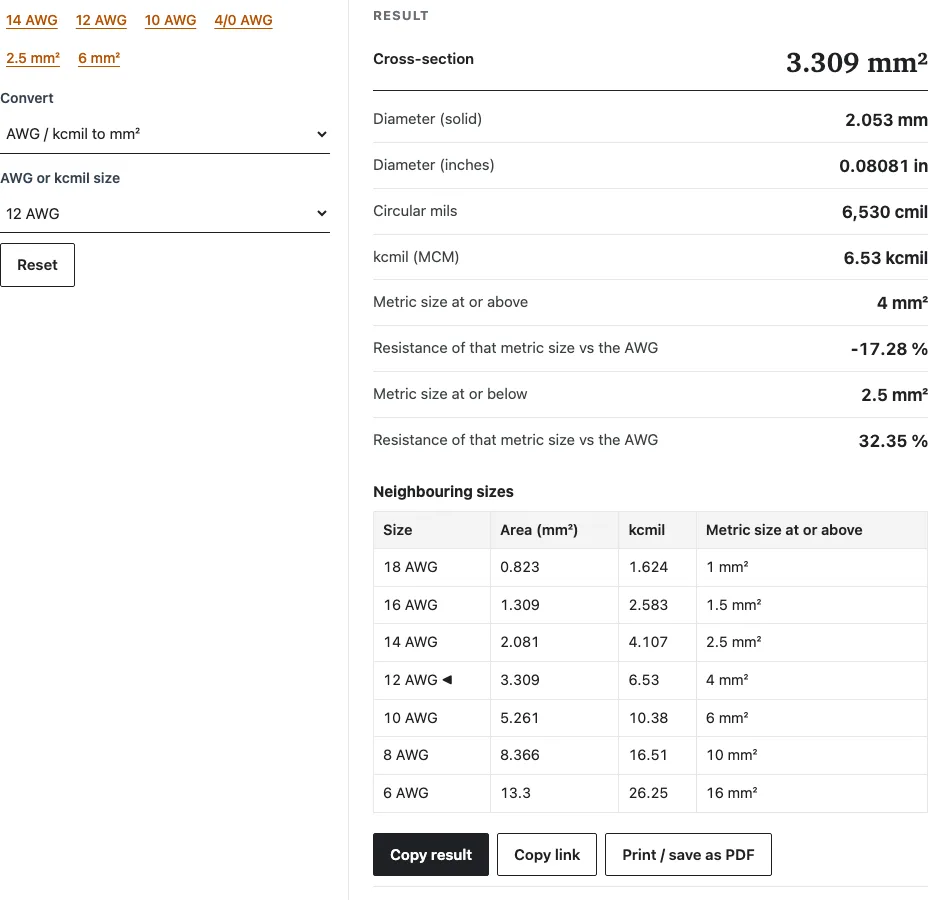
- Check the neighbouring sizes. For an AWG input, Metric size at or above and Metric size at or below each come with a resistance comparison. For a metric input, Next AWG size up and Next AWG size down do the same.
- The Diameter (solid), Diameter (inches), Circular mils and kcmil (MCM) rows give the other ways the same wire is described.
- Look at the Neighbouring sizes table for the three gauges on each side with their metric equivalents.
The example buttons above the form load 14, 12, 10 and 4/0 AWG, 2.5 mm² and 6 mm². Copy result, Copy link and Print / save as PDF keep the conversion, and Reset returns to 12 AWG.
How do you convert AWG to mm²?
Find the diameter from the gauge number, then the area of a circle with that diameter. The AWG definition is d = 0.127 mm × 92^((36 − n) ÷ 39), and the area is A = π ÷ 4 × d². For 12 AWG that gives a 2.0525 mm diameter and 3.3088 mm², or 6,529.95 circular mils.
Sizes above 4/0 AWG are named in kcmil, so the step is simpler: 1 kcmil = 0.5067075 mm². 250 kcmil is 126.7 mm² and 500 kcmil is 253.4 mm². Common gauges and their nearest IEC 60228 sizes, as the tool returns them:
| AWG | Area (mm²) | Metric size at or above | Its resistance vs the AWG | Metric size at or below |
|---|---|---|---|---|
| 18 | 0.823 | 1 mm² | −17.7 % | 0.75 mm² |
| 16 | 1.309 | 1.5 mm² | −12.75 % | 1 mm² |
| 14 | 2.081 | 2.5 mm² | −16.76 % | 1.5 mm² |
| 12 | 3.309 | 4 mm² | −17.28 % | 2.5 mm² |
| 10 | 5.261 | 6 mm² | −12.31 % | 4 mm² |
| 8 | 8.366 | 10 mm² | −16.34 % | 6 mm² |
| 6 | 13.30 | 16 mm² | −16.86 % | 10 mm² |
| 4 | 21.15 | 25 mm² | −15.4 % | 16 mm² |
What AWG is 2.5 mm²?
The nearest AWG size to 2.5 mm² is 14 AWG (2.081 mm²), but 14 AWG is 16.76 % smaller, so it has about 20 % more resistance. The next AWG size with at least 2.5 mm² is 12 AWG (3.309 mm²). Use 12 AWG when the replacement must never be smaller.
The same pattern holds for most metric sizes: the nearest gauge is often the smaller one.
| Metric size | Nearest AWG | Next AWG size up | Its resistance vs your cable |
|---|---|---|---|
| 1.5 mm² | 16 AWG | 14 AWG | −27.92 % |
| 2.5 mm² | 14 AWG | 12 AWG | −24.44 % |
| 4 mm² | 12 AWG | 10 AWG | −23.97 % |
| 6 mm² | 10 AWG | 8 AWG | −28.28 % |
| 10 mm² | 8 AWG | 6 AWG | −24.82 % |
| 16 mm² | 6 AWG | 4 AWG | −24.35 % |
Is 4 mm² the same as 12 AWG?
No. 12 AWG is 3.309 mm², so a 4 mm² cable has 17.28 % less resistance and carries the same current with less voltage drop. Replacing 4 mm² with 12 AWG adds about 21 % resistance. They are often called equivalents, but not closely enough for a voltage drop or ampacity calculation.
Current ratings do not convert with the area. A metric cable’s rating comes from the wiring rules it was made for, and an AWG wire’s from NEC 310.16, so look up the rating in the system you are installing under.
Worked examples
| Input | Result |
|---|---|
| 14 AWG | 2.081 mm² |
| 12 AWG | 3.309 mm² |
| 10 AWG | 5.261 mm² |
| 4/0 AWG | 107.2 mm² |
| 2.5 mm² | 14 AWG (2.081 mm²) |
| 16 mm² | 6 AWG (13.3 mm²) |
Calculated by the tool above; open it with the same values to see each step.
Questions, briefly answered
What is a circular mil?
The area of a circle one mil (0.001 in) across, or 5.067075 × 10⁻⁴ mm². The Circular mils row shows it for your size, and kcmil (MCM) shows the same figure in thousands.
Can I convert kcmil to mm²?
Yes. Choose “AWG / kcmil to mm²” and pick the kcmil size; 1 kcmil is 0.5067075 mm², so 250 kcmil is 126.7 mm².
What is 6 mm² in AWG?
The nearest gauge is 10 AWG (5.261 mm², 12.31 % smaller). The next size with at least 6 mm² is 8 AWG at 8.366 mm².
How many mm² is 10 gauge wire?
10 AWG is 5.261 mm² (10,383 circular mils) with a solid diameter of 2.588 mm. The metric sizes either side are 6 mm² and 4 mm².
What does a negative resistance percentage mean?
The other size has less resistance than yours because its area is larger. Resistance is inversely proportional to area for the same metal and temperature.
Why does the converter accept a size like 3 mm²?
Some cables and old data sheets use non-standard sizes. 3 mm² converts to 12 AWG as the nearest size (10.29 % larger), and the tool warns that it is not an IEC 60228 size and names 4 mm² as the next standard size up.
What is a kcmil?
Kcmil means thousand circular mils, the unit used for conductors larger than 4/0 AWG. One kcmil is 0.5067 mm2, so a 500 kcmil conductor has a cross-section of about 253 mm2.
Related tools
- Wire Gauge Chart: diameter, area, resistance and weight of every AWG size.
- Cable Size Calculator: size a cable in mm² from current and run length.
- Voltage Drop Calculator: check the drop on AWG or metric cable.
- Wire Size Calculator: the AWG size a load and run length need.
- Wire Ampacity Calculator: amps an AWG size can carry under NEC 310.16.
- DC Voltage Drop Calculator: 12 V, 24 V and 48 V runs in AWG or mm².
- Wire and Cable Calculators: every wire tool on the site.