Battery Cable Size Chart Calculator
Enter battery voltage, current and cable length to get the fuse size and a cable gauge that meets the drop and is protected by that fuse.
Assumes stranded copper or aluminum, a two-wire DC circuit, a fuse at 125 % of the current, and the conservative NEC 310.16 90 °C ampacity unless you enter the cable maker's rating. Free, runs in your browser. Verify with your local code and a licensed electrician before you install.
Recent
Your last 10 settings, saved only in this browser. Nothing is uploaded.
How to use the Battery Cable Size Calculator
- Enter “Battery voltage (V DC)”: 12, 24 or 48 for most systems.
- Under “Load given as”, pick “Inverter (AC watts)” or “DC current (amps)”.
- For an inverter, type “Inverter output (W)” and “Inverter efficiency (%)” from the data sheet. For any other load, type the “DC current (A)”.
- Enter the “One-way distance battery to load” in ft or m. The calculator doubles it, since the current goes out on the positive cable and back on the negative.
- Set “Allowed voltage drop (%)”: the help text suggests 3 % for general loads and 2 % or less for inverters and engine starting.
- Choose the “Fuse type”: ANL, MRBF terminal fuse or Class T.
- Optionally type “Cable ampacity from the maker (A, optional)” from the cable’s data sheet for your size and installation. Left empty, the tool uses the NEC 310.16 90 °C value.
- In the advanced settings you can switch “Conductor” to aluminum, add a “Low-voltage cutoff (V, optional)” so the inverter current is taken at its lowest input voltage, change the “Conductor temperature (°C)”, or tick “Battery bank (series / parallel)” to enter the batteries and get the bank voltage, capacity and a rough runtime.
- Read “Cable size (drop and fuse)” and “Fuse rating”, the two sizes behind them, then the warnings.
The example buttons above the form load 1000 W to 5000 W inverters, a 300 A winch and a 24 V trolling motor. “Copy result”, “Copy link” and “Print / save as PDF” keep the answer, and Reset brings back the starting values.
What size battery cable do I need?
Size the cable for the current, the fuse and the round-trip length together. Work out the DC current and the fuse first, then take the smallest cable whose voltage drop over twice the one-way distance stays within your limit and whose ampacity is at least the fuse rating.
The calculator follows these steps:
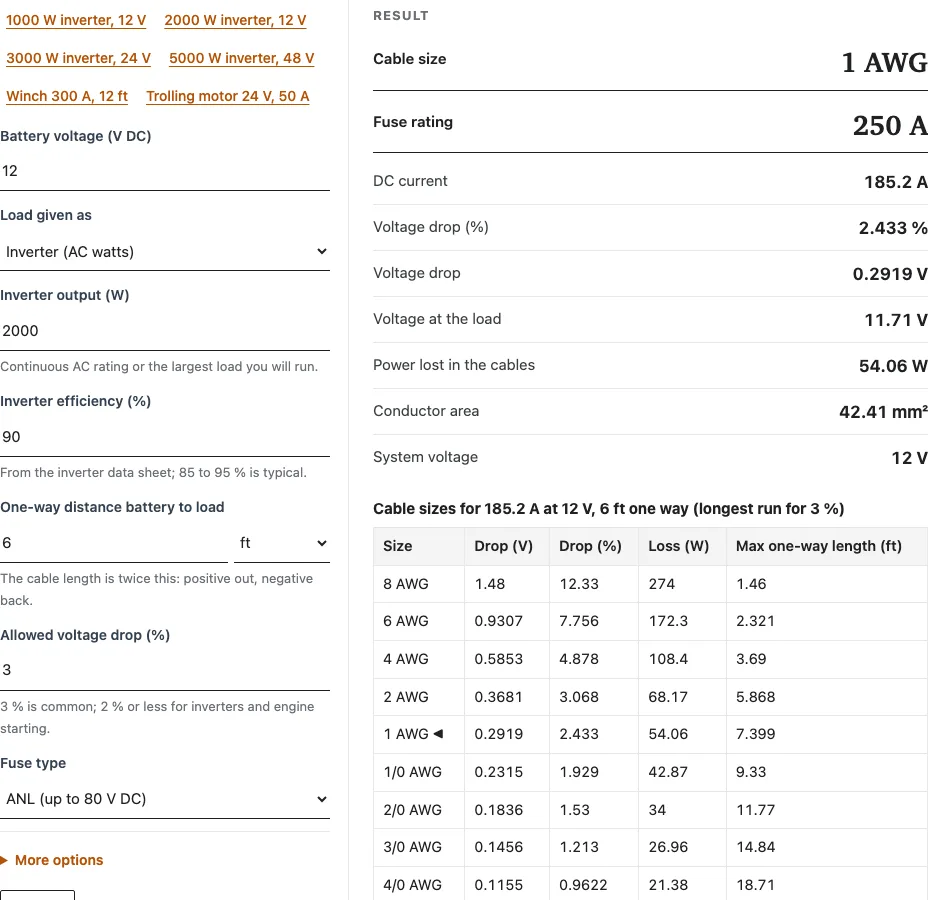
- DC current: for an inverter, I = watts ÷ (efficiency × battery voltage). 2000 W ÷ (90 % × 12 V) = 185.2 A.
- Voltage drop: VD = 2 × L × I × R, with L the one-way length and R the resistance per length of the size being tested.
- Size for the drop: the smallest size whose drop is within the target. In the starting example 1 AWG drops 0.29 V (2.43 %).
- Fuse: 125 % of the current rounded up to the next rating of the chosen fuse type, 250 A ANL here.
- Size the fuse protects: the smallest size whose NEC 310.16 ampacity in the 90 °C column is at least 250 A, which is 4/0 AWG (260 A; 3/0 AWG has 225 A).
- The larger of the two wins: 4/0 AWG, which drops only 0.96 %.
For a 100 A load on 12 V and a 3 % target, the tool gives:
| One-way length | Size for the drop | Cable size (drop and fuse) | Drop | Fuse (ANL) |
|---|---|---|---|---|
| 3 ft | 6 AWG | 2 AWG | 0.83 % | 125 A |
| 5 ft | 4 AWG | 2 AWG | 1.38 % | 125 A |
| 10 ft | 2 AWG | 2 AWG | 2.76 % | 125 A |
| 15 ft | 1/0 AWG | 1/0 AWG | 2.60 % | 125 A |
| 20 ft | 2/0 AWG | 2/0 AWG | 2.75 % | 125 A |
On the short runs the drop alone would allow 6 or 4 AWG, but a 125 A fuse needs 2 AWG (130 A at 90 °C), so the fuse check sets the size there. From 10 ft on, the drop decides.
Why does a higher battery voltage need a thinner cable?
The same power at a higher voltage needs less current, and voltage drop grows with current. Doubling the battery voltage halves the current and also doubles the volts you can lose for the same percentage. That is why 24 V and 48 V systems are common for large inverters.
| 2000 W inverter, 90 %, 6 ft one way, 3 % | DC current | Fuse | Size by drop | Cable size (drop and fuse) |
|---|---|---|---|---|
| 12 V | 185.2 A | 250 A | 1 AWG | 4/0 AWG |
| 24 V | 92.6 A | 125 A | 6 AWG | 2 AWG |
| 48 V | 46.3 A | 60 A | 12 AWG | 6 AWG |
On a short run the fuse, not the drop, sets the size at every voltage: at 48 V the drop alone would allow 12 AWG, but a 60 A fuse needs 6 AWG (75 A at 90 °C).
Worked examples
| Input | Result |
|---|---|
| 2000 W inverter (90 %), 12 V, 6 ft one way, 3 % | 4/0 AWG, fuse 250 A |
| 1000 W inverter (90 %), 12 V, 4 ft one way, 3 % | 2 AWG, fuse 125 A |
| 3000 W inverter (90 %), 24 V, 8 ft one way, 3 % | 2/0 AWG, fuse 175 A |
| 5000 W inverter (90 %), 48 V, 10 ft one way, 3 % | 1/0 AWG, fuse 150 A |
| 150 A, 12 V, 15 ft one way, 2 % | 4/0 AWG, fuse 200 A |
Calculated by the tool above; open it with the same values to see each step.
Questions, briefly answered
What gauge wire is best for a 12V battery?
No single gauge fits every 12 V circuit. At 100 A (125 A fuse) and a 3 % drop the tool gives 2 AWG up to 10 ft and 2/0 AWG for 20 ft, so enter your own current and distance.
How many amps will 2 AWG carry?
By the NEC 310.16 table the tool uses, 2 AWG copper carries 130 A in the 90 °C column (conductors in a raceway or cable, 30 °C), so it can sit behind a fuse of up to 130 A, such as a 125 A or 130 A ANL fuse. A single battery cable in free air with 105 °C insulation is usually rated higher by its maker or by ABYC E-11; enter that rating in the optional field and keep the fuse at or below it.
Is 4 gauge good for battery cables?
It can be. The tool chooses 4 AWG for a 50 A trolling motor 20 ft away on 24 V (75 A fuse). For a 100 A load the 125 A fuse needs 2 AWG by the NEC 90 °C value, unless your cable maker rates its 4 AWG cable at 125 A or more.
Which is bigger, 1/0 or 2/0 battery cable?
2/0 is bigger. In the aught sizes more zeros mean a thicker conductor, so 2/0 has more copper area and less resistance per foot than 1/0.
Should I use the low-voltage cutoff field?
Yes, for inverters. An inverter draws more current as the battery voltage falls. With 10.5 V entered, the 2000 W example rises from 185.2 A to 211.6 A, the fuse from 250 A to 275 A, and the cable from 4/0 AWG to 250 kcmil by the NEC 90 °C value.
Does the gauge of wire on the battery matter?
Yes. A thinner cable drops more voltage and turns more power into heat, which the “Voltage at the load” and “Power lost in the cables” rows show for your size.
Related tools
- DC Voltage Drop Calculator: to check the drop of a DC cable you already have.
- Wire Ampacity Calculator: to see every NEC factor behind a cable’s current limit.
- Wire Gauge Chart: to compare AWG diameters and areas.
- AWG to mm2 Converter: when your cable is sold in square millimeters.
- Watts to Amps Calculator: to turn a DC appliance rating into amps.
- Ohm’s Law Calculator: to work out resistance, current or voltage directly.
- Wire and Cable Calculators: every wire sizing tool on the site.