Box Fill Calculator
Count conductors, devices, clamps and grounds to see the box volume you need and whether your box passes.
Assumes NEC 2023 314.16(B) volume allowances and, for each box listed, the NEC Table 314.16(A) volume or the volume the maker marks on that steel box; for a nonmetallic or other box choose Custom and enter the volume marked on it. Free, runs in your browser. Verify with your local code and a licensed electrician before you install.
Recent
Your last 10 settings, saved only in this browser. Nothing is uploaded.
How to use the Box Fill Calculator
- Choose the “Box”. For a plastic or unlisted box, pick “Other box (enter its marked volume)” and type the figure into “Box volume (in³)”.
- Enter the wires in “Insulated 14 AWG conductors” through “Insulated 6 AWG conductors”. Count each wire that enters from outside once, an unbroken loop of 12 in or more twice, and pigtails made inside the box not at all.
- Enter “Devices (switches, receptacles) on separate yokes”. Leave “Largest wire connected to the devices” on “Largest insulated wire in the box” unless a smaller wire feeds the device.
- Enter “Equipment grounding conductors (bare or green)” as one total, then set “Largest grounding conductor”.
- Tick “Internal cable clamps in the box” if the box has built-in clamps.
- Open “More options” for fixture studs or hickeys, wide devices, an extension ring, a marked plaster ring or raised cover volume, 16 and 18 AWG fixture wires, and the “NEC edition”.
- Read “Result”, “Volume required”, “Box volume”, “Volume left over” and “Smallest box of the same kind that fits”.
The example buttons above the form, such as “Receptacle, 12 AWG in and out” or “Ceiling light box with stud”, load a full setup to edit. “Copy result” and “Copy link” copy the figures or a link that reopens the same inputs, “Print / save as PDF” prints them, and “Reset” restores the defaults.
How do you calculate box fill?
To calculate box fill, give each item in the box a volume allowance under NEC 314.16(B), add them, and compare the sum with the box’s marked volume plus any extension ring. Allowances follow wire size: 2.00 in³ for 14 AWG, 2.25 in³ for 12 AWG and 2.50 in³ for 10 AWG. The box passes when the total fits.
What gets counted, as the tool applies it:
- Each insulated conductor from outside the box: one allowance of its own size (314.16(B)(1)).
- Internal cable clamps, however many: one allowance of the largest conductor (314.16(B)(2)).
- Each fixture stud or hickey: one allowance of the largest conductor (314.16(B)(3)).
- Each device yoke: two allowances of the largest wire connected to it (314.16(B)(4)).
- Grounding conductors: one allowance of the largest one for the first four, then a quarter allowance for each extra (314.16(B)(5), 2020 and 2023 NEC).
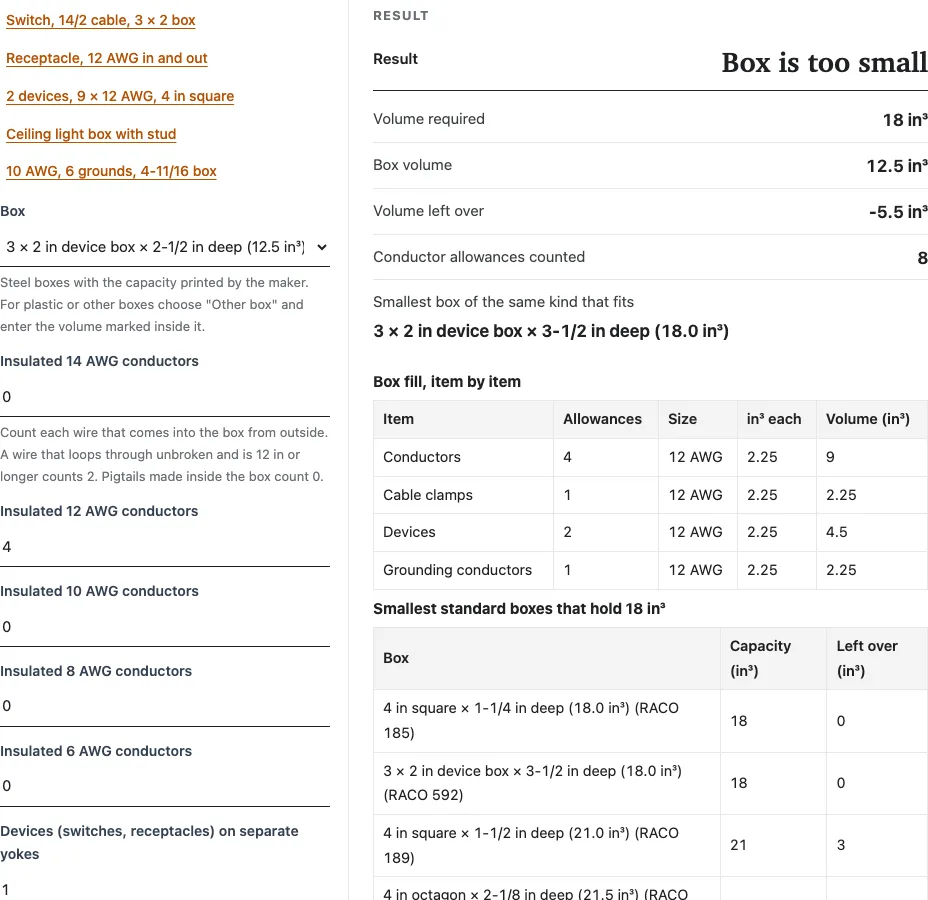
With the default inputs (four 12 AWG wires, clamps, one receptacle and two grounds in a 3 × 2 in device box 2-1/2 in deep), the tool prints:
| Item | Allowances | Volume (in³) |
|---|---|---|
| 12 AWG conductors | 4 | 9 |
| Cable clamps | 1 | 2.25 |
| Device yoke | 2 | 4.5 |
| Grounding conductors | 1 | 2.25 |
| Total required | 8 | 18 |
The box holds 12.5 in³, so it is too small. The smallest device box that passes is the 3-1/2 in deep one at 18.0 in³.
How many wires can I put in an electrical box?
Divide the box’s marked volume by the allowance for the wire size and round down; that is the limit with nothing else in the box. A 4 in square box 1-1/4 in deep (18.0 in³) takes nine 14 AWG or eight 12 AWG conductors. Every device, clamp and group of grounds lowers that number.
The tool’s “Most conductors of one size this box holds” table gives the bare limit for the box you selected. For the 18.0 in³ box:
| Wire size | in³ each | Maximum conductors |
|---|---|---|
| 14 AWG | 2.00 | 9 |
| 12 AWG | 2.25 | 8 |
| 10 AWG | 2.50 | 7 |
| 8 AWG | 3.00 | 6 |
| 6 AWG | 5.00 | 3 |
Do grounds count in box fill?
Yes. Under the 2020 and 2023 NEC, all equipment grounding conductors and bonding jumpers together count as one allowance of the largest one for the first four, plus a quarter allowance for each one beyond four. The 2017 NEC and earlier count one allowance for all of them, plus one more for isolated grounding conductors.
Six 12 AWG grounds under the current rule count 1.5 allowances, or 3.375 in³, and the tool prints a warning that explains the extra quarter allowances. Switch “NEC edition” to “2017 NEC or earlier” to see the older count and enter “Isolated grounding conductors”.
Worked examples
| Input | Result |
|---|---|
| 4 × 12 AWG, 1 device(s), 2 ground(s), 3 × 2 in device box × 2-1/2 in deep (12.5 in³) | needs 18 in³, box has 12.5 in³: too small |
| 6 × 14 AWG, 1 device(s), 2 ground(s), 4 in square × 1-1/2 in deep (21.0 in³) | needs 18 in³ of 21 in³: fits |
| 9 × 12 AWG, 2 device(s), 3 ground(s), 4 in square × 2-1/8 in deep (30.3 in³) | needs 31.5 in³, box has 30.3 in³: too small |
| 5 × 14 AWG, 0 device(s), 2 ground(s), 4 in octagon × 1-1/2 in deep (15.5 in³) | needs 16 in³, box has 15.5 in³: too small |
| 6 × 12 AWG, 1 device(s), 2 ground(s), a 20.3 in³ box | needs 22.5 in³, box has 20.3 in³: too small |
Calculated by the tool above; open it with the same values to see each step.
Questions, briefly answered
What is box fill calculation?
It is the check that an electrical box has enough volume for everything inside it, done with the allowances in NEC 314.16. The result is a required volume that must not exceed the volume marked on the box.
Do wire nuts count in box fill?
No. Twist-on connectors are not one of the items NEC 314.16(B) counts, so the tool has no field for them.
Do pigtails count in box fill?
No. A pigtail or jumper that starts and ends inside the box counts zero. Only conductors that come in from outside, or loop through, are counted.
How much volume does a #12 wire need in a box?
Each 12 AWG conductor needs 2.25 in³. Clamps, studs, devices and grounds sized by a 12 AWG wire also use 2.25 in³ per allowance.
How do I calculate box fill for a plastic box?
Choose “Other box (enter its marked volume)” and type the cubic-inch volume printed inside the box, as NEC 314.16(A)(2) requires. Plastic box volumes differ by model, so the tool does not list them.
Does an extension ring add volume?
Yes. Pick the ring under “Extension ring” and its volume is added to the box. A plaster ring or raised cover adds volume only when the volume is marked on it; enter that figure in its own field.
Do fixture wires from a light count?
Up to four fixture wires smaller than 14 AWG coming from a domed luminaire canopy are not counted (314.16(B)(1) Exception). Leave those out; enter other 16 or 18 AWG wires under “More options”.
Related tools
- Junction Box Size Calculator: size a pull or junction box for 4 AWG and larger conductors.
- Conduit Fill Calculator: check how many wires fit in the conduit feeding the box.
- Conduit Bending Calculator: bend the offset that brings the conduit into the box.
- Conduit Bending Chart: print bend multipliers to keep at the job.
- Wire Gauge Chart: look up AWG sizes before counting them.
- Electrical Wire Color Code: tell grounds from circuit conductors when counting.
- Electrical Load Calculator: estimate the load on the circuits in the box.
- Conduit, Box and Load Calculators: see every raceway and box tool on the site.