Cable Size Calculator
Enter volts, amps and length in metres to get the minimum cable cross-section in mm2 and the next standard size.
Assumes stranded copper or aluminum at the temperature you enter and IEC 60228 sizes; voltage drop only unless you enter the cable's rated current for its installation method (IEC 60364-5-52 / BS 7671). Free, runs in your browser. Verify with your local code and a licensed electrician before you install.
Recent
Your last 10 settings, saved only in this browser. Nothing is uploaded.
How to use the Cable Size Calculator
- Choose the Supply type: Single phase AC, Three phase AC or DC.
- Enter the Voltage (V), for example 230 V single phase or 400 V three phase line to line.
- Set Load given as. With “Current (amps)”, type the Load current (A); with “Power (watts)”, enter the Load power in W or kW.
- For AC circuits, set the Power factor: 1 for heaters and resistive loads, about 0.8 to 0.9 for motors. It converts a power into a current.
- Type the One-way length in m or ft, along the route the cable follows.
- Choose the Conductor: Copper or Aluminum.
- Set the Allowed voltage drop (%). The help text gives 3 % for lighting and 5 % for other uses as common limits; follow the wiring rules where you work.
- Under More options, change the Conductor temperature (°C) (70 °C for PVC, 90 °C for XLPE at full load), untick Stranded conductor (+2 % resistance) for solid cores, or enter the Cable current rating from the data sheet (A, optional) with a Total derating factor.
- Read Cable size and Voltage drop (%), then the warnings.
The example buttons above the form load a 20 A circuit, a 9.5 kW shower, a 32 A EV charger, a 63 A three phase feed and a 48 V DC solar run. Copy result, Copy link and Print / save as PDF keep the result, and Reset restores the defaults.
What is the formula for calculating cable size?
For a voltage drop limit, the minimum area is A = ρ × 1.02 × k × L × I ÷ (p × V): ρ is the resistivity at the conductor temperature, 1.02 allows for stranding, k is 2 (single phase, DC) or √3 (three phase), L the one-way length, I the current, p the allowed drop, V the voltage.
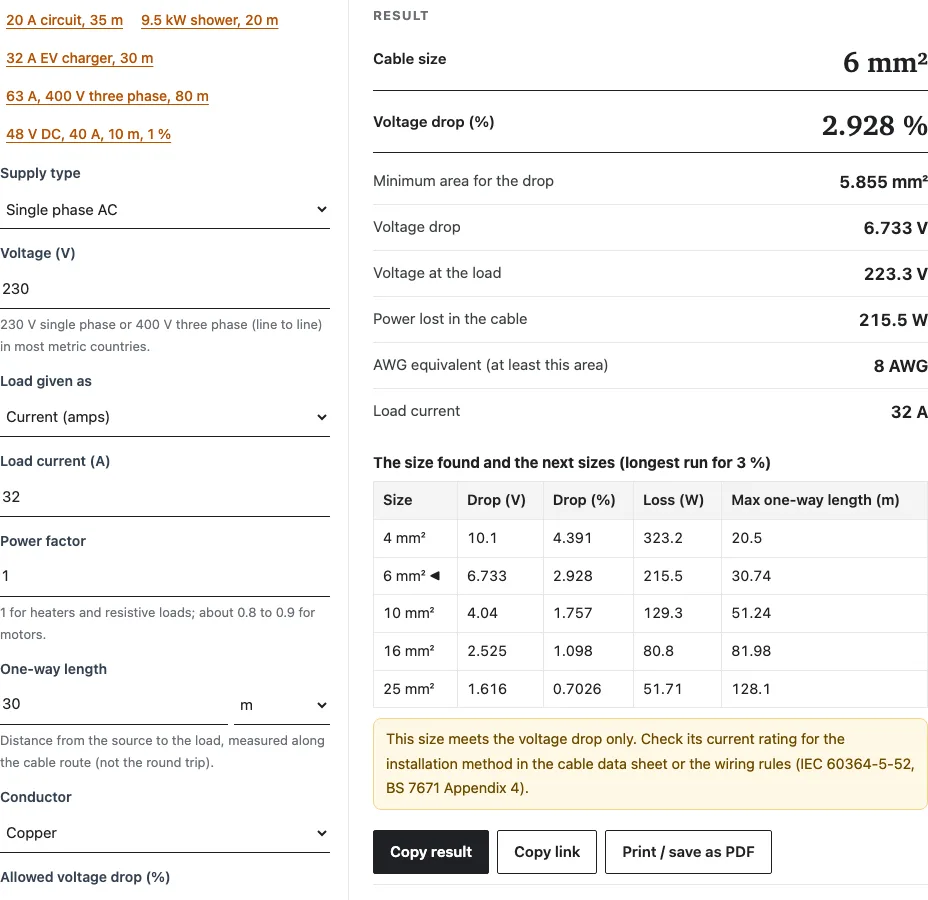
The tool’s default case, 32 A at 230 V single phase over 30 m of copper at 70 °C with a 3 % limit, runs as follows:
- Minimum area: ρ(copper, 70 °C) × 1.02 × 2 × 30 m × 32 A ÷ (3 % × 230 V) = 5.855 mm².
- Round up to the next IEC 60228 size: 6 mm².
- Real drop of 6 mm²: 6.733 V, or 2.93 %, leaving 223.3 V at the load.
- Power lost in the cable: 215.5 W.
How to calculate what size cable to use?
Size it twice: once for voltage drop and once for current rating, and use the larger result. The calculator does the voltage drop part and shows how much headroom each size gives. The current rating depends on the installation method, so take it from the data sheet or the wiring rules (IEC 60364-5-52, BS 7671 Appendix 4).
The table under the result shows the drop and the longest run for the size found and the sizes around it. For the default 32 A, 30 m circuit:
| Size | Drop (%) | Loss (W) | Max one-way length (m) |
|---|---|---|---|
| 4 mm² | 4.39 | 323.2 | 20.50 |
| 6 mm² | 2.93 | 215.5 | 30.74 |
| 10 mm² | 1.76 | 129.3 | 51.24 |
| 16 mm² | 1.10 | 80.80 | 81.98 |
To add the current check, type the data sheet rating of the size found and your total derating factor. With 41 A × 0.7, the 6 mm² cable has 28.7 A available, less than the 32 A load, and the tool warns you to choose a larger cable.
What wire size is needed for 3 amps?
It depends on the length as much as the current. At 230 V with a 3 % limit, 3 A over 20 m needs only 0.5 mm² for voltage drop, while 100 m needs 2.5 mm². Below 1.5 mm² the tool also reminds you that many wiring rules set 1.5 mm² as the minimum for power circuits.
| Load | One-way length | Cable size | Drop |
|---|---|---|---|
| 3 A, 230 V | 20 m | 0.5 mm² | 2.20 % |
| 3 A, 230 V | 100 m | 2.5 mm² | 2.20 % |
Worked examples
| Input | Result |
|---|---|
| 32 A, 230 V Single phase AC, 30 m, 3 % | 6 mm² (2.93 %) |
| 16 A, 230 V Single phase AC, 25 m, 3 % | 2.5 mm² (2.93 %) |
| 20 A, 230 V Single phase AC, 60 m, 5 % | 6 mm² (3.66 %) |
| 63 A, 400 V Three phase AC, 80 m, 3 % | 16 mm² (2.87 %) |
| 40 A, 48 V DC, 10 m, 3 % | 16 mm² (1.98 %) |
Calculated by the tool above; open it with the same values to see each step.
Questions, briefly answered
How do I calculate wire size?
Find the smallest area whose resistance over the out-and-back run keeps the drop within your allowed volts, using the formula above, then round it up to a standard size. The tool prints every step under the result.
Does the cable size calculator check the current rating?
Only if you type the cable’s data sheet rating. Without it, the tool warns that the size meets the voltage drop only.
Why is the cable size rounded up?
The minimum area is rarely a standard size. Rounding up to the next IEC 60228 size keeps the drop within your limit; 5.855 mm² becomes 6 mm².
What size cable for a 9.5 kW shower?
On 230 V the shower draws 41.30 A, and over 20 m at 3 % the drop alone needs 6 mm² (2.52 %). Check that size’s current rating for your installation method before choosing it.
Is aluminium cable sized the same way?
Yes, with aluminium’s higher resistivity. The default 32 A, 30 m circuit needs 6 mm² in copper and 10 mm² in aluminium.
What does the AWG equivalent mean?
It is the smallest AWG or kcmil size with at least the minimum area; for 5.855 mm² that is 8 AWG.
Does the cable size calculator check the cable’s current rating?
Only if you type the maximum current from the cable’s datasheet and a derating factor under More options. Without them the size comes from voltage drop alone, so check the rating in the datasheet before you buy.
Related tools
- AWG to mm2 Converter: convert a size between mm² and AWG.
- Voltage Drop Calculator: the drop for a cable you already have.
- DC Voltage Drop Calculator: 12 V, 24 V and 48 V battery and solar runs.
- Wire Size Calculator: AWG sizing with NEC ampacity.
- Wire Ampacity Calculator: the current an AWG size may carry under NEC 310.16.
- Watts to Amps Calculator: the current a load draws.
- Three Phase Power Calculator: current and power of a three phase load.
- Wire and Cable Calculators: every wire tool on the site.