Conduit Bending Chart
Print a bending chart with multipliers, shrink and distance between bends for the angles you use.
Free · runs in your browser · nothing is uploaded
Recent
Your last 10 settings, saved only in this browser. Nothing is uploaded.
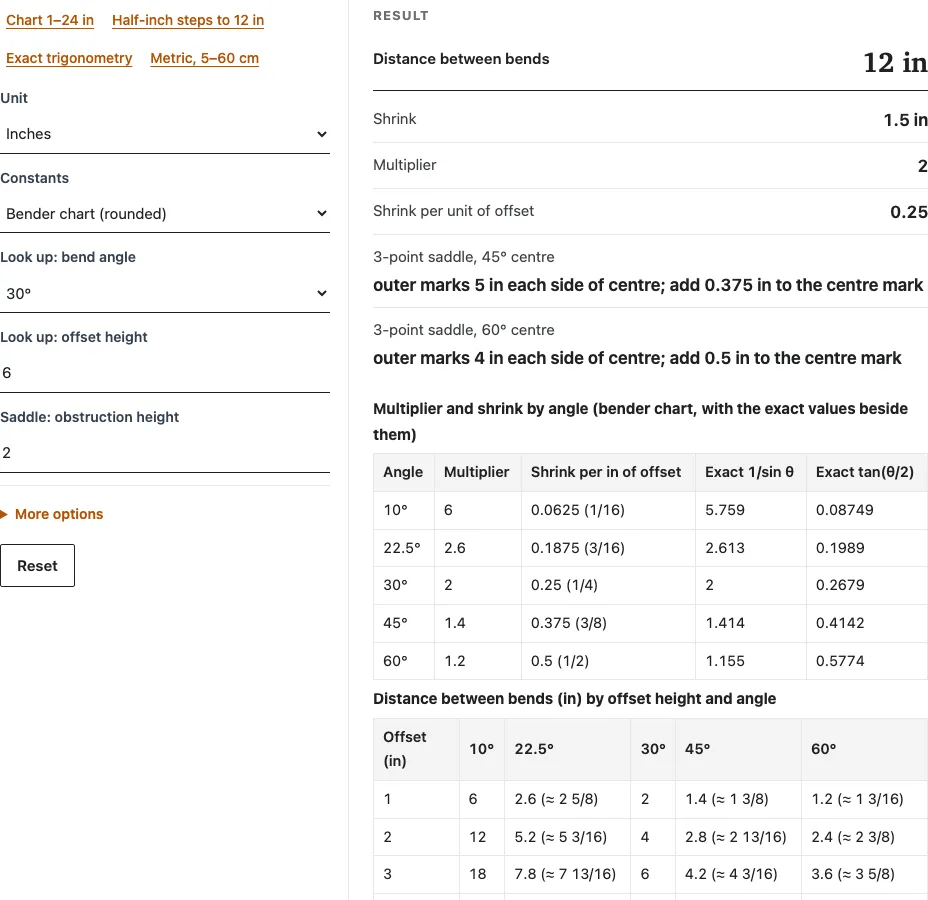
How to use the Conduit Bending Chart
- Choose the “Unit”: “Inches” or “Centimetres”. Inch cells that are not whole numbers also show the nearest 1/16 in, so 10.4 reads “10.4 (≈ 10 3/8)”.
- Set “Constants” to “Bender chart (rounded)” to match the numbers on a hand bender, or “Exact trigonometry” for the calculated values.
- For a single answer, pick “Look up: bend angle” and type “Look up: offset height”. The result rows show “Distance between bends”, “Shrink”, “Multiplier” and “Shrink per unit of offset”.
- Type “Saddle: obstruction height” to fill the 3-point saddle table and the two saddle result rows.
- Open “More options” to change the range: “Chart up to (offset)” sets the largest offset and “Chart step” the spacing. A chart can have up to 200 rows.
- Read across the “Distance between bends” and “Shrink” tables: find your offset height in the first column, then the column for your angle.
The example buttons above the form load “Chart 1–24 in”, “Half-inch steps to 12 in”, “Exact trigonometry” or “Metric, 5–60 cm”. “Print / save as PDF” prints the result, “Copy result” copies the lookup figures, “Copy link” copies a link that reopens the same settings, and “Reset” goes back to the 1–24 in chart.
Changing any field updates the result rows, the steps and the tables straight away, and Copy link keeps your exact inputs in the address so you can share or reopen the calculation.
How do I calculate the bending of conduit?
For a two-bend offset, multiply the offset height by the angle’s multiplier to get the distance between bends, and by its shrink factor to get the length the run loses. Exactly, those are 1 ÷ sin θ and tan(θ ÷ 2). A 6 in offset at 30° gives 12 in between bends and 1.5 in of shrink.
The factor table the tool prints with chart constants:
| Angle | Multiplier | Shrink per in of offset | Exact 1/sin θ | Exact tan(θ/2) |
|---|---|---|---|---|
| 10° | 6 | 1/16 | 5.759 | 0.08749 |
| 22.5° | 2.6 | 3/16 | 2.613 | 0.1989 |
| 30° | 2 | 1/4 | 2 | 0.2679 |
| 45° | 1.4 | 3/8 | 1.414 | 0.4142 |
| 60° | 1.2 | 1/2 | 1.155 | 0.5774 |
Smaller angles need more room between bends but lose less length: a 10 in offset needs 60 in between bends at 10° and 12 in at 60°, and shrinks 0.625 in against 5 in.
Why do bender chart values differ from exact values?
Hand benders print rounded constants that are easy to use with a tape measure, such as 6 for a 10° offset where the exact multiplier is 5.759. The gap grows with offset height, so it matters most on tall offsets. The chart treats each bend as a sharp corner; the marking on your own bender governs.
Two examples from the tool’s tables show the size of the gap:
- A 6 in offset at 45° is 8.4 in between bends with chart constants and 8.4853 in exact.
- Its shrink is 2.25 in with chart constants and 2.4853 in exact, about 1/4 in more.
How many 90-degree bends are allowed in conduit?
A run between pull points may have no more than 360° of bends in total, the same as four 90° bends. Each raceway article sets this in its .26 section, such as 358.26 for EMT. Offsets and saddles count too: a 30° offset adds 60°, and a 3-point saddle with a 45° centre adds 90°.
Add up every bend in the run before you pull wire. If the total passes 360°, put a pull point, such as a box or conduit body, in the run.
Worked examples
| Input | Result |
|---|---|
| 6 in offset at 30°, Bender chart (rounded) | 12 in between bends, shrink 1.5 in |
| 10 in offset at 45°, Bender chart (rounded) | 14 in between bends, shrink 3.75 in |
| 4 in offset at 22.5°, Bender chart (rounded) | 10.4 in (≈ 10 3/8 in) between bends, shrink 0.75 in |
| 6 in offset at 45°, Exact trigonometry | 8.4853 in (≈ 8 1/2 in) between bends, shrink 2.4853 in (≈ 2 1/2 in) |
| 15 cm offset at 30°, Bender chart (rounded) | 30 cm between bends, shrink 3.75 cm |
Calculated by the tool above; open it with the same values to see each step.
Questions, briefly answered
How do I use the 3-point saddle table?
Measure to the centre of the obstruction, add the “Add to centre mark” figure and mark the centre bend there. The outer marks go the “Outer marks from centre” distance either side; for a 2 in obstruction with a 45° centre, that is 0.375 in added and 5 in each side.
What is an EMT conduit bender tool?
It is a hand tool with a curved shoe and a handle that bends EMT around a fixed radius. Its head carries reference marks, usually an arrow, a star for the back of a 90° and a notch for the centre of a saddle bend, which line up with the marks you put on the conduit.
How many inches do you deduct for a 90 degree bend?
A standard hand bender takes up 5 in on 1/2 in EMT, 6 in on 3/4 in EMT and 8 in on 1 in EMT. This chart does not cover 90° bends; use the Conduit Bending Calculator for stub-up and back-to-back marks.
What are the NEC guidelines for conduit bending?
Bends must not damage the raceway or reduce its inside diameter (358.24 for EMT), and a run between pull points may total no more than 360° of bends (358.26). Other raceway types have matching sections in their own articles.
Can I make the chart in centimetres?
Yes. Set “Unit” to “Centimetres” and choose a range such as 5 to 60 cm in 5 cm steps. The multipliers stay the same, so a 15 cm offset at 30° needs 30 cm between bends.
Why does the chart stop at 200 rows?
The tool builds at most 200 offset heights at once. For a longer range, raise “Chart step” or lower “Chart up to (offset)”.
Related tools
- Conduit Bending Calculator: get the actual marks for an offset, saddle or 90° stub.
- Conduit Fill Calculator: choose the trade size before you bend.
- Junction Box Size Calculator: size a pull box when the run has too many bends.
- Box Fill Calculator: check the box at the end of the offset.
- Wire Gauge Chart: look up the conductors that go into the run.
- Voltage Drop Calculator: check a long run once its length is known.
- Conduit, Box and Load Calculators: see every raceway and box tool on the site.