Conduit Fill Calculator
List your conductors and the conduit to get the fill percentage, or let the tool find the smallest trade size.
Assumes NEC Chapter 9 Table 1 fill limits (53/31/40 %, 60 % for nipples), conductor diameters from maker data (never below NEC Table 5 for THHN) and conduit bores from maker data; ampacity derating is a separate check. Free, runs in your browser. Verify with your local code and a licensed electrician before you install.
Recent
Your last 10 settings, saved only in this browser. Nothing is uploaded.
How to use the Conduit Fill Calculator
- Under “What do you want to find?”, choose “Check a conduit size” to test a conduit you already have, or “Find the smallest conduit” to get a size.
- Pick the “Conduit type”. Flexible types such as FMC and LFNC are not in the list.
- In check mode, choose the “Trade size”. A size the tool has no inside diameter for, such as 5 in EMT, returns an error instead of a result.
- Set “Number of wire rows” to the number of different size and insulation combinations in the run.
- Fill in “Row 1: number of wires”, “Row 1: wire size” and “Row 1: insulation type”, then the same fields for each further row. Include the equipment grounding conductor; bare copper is one of the insulation choices.
- For a short nipple between two enclosures, open “More options” and tick “Nipple 24 in (600 mm) or shorter between enclosures (60 % fill)”.
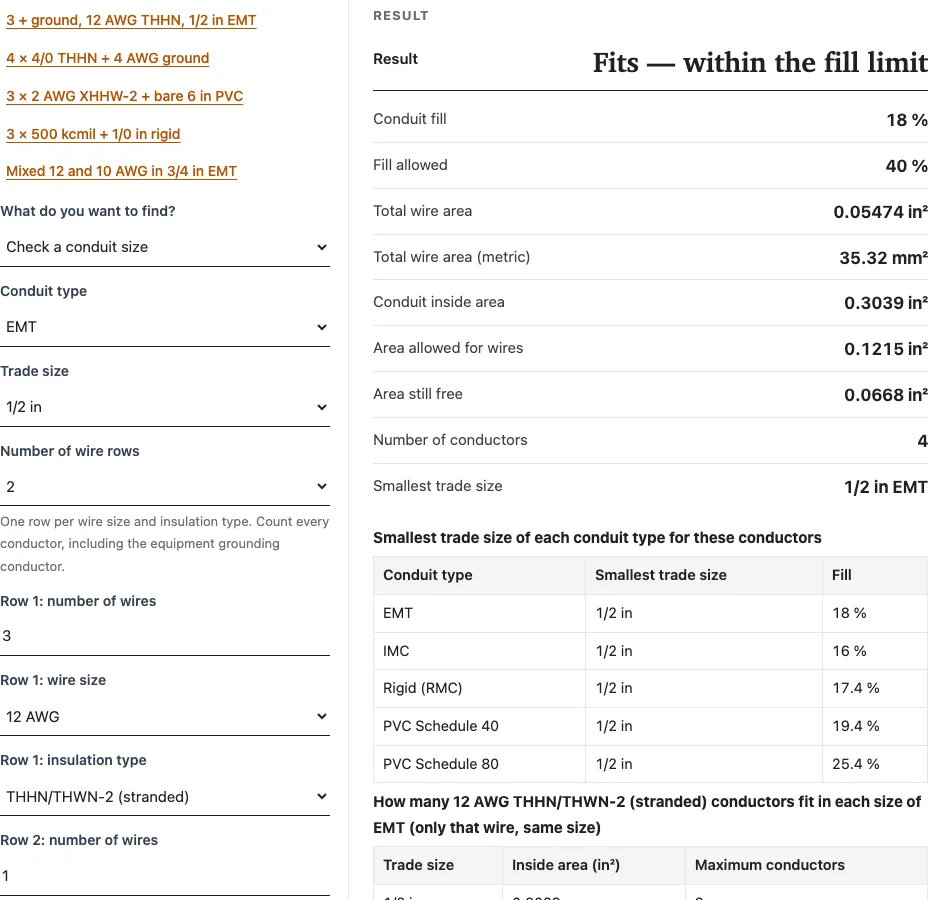
- Read “Result” (check mode) or “Smallest trade size” (find mode), then “Conduit fill”, “Fill allowed” and “Area still free”. Look at any warnings and at the steps under “How it was calculated”.
The example buttons above the form, such as “4 × 4/0 THHN + 4 AWG ground”, load a complete setup you can edit. “Copy result” copies the figures, “Copy link” copies a link that reopens the same inputs, “Print / save as PDF” prints the result, and “Reset” restores the default values.
How do I calculate conduit fill?
To calculate conduit fill, find the cross-sectional area of each conductor from its outside diameter (π/4 × d²), multiply by the number of wires and add the rows. Divide that total by the inside area of the conduit and multiply by 100. The percentage must not exceed the NEC Chapter 9, Table 1 limit for that many conductors.
The default inputs show each step with the tool’s own figures:
- A single 12 AWG THHN/THWN-2 wire has a diameter of 0.132 in, so one wire covers 0.013685 in².
- Three circuit wires plus a ground of the same size make 4 conductors and 0.054739 in² (35.315 mm²).
- 1/2 in EMT has an inside diameter of 0.622 in, an area of 0.3039 in². With more than two conductors, 40 % of that, 0.1215 in², is available.
- Fill = 0.054739 ÷ 0.30386 = 18 %, so the run passes with 0.0668 in² still free.
Wire diameters come from Southwire spec pages, raised to the NEC Chapter 9 Table 5 diameter for THHN/THWN-2 wherever Table 5 is larger, and conduit inside diameters come from Wheatland Tube and CANTEX data, so a result can differ slightly from a table lookup. The tool warns once fill passes 95 % of the limit.
What is the NEC conduit fill percentage?
NEC Chapter 9, Table 1 lets conductors fill 53 % of a conduit’s inside area when there is one conductor, 31 % when there are two, and 40 % when there are more than two. Note 4 of that table raises the limit to 60 % for a nipple of 24 in (600 mm) or less between enclosures.
The tool picks the limit from the total number of conductors you enter, and equipment grounding conductors count toward that total (Note 3). Applying the 40 % rule to those same wires in EMT gives these maximums:
| EMT trade size | Inside area (in²) | Maximum 12 AWG conductors |
|---|---|---|
| 1/2 in | 0.3039 | 9 |
| 3/4 in | 0.5333 | 15 |
| 1 in | 0.8643 | 25 |
| 1-1/4 in | 1.496 | 43 |
| 1-1/2 in | 2.036 | 59 |
| 2 in | 3.356 | 98 |
What size conduit do I need for mixed wire sizes?
Give each combination of wire size and insulation its own row, then choose “Find the smallest conduit”. The tool adds the areas of all rows, applies the limit for the total conductor count and returns the smallest trade size of the chosen type. The table under the result repeats the search for all five conduit types.
For the “4 × 4/0 THHN + 4 AWG ground” example (five conductors, 40 % limit), the tool returns:
| Conduit type | Smallest trade size | Fill |
|---|---|---|
| EMT | 2-1/2 in | 23.5 % |
| IMC | 2 in | 37.9 % |
| Rigid (RMC) | 2-1/2 in | 28.3 % |
| PVC Schedule 40 | 2-1/2 in | 29.4 % |
| PVC Schedule 80 | 2-1/2 in | 33.5 % |
The five conductors take 1.377 in² with the NEC Chapter 9 Table 5 diameter of 4/0 THHN (0.642 in), just over the 1.342 in² that 40 % of 2 in EMT allows, so only IMC, with its larger bore, stays at 2 in. Compact-stranded wire is thinner, but an inspector checks fill with the Table 5 figures, so the tool never uses a diameter smaller than Table 5 for THHN. A mixed branch run of six 12 AWG and four 10 AWG THHN/THWN-2 conductors in 3/4 in EMT comes to 31.4 %, inside the 40 % limit.
Worked examples
| Input | Result |
|---|---|
| 3 × 12 AWG THHN/THWN-2 (stranded) in 1/2 in EMT | 13.5 % fill, fits (40 % allowed) |
| 3 × 12 AWG THHN/THWN-2 (stranded), 1 × 12 AWG THHN/THWN-2 (stranded) in 1/2 in EMT | 18 % fill, fits (40 % allowed) |
| 4 × 4/0 AWG THHN/THWN-2 (stranded), EMT | 2 in EMT |
| 3 × 6 AWG THHN/THWN-2 (stranded), 1 × 10 AWG THHN/THWN-2 (stranded), PVC Schedule 40 | 3/4 in PVC Schedule 40 |
| 3 × 500 kcmil XHHW-2 (stranded), 1 × 2 AWG Bare copper (stranded), Rigid (RMC) | 3 in Rigid (RMC) |
Calculated by the tool above; open it with the same values to see each step.
Questions, briefly answered
What is a conduit fill calculator?
It is a tool that compares the total area of the wires in a raceway with the raceway’s inside area and checks the result against the NEC fill limit. This one also finds the smallest trade size that holds a given set of conductors.
How many 12 AWG wires fit in 1/2 inch EMT?
Nine of the 12 AWG wires fit in 1/2 in EMT at the 40 % limit, according to the tool’s same-size table. Other insulation types have different diameters, so pick the right type in the row before reading the table.
Does the equipment grounding conductor count toward conduit fill?
Yes. Equipment grounding and bonding conductors count like any other conductor (NEC Chapter 9, Table 1, Note 3), so add the ground as its own row or include it in the count of a matching row.
What conduit types does this calculator support?
EMT, IMC, Rigid (RMC), PVC Schedule 40 and PVC Schedule 80, with trade sizes the tool has inside-diameter data for. FMC and LFNC are not included.
What does the jam ratio warning mean?
When exactly three identical conductors are in the conduit, the tool divides the conduit’s inside diameter by the conductor diameter. A ratio between 2.8 and 3.2 means the wires can wedge while pulling (Chapter 9, Table 1, Informational Note 2), so choose another size or pull with care.
Why does the tool mention NEC 310.15(C)(1)?
When more than three current-carrying conductors share a raceway, their ampacity must be reduced by the adjustment factors in 310.15(C)(1). The tool cannot tell which wires carry current, so it reminds you to check whenever the count is above three.
When can I use the 60 % nipple limit?
Only for a conduit nipple 24 in (600 mm) or shorter installed between enclosures such as boxes and cabinets. Tick the nipple box under “More options” and the tool applies 60 % and drops the ampacity adjustment reminder, since Note 4 exempts nipples from it.
Related tools
- Box Fill Calculator: check how many conductors, devices and clamps a box can hold.
- Junction Box Size Calculator: size a pull or junction box for large conductors.
- Conduit Bending Calculator: work out offsets, saddles and marks for the run.
- Conduit Bending Chart: print multipliers and shrink values for common bend angles.
- Wire Size Calculator: pick the conductor size before you size the conduit.
- Wire Ampacity Calculator: apply the adjustment for more than three current-carrying wires.
- Electrical Load Calculator: estimate the load the conductors must carry.
- Conduit, Box and Load Calculators: see every raceway and box tool on the site.