DC Voltage Drop Calculator
Enter volts, amps and one-way length to see the drop, the watts lost in the wire and the wire size a 12, 24 or 48 V circuit needs.
Assumes stranded copper or aluminum at the temperature you enter and a two-wire DC circuit (out and back). Voltage drop only: the fuse and cable ampacity are your check. Free, runs in your browser. Verify with your local code and a licensed electrician before you install.
Recent
Your last 10 settings, saved only in this browser. Nothing is uploaded.
How to use the DC Voltage Drop Calculator
- Under Calculate, choose “Voltage drop for a wire size” to check a wire you already have, or “Wire size for a target drop” to let the tool find one.
- Enter the System voltage (V DC), such as 12, 24 or 48. For a worst case, use the lowest voltage the system runs at.
- Set Load given as. With “Current (amps)”, type the Load current (A); with “Power (watts)”, type the Load power in W or kW and the tool divides by the voltage.
- Type the One-way distance in ft or m, from the battery or source to the load.
- Choose the Conductor (Copper or Aluminum) and the Size system (AWG / kcmil or mm² (IEC 60228)).
- In the drop mode, pick the Wire size or Cable size you plan to use.
- Enter the Allowed voltage drop (%). It sets the target in the size mode and the longest-run figures in both modes.
- Under More options, raise the Conductor temperature (°C) for engine rooms or roofs, or untick Stranded conductor (+2 % resistance) for solid wire.
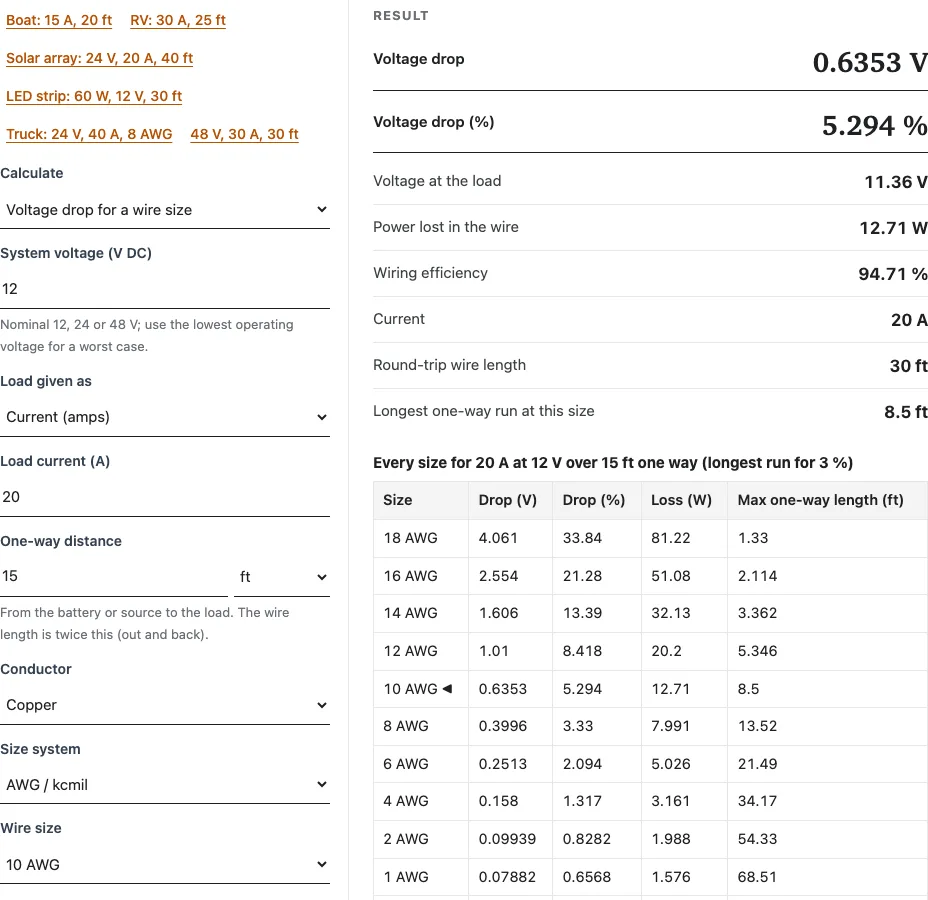
- Read Voltage drop, Voltage drop (%), Voltage at the load, Wiring efficiency and Longest one-way run at this size, then the warnings.
The example buttons above the form load each preset. Copy result, Copy link and Print / save as PDF keep a record of the run, and Reset restores the defaults.
How to calculate DC voltage drop?
DC voltage drop is the current times the resistance of the whole loop: VD = I × 2 × L × R, where L is the one-way distance and R the resistance per unit length. The 2 counts the positive and the return wire. Divide by the system voltage for the percentage; wiring efficiency is 100 % minus it.
The default case, 20 A at 12 V over 15 ft of 10 AWG stranded copper, works out as the tool prints it:
- Round trip: 15 ft out and back is 30 ft of wire.
- Resistance at 30 °C: 1.059 Ω per 1000 ft.
- Drop: 2 × 0.015 kft × 20 A × 1.059 Ω per 1000 ft = 0.6353 V.
- Percent: 0.6353 V ÷ 12 V = 5.29 %, leaving 11.36 V at the load.
- Heat in the wire: 12.71 W; wiring efficiency 94.71 %.
Raising Conductor temperature (°C) to 60 for the same circuit gives 5.89 %, because copper resistance rises with heat.
How much DC voltage drop is acceptable?
The NEC informational notes to 210.19(A) and 215.2(A) suggest 3 % for one branch circuit or feeder and 5 % in total, and the tool uses the same two figures for its warnings. On 12 V, 3 % is only 0.36 V. The solar array and 48 V presets use a tighter 2 % target.
A percentage is not the only check on 12 V systems. The tool also warns when less than about 11.5 V reaches the load, the point below which many 12 V fridges, inverters and pumps cut out. The default run trips both warnings: 5.29 % and 11.36 V.
What is the typical voltage drop on 12V DC?
No single figure is typical, because the drop depends on the current, the distance and the wire size. A 3 % limit on 12 V allows 0.36 V, and the right wire for that grows quickly with amps and feet. These runs come from the tool’s presets in the size mode:
| Preset | Target | Size found | Drop |
|---|---|---|---|
| Boat: 15 A, 20 ft | 3 % | 6 AWG | 0.2513 V (2.09 %) |
| RV: 30 A, 25 ft | 3 % | 3 AWG | 0.3133 V (2.61 %) |
| Solar array: 24 V, 20 A, 40 ft | 2 % | 4 AWG | 0.4214 V (1.76 %) |
| 48 V, 30 A, 30 ft | 2 % | 6 AWG | 0.7538 V (1.57 %) |
The 48 V row carries more current over a longer run than the boat, yet needs the same size, because each volt lost is a smaller share of 48 V.
Worked examples
| Input | Result |
|---|---|
| 20 A, 12 V DC, 15 ft one way, 10 AWG | 0.635 V (5.29 %) |
| 30 A, 12 V DC, 25 ft one way, 8 AWG | 0.999 V (8.32 %) |
| 20 A, 24 V DC, 40 ft one way, 3 % | 6 AWG (2.79 %) |
| 5 A, 12 V DC, 30 ft one way, 3 % | 10 AWG (2.65 %) |
| 30 A, 48 V DC, 10 m one way, 6 mm² | 1.83 V (3.81 %) |
Calculated by the tool above; open it with the same values to see each step.
Questions, briefly answered
Why is DC voltage drop critical?
At 12 or 24 V, a fraction of a volt is a large share of the supply. The default 20 A, 15 ft run on 10 AWG loses 0.635 V, which is 5.29 % of 12 V, and drops the load below 11.5 V.
What is the 3% rule in DC systems?
It is the suggestion in the NEC informational notes that one branch circuit or feeder lose no more than 3 %. On 12 V that is 0.36 V. Type a different value in Allowed voltage drop (%) if a device or a standard you follow calls for less.
How much voltage drop is there in 200 feet?
With 20 A on 10 AWG copper at 12 V, a 200 ft one-way run loses 8.471 V (70.6 %), leaving 3.529 V. In the size mode the same load needs 250 kcmil to stay within 3 %, so long 12 V runs usually call for a higher system voltage.
Does a longer wire cause more voltage drop?
Yes, the drop rises in step with the distance. Longest one-way run at this size shows how far the chosen wire can go at your percentage; for the default 10 AWG at 20 A and 3 %, that is 8.50 ft.
Does wire insulation matter for voltage drop?
No. The drop depends on conductor material, size, length, current and temperature. Insulation sets the temperature rating and the current the wire may carry, which is why the tool reminds you to fuse the positive wire near the battery.
Can I calculate DC voltage drop in mm²?
Yes. Set Size system to “mm² (IEC 60228)”. 30 A at 48 V over 10 m of 6 mm² copper drops 1.83 V (3.81 %).
Why does the tool double the one-way distance?
The current flows out on one wire and back on the other. Enter the distance from the battery to the load; Round-trip wire length shows the doubled figure.
Related tools
- Voltage Drop Calculator: single phase and three phase AC circuits.
- Battery Cable Size Calculator: cables between a battery bank and an inverter.
- Wire Ampacity Calculator: the current a size may carry, for choosing the fuse.
- Wire Size Calculator: size from current, run length and insulation.
- Wire Gauge Chart: diameters, areas and resistance of every AWG size.
- AWG to mm2 Converter: when a product lists metric cable sizes.
- Cable Size Calculator: sizing cable in mm².
- Watts to Amps Calculator: convert a device’s wattage to current.
- Wire and Cable Calculators: every wire tool on the site.