Electrical Load Calculator
Enter the floor area and appliances to get the dwelling demand load and the service size by two NEC methods.
Assumes a one-family dwelling under NEC 2023 Article 220 (standard method and 220.82 optional method), at 120/240 V or 120/208 V; existing-house additions may use 220.83 instead. Free, runs in your browser. Verify with your local code and a licensed electrician before you install.
Recent
Your last 10 settings, saved only in this browser. Nothing is uploaded.
How to use the Electrical Load Calculator
- Under “Result to show first”, pick “Standard method (NEC 220 Part III)” or “Optional method (NEC 220.82)”. Both are always calculated.
- Type the “Living area” in ft² or m², measured from the outside dimensions.
- Enter “Electric range or cooktop + oven, nameplate kW” and “Electric clothes dryer, nameplate W” (0 for gas).
- Under “Fastened-in-place appliances (one per line: name, watts)”, type lines such as “water heater, 4500”. Put hot tubs, pool pumps and similar loads under “Other loads at 100 % (name, watts)”.
- Fill in “EV charger, nameplate W” and “Air conditioner or heat-pump compressor, VA”.
- Choose “Electric heating”, then enter “Electric heat, nameplate VA” and, for separate heaters, “Separately controlled heating units”.
- Set “Service voltage” to “120/240 V single phase” or “120/208 V (from a three-phase network)”.
- “More options” holds the small-appliance circuit count, the “Laundry circuit (1500 VA)” box and the 25 % largest-motor adder.
Read “Service size (selected method)” with the standard and optional loads and services beside it. The example buttons above the form, such as “All-electric with heat pump”, load a full house. “Copy result”, “Copy link” (reopens the same inputs) and “Print / save as PDF” keep the result; “Reset” restores the defaults.
Changing any field updates the result rows, the steps and the tables straight away, and Copy link keeps your exact inputs in the address so you can share or reopen the calculation.
How do I calculate the electrical load of a house?
With the standard method, take 3 VA per square foot for general lighting, add 1500 VA for each small-appliance circuit and the laundry circuit, and reduce that total with the Table 220.45 demand factors. Then add the appliances, dryer, range, EV charger and the larger of heating or cooling, and divide by the service voltage.
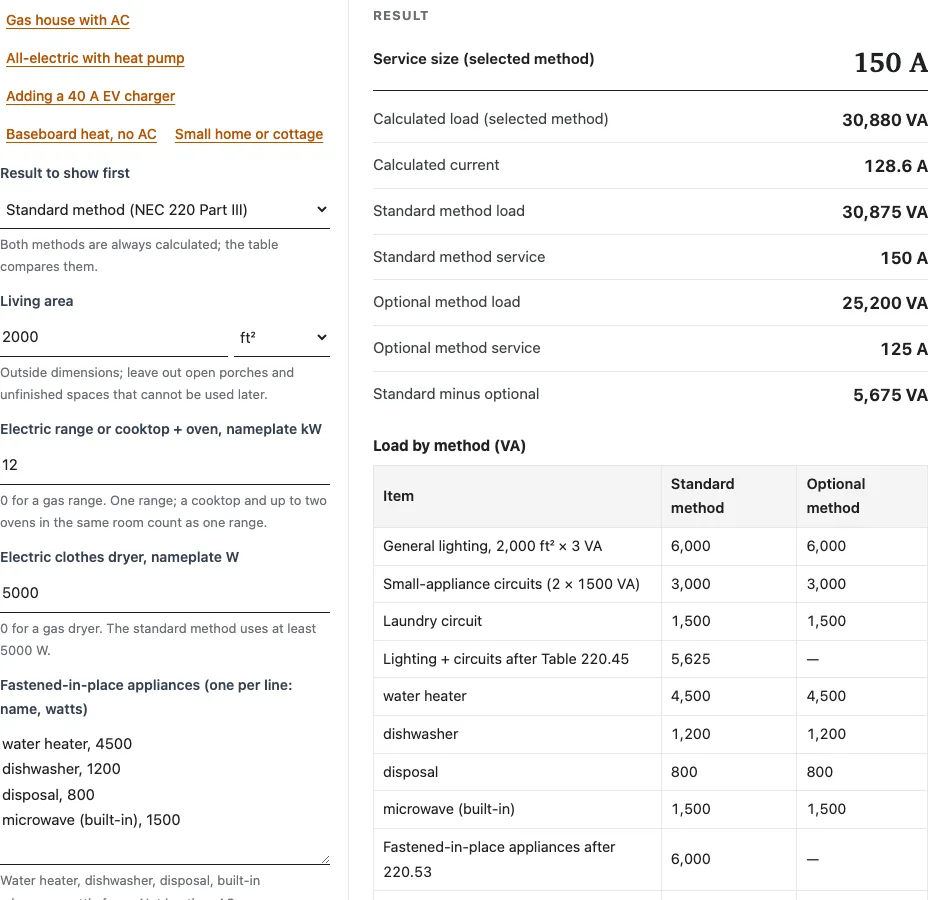
The tool’s default house (2,000 ft², 12 kW range, 5,000 W dryer, four fastened-in-place appliances and 5,000 VA of air conditioning) works out as:
- Lighting and circuits: 6,000 + 3,000 + 1,500 = 10,500 VA, reduced to 5,625 VA (first 3,000 VA at 100 %, the rest at 35 %).
- Four appliances of 500 W or more total 8,000 VA, taken at 75 % = 6,000 VA (220.53).
- Dryer 5,000 VA (220.54) and range 8,000 VA (Table 220.55, Column C).
- Cooling 5,000 VA, the larger of heating and cooling (220.60), plus 25 % of the largest motor = 1,250 VA.
- Total 30,875 VA ÷ 240 V = 128.6 A, so a 150 A service.
The service size is the next common rating of residential service equipment: 100, 125, 150, 200 and 225 A, then a 320 A service (Class 320 meter socket on a 400 A rated service) and 400 A. The tool also shows the code minimum, the next standard rating of NEC 240.6(A) (for example 175 A for a 151 A load), which some installers use with equipment rated at that value.
What is NEC 220.82?
Section 220.82 sets out the optional way to size a dwelling service. General loads go in at nameplate, the first 10,000 VA counts at 100 % and the rest at 40 %, and heating or air conditioning follows 220.82(C). With electric cooking, drying and cooling it often comes out lower than the standard method.
For the same default house, general loads total 35,500 VA. The first 10,000 VA plus 40 % of the remaining 25,500 VA gives 20,200 VA, and air conditioning at 100 % adds 5,000 VA. The total is 25,200 VA ÷ 240 V = 105 A, so 125 A, against 150 A by the standard method. These are the tool’s results for some of its examples:
| House | Standard method | Optional method |
|---|---|---|
| 2,000 ft², 12 kW range, 5,000 VA AC | 30,875 VA, 150 A | 25,200 VA, 125 A |
| 1,500 ft², 12 kW range, no AC | 18,600 VA, 100 A | 16,600 VA, 100 A |
| 3,200 ft², 14 kW range, hot tub, 9,600 W EV, 7,000 VA AC | 51,560 VA, 225 A | 36,280 VA, 200 A |
How do I calculate the load for a new EV charger?
Enter the charger’s nameplate watts. The standard method counts the larger of that figure and 7,200 W (NEC 220.57), and the optional method adds it to the general loads that are reduced to 40 % above 10,000 VA. A 9,600 W charger on a 2,500 ft² house raises the standard result from 150 A to 200 A.
The figures for that house (12 kW range, 5,000 W dryer, 5,000 VA AC) before and after the charger:
| Case | Standard method | Optional method |
|---|---|---|
| No EV charger | 31,400 VA, 150 A | 25,800 VA, 125 A |
| 9,600 W charger | 41,000 VA, 200 A | 29,640 VA, 125 A |
For an existing house, NEC 220.83 or a year of measured demand (220.87) may allow a different answer; the tool does not run those methods.
Worked examples
| Input | Result |
|---|---|
| 2000 ft², 12 kW range, 5000 VA AC | standard 30,875 VA → 150 A; optional 25,200 VA → 125 A |
| 1500 ft², 12 kW range, 0 VA AC | standard 18,600 VA → 100 A; optional 16,600 VA → 100 A |
| 2500 ft², 12 kW range, 4500 VA AC | standard 48,455 VA → 225 A; optional 34,872 VA → 150 A |
| 1200 ft², 0 kW range, 0 VA AC | standard 22,785 VA → 100 A; optional 17,240 VA → 100 A |
| 3200 ft², 14 kW range, 7000 VA AC | standard 51,560 VA → 225 A; optional 36,280 VA → 200 A |
Calculated by the tool above; open it with the same values to see each step.
Questions, briefly answered
What are demand factors and why do they matter?
Demand factors reduce a connected load to what is expected to run at once. The lighting table, the 75 % for four or more appliances and the 40 % above 10,000 VA in the optional method are all demand factors, and they are why a 35,500 VA house can need only a 125 A service.
Does this tool calculate heating and cooling together?
No. Heating and cooling do not run at the same time, so only the larger counts (220.60 in the standard method, 220.82(C) in the optional method). Heat-pump backup strips go in “Electric heat, nameplate VA”.
What if my calculation exceeds 400 amps?
The tool shows no service size above 400 A and warns that a service that large needs an engineered calculation.
How much load can a 200-amp service handle?
At 240 V, a 200 A service covers a calculated load of up to 48,000 VA (200 × 240). Compare that with the total the tool returns, not with the sum of every nameplate.
Can I use this calculator for commercial buildings?
No. It follows the dwelling rules of Article 220 for one-family houses. Multifamily, commercial and industrial services use other sections of that article.
What is NEC 220.83?
It is the method for adding load to an existing dwelling. This tool does not include it and prints a reminder that it, or a year of measured demand under 220.87, may give a different result.
Related tools
- Wire Size Calculator: size the service or feeder conductors for the result.
- Watts to Amps Calculator: convert one appliance’s watts to amps.
- Generator Size Calculator: size a standby generator for the house.
- Minimum Circuit Ampacity Calculator: work out the circuit ampacity of an AC unit or heat pump.
- Voltage Drop Calculator: check a long service or feeder run.
- Conduit Fill Calculator: pick the conduit for the service conductors.
- Box Fill Calculator: check the boxes on the new circuits.
- Conduit, Box and Load Calculators: see every raceway, box and load tool on the site.