Electrical Wire Color Code
Choose a country and system to see the wire colors for line, neutral and ground, including older colors.
Free · runs in your browser · nothing is uploaded
Recent
Your last 10 settings, saved only in this browser. Nothing is uploaded.
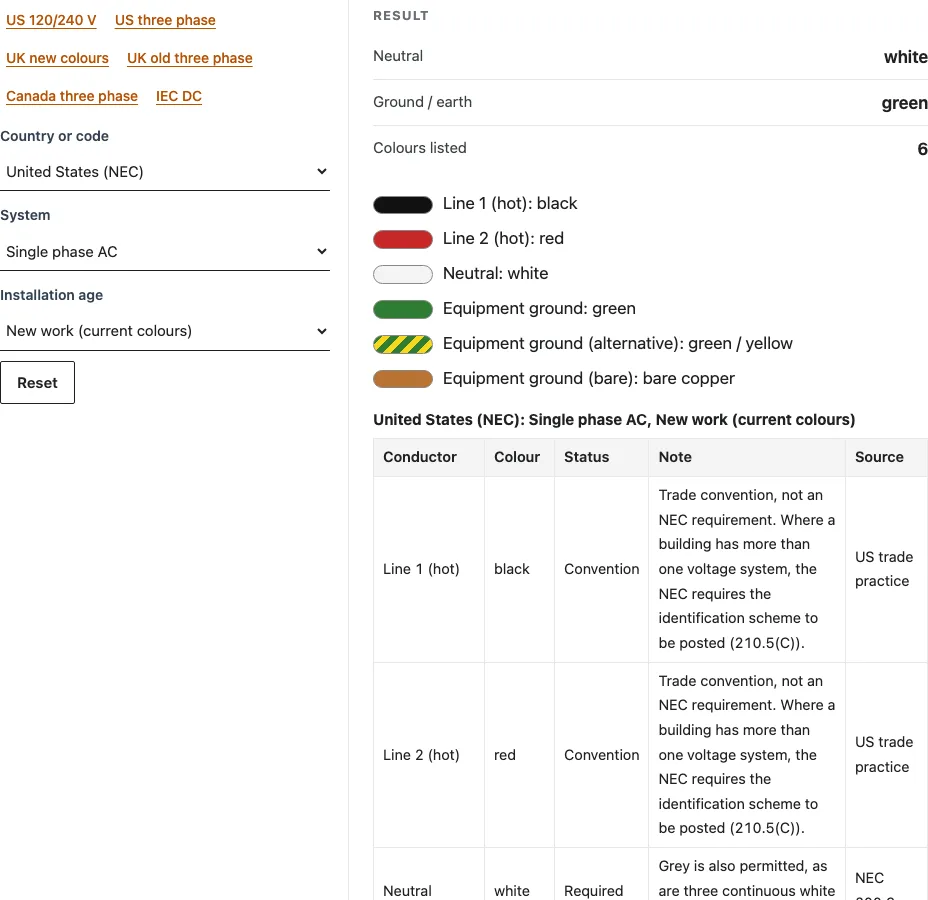
How to use the Electrical Wire Color Code tool
- Choose the standard in “Country or code”: “United States (NEC)”, “Canada (CEC)”, “United Kingdom (BS 7671)”, “Europe (IEC 60445 / HD 308)” or “Australia / New Zealand (AS/NZS 3000)”.
- Choose the “System”: “Single phase AC” for household circuits, “Three phase AC” for commercial and industrial supplies, or “DC” for battery and solar wiring.
- Set “Installation age” to “New work (current colours)”, or to “Older installations” when you open up wiring done under an earlier scheme, such as UK wiring from before 2004.
- Read the swatch list: each line shows a conductor role, such as Line 1 or Protective earth (PE), next to its color.
- Check the summary rows “Neutral”, “Ground / earth” and “Colours listed”.
- Read the table under the result. Its “Status” column says whether a color is required or only convention, and “Source” names the rule.
- Read the warnings. They change with the country, for example the posted-scheme reminder for the US and the mixed-colors notice for UK installations.
The example buttons above the form load US 120/240 V, US three phase, UK new colors, UK old three phase, Canada three phase and IEC DC. “Copy result” and “Copy link” share the list, “Print / save as PDF” makes a sheet for the panel door, and Reset goes back to the US single phase list.
What are the standard US wire color codes?
In US wiring the neutral is white or gray and the equipment ground is green, green with yellow stripes, or bare copper, as NEC 200.6 and 250.119 require. The hot conductors have no required color. Black, red and blue for 120/208/240 V, and brown, orange and yellow for 277/480 V, are trade convention.
Where a building has more than one voltage system, NEC 210.5(C)(1) requires the identification scheme for the hot conductors to be posted at the panel or otherwise documented.
| System | Hot 1 (A) | Hot 2 (B) | Hot 3 (C) | Neutral | Ground |
|---|---|---|---|---|---|
| 120/240 V single phase | black | red | none | white | green or bare |
| 120/208 V three phase | black | red | blue | white | green |
| 277/480 V three phase | brown | orange | yellow | white | green |
Two rules add detail. On a 4-wire delta system, the high leg must be marked orange (NEC 110.15). Where neutrals of different systems share an enclosure, NEC 200.6(D) requires them to be told apart, which is why 277/480 V neutrals are commonly gray.
Are wire color codes the same internationally?
No. The UK and the rest of Europe share one harmonised set: brown line, blue neutral and green-and-yellow earth. North America uses white neutrals and green grounds, while Australia and New Zealand use red actives and black neutrals. The same color can mean opposite things, since black is a line in Europe but a neutral in Australia.
| Single phase, new work | Line / hot | Neutral | Ground / earth |
|---|---|---|---|
| United States (NEC) | black, red | white | green |
| Canada (CEC) | black, red | white | green (bonding) |
| United Kingdom (BS 7671) | brown | blue | green / yellow |
| Europe (IEC 60445) | brown | blue | green / yellow |
| Australia / New Zealand | red | black | green / yellow |
For three phase, the UK and Europe use brown, black and grey, Canada red, black and blue, and Australia red, white and blue. The Australian rows come from secondary sources, and the tool says so in a warning.
What are the colors for DC power wiring?
It depends on the code. In the US, NEC 210.5(C)(2) marks DC branch circuits of 6 AWG and smaller red for positive and black for negative. Under IEC 60445 and BS 7671 the positive is brown, the negative grey and the mid-wire blue. For Canada and Australia the tool lists no DC scheme, so follow the equipment maker’s marking.
Larger US DC conductors are identified with + and − markings at every termination instead of by color.
Worked examples
| Input | Result |
|---|---|
| United States (NEC), Single phase AC, New work (current colours) | Line 1 (hot): black; Line 2 (hot): red; Neutral: white; Equipment ground: green; Equipment ground (alternative): green / yellow; Equipment ground (bare): bare copper |
| United States (NEC), Three phase AC, New work (current colours) | Phase A (120/208 V, 240 V): black; Phase B (120/208 V, 240 V): red; Phase C (120/208 V): blue; Phase A (277/480 V): brown; Phase B (277/480 V): orange; Phase C (277/480 V): yellow; Neutral: white; High leg (4-wire delta): orange; Equipment ground: green |
| United Kingdom (BS 7671), Single phase AC, New work (current colours) | Line (L): brown; Neutral: blue; Protective earth (PE): green / yellow |
| United Kingdom (BS 7671), Three phase AC, Older installations | Line 1 (hot): red; Line 2 (hot): yellow; Line 3: blue; Neutral: black; Protective earth (PE): green / yellow |
| Canada (CEC), Three phase AC, New work (current colours) | Phase A: red; Phase B: black; Phase C: blue; Neutral: white; Bonding conductor: green |
| Europe (IEC 60445 / HD 308), DC, New work (current colours) | Positive (+): brown; Negative (−): grey; Mid-wire (M): blue; Protective earth (PE): green / yellow |
Calculated by the tool above; open it with the same values to see each step.
Questions, briefly answered
Which color wire is L and N?
Under the harmonised UK and European colors, L (line) is brown and N (neutral) is blue. Older UK wiring used red for L and black for N, while North American circuits usually have a black hot and a white neutral.
What were the old UK wire colors?
Before the harmonised colors (introduced in 2004 and required for new work from 2006), line was red, neutral black, and three phase used red, yellow and blue. Installations from before about 1977 may have a plain green earth.
Should wire colors ever be mixed?
Old and new colors do meet in extended installations. BS 7671 then requires a warning notice at the board, because black can be an old neutral or a new line conductor.
What do I do if I find a black wire and I don’t know where it goes?
Treat it as live until a voltage tester proves otherwise. In US wiring black is usually a hot, but the color only shows what the installer intended.
Can a white wire be a hot in the US?
The NEC reserves white and gray for the grounded (neutral) conductor. Where a white wire is used as a hot in a cable, it should be re-marked, often with black or red tape, so test before you trust the color.
What colors are used for 277/480V?
By convention brown, orange and yellow for the phases, with a white or gray neutral and a green ground. Check the scheme posted at the panel, since the NEC does not fix phase colors.
Related tools
- Wire Size Calculator: to choose the conductor size once you know the circuit.
- Wire Gauge Chart: to compare AWG sizes and diameters.
- AWG to mm2 Converter: when a cable is marked in square millimeters.
- Single Phase vs Three Phase Calculator: to compare the two systems the color tables cover.
- DC Voltage Drop Calculator: for the battery and solar runs in the DC table.
- Battery Cable Size Calculator: to size the red and black battery cables.
- Wire and Cable Calculators: every wire tool on the site.