Extension Cord Gauge Chart
Enter the cord length and the amps or watts of your tool to see the minimum gauge for a safe voltage drop.
Assumes a copper cord with two current-carrying conductors at 40 °C, 16 AWG up to 13 A, 14 AWG up to 15 A, 12 AWG up to 20 A; the cord's UL label rating always governs. Free, runs in your browser. Verify with your local code and a licensed electrician before you install.
Recent
Your last 10 settings, saved only in this browser. Nothing is uploaded.
How to use the Extension Cord Gauge Chart
- Enter the “Cord length” and choose ft or m. For two cords joined together, enter the combined length.
- Choose how you know the load under “Load given as”: “Current (amps)” or “Power (watts)”.
- Type the amps from the nameplate into “Tool or appliance current (A)”, or the wattage into “Load power” with W or kW.
- Pick the “Allowed voltage drop”: “3 % (motors, power tools)” for saws, mowers and compressors, “5 % (lights, heaters)” for resistive loads.
- In the advanced settings, keep “Outlet voltage (V)” at 120 for the US and Canada, and raise “Cord temperature (°C)” if the cord will lie in the sun.
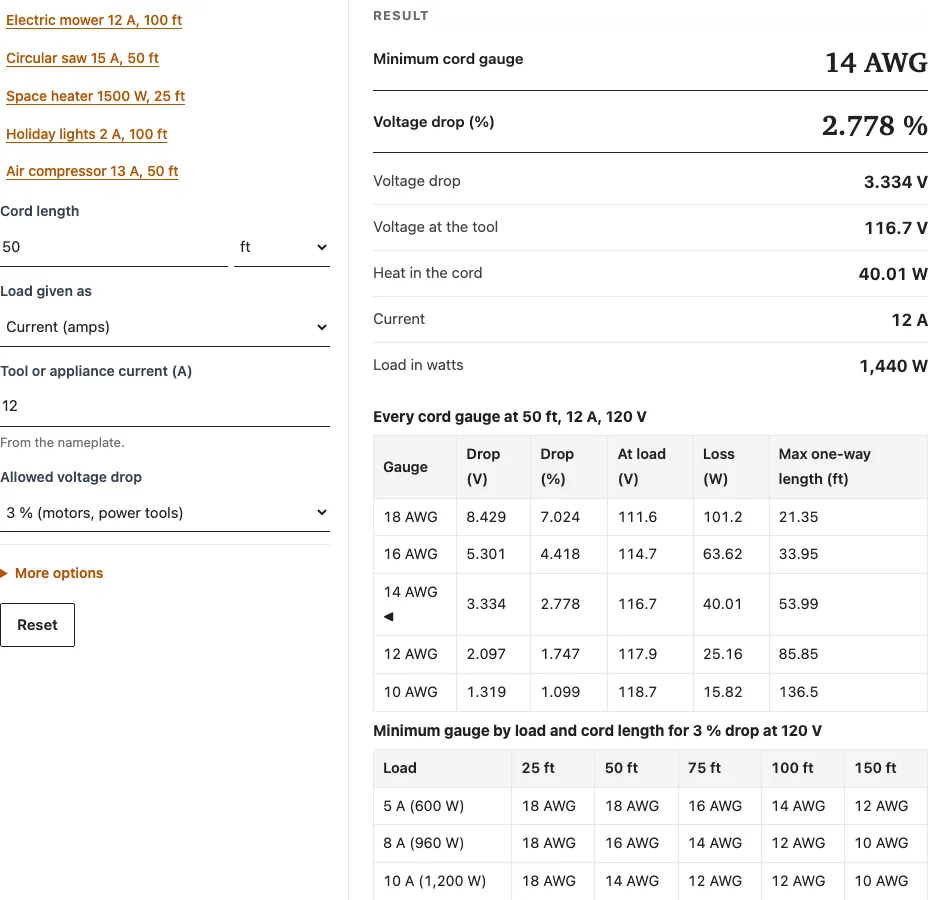
- Read “Minimum cord gauge” and “Voltage drop (%)”, then “Voltage at the tool” and “Heat in the cord”.
- Look at the two tables: every gauge at your length and load, and the chart of minimum gauges by load and length.
- Read the warnings, which include the reminder to stay within the rating on the cord’s label.
The example buttons above the form load an electric mower at 100 ft, a circular saw, a 1500 W space heater, holiday lights and an air compressor. “Copy result” and “Copy link” share the answer, “Print / save as PDF” keeps the chart for the workshop wall, and Reset restores the starting values.
What gauge extension cord do I need?
Pick the gauge from two numbers: the amps on the tool’s nameplate and the cord length. The minimum is the thinnest cord whose voltage drop over that length stays within 3 % (power tools) or 5 % (lights and heaters) and whose gauge is heavy enough for the current: 16 AWG up to 13 A (common 16 AWG cord sets are labelled 13 A / 1625 W), 14 AWG up to 15 A (a cord maker’s selector chart asks for at least 14 gauge up to 15 A) and 12 AWG up to 20 A. Then check that the cord’s label rating in amps is at least the tool’s current.
Part of the chart the calculator prints for 120 V and 3 %:
| Load | 25 ft | 50 ft | 100 ft | 150 ft |
|---|---|---|---|---|
| 5 A (600 W) | 16 AWG | 16 AWG | 14 AWG | 12 AWG |
| 10 A (1,200 W) | 16 AWG | 14 AWG | 12 AWG | 10 AWG |
| 15 A (1,800 W) | 14 AWG | 12 AWG | 10 AWG | none |
| 13 A (1,560 W) | 16 AWG | 12 AWG | 10 AWG | none |
“None” means that even 10 AWG loses more than 3 %, so use a shorter cord or a closer outlet. At 5 A on a short cord even 18 AWG would pass the drop test, but the chart never goes below 16 AWG, and above 13 A it never shows 16 AWG, whatever the length.
Does a longer extension cord reduce power?
Yes. The current flows out on one conductor and back on the other, so the drop is VD = 2 × L × I × R and grows in step with the length. Doubling the cord length doubles the volts lost, and those volts become heat in the cord instead of power at the tool.
For a 12 A load on 120 V, the calculator gives:
| Cord length | Minimum gauge | Drop |
|---|---|---|
| 25 ft | 16 AWG | 2.21 % |
| 50 ft | 14 AWG | 2.78 % |
| 100 ft | 10 AWG | 2.20 % |
A motor that gets too little voltage draws more current and runs hotter, which is why the 3 % option is meant for power tools.
Is a 10 gauge or 12 gauge extension cord better?
10 gauge is thicker, so it always drops less voltage, but it is heavier and costs more. 12 gauge is enough whenever it stays within your drop limit. The calculator shows where the line falls: for 15 A, 12 AWG is fine at 50 ft (2.18 %), while 100 ft needs 10 AWG (2.75 %).
At 12 A over 50 ft both pass: 12 AWG drops 1.75 % and 10 AWG drops 1.10 %, so the extra copper buys little there.
Worked examples
| Input | Result |
|---|---|
| 12 A, 50 ft, 120 V, 3 % | 14 AWG |
| 10 A, 25 ft, 120 V, 3 % | 16 AWG |
| 15 A, 100 ft, 120 V, 3 % | 10 AWG |
| 12.5 A, 50 ft, 120 V, 3 % | 14 AWG |
| 13 A, 100 ft, 120 V, 5 % | 12 AWG |
Calculated by the tool above; open it with the same values to see each step.
Questions, briefly answered
Which is thicker, a 12 gauge or 14 gauge extension cord?
12 gauge. AWG numbers run backward, so the smaller number has the thicker conductor and the lower resistance.
Can I use a 16-gauge cord for heavy appliances?
Usually not. Common 16 AWG cord sets are labelled 13 A / 1625 W, so the tool never picks 16 AWG for a load above 13 A. Even at 12 A, 16 AWG passes the 3 % test only up to about 34 ft.
What gauge cord does a 1500 W space heater need?
At 120 V a 1500 W heater draws 12.5 A. The tool gives 16 AWG for 25 ft and 14 AWG for 50 ft. A cord to a heater must be rated for the heater’s full load.
Is it safe to connect multiple extension cords?
Joined cords act like one long cord, so enter the combined length. The weakest cord in the chain sets the limit, and every cord must be rated for the load.
Does the calculator give an amp rating for each gauge?
Not as a rating. It sizes the cord by voltage drop and applies a minimum gauge for the current from the cord maker’s published guidance (16 AWG up to 13 A, 14 AWG up to 15 A, 12 AWG up to 20 A). The rating that counts is the amp or watt figure printed on the cord’s UL label; never go above it.
Why does the cord temperature matter?
Copper resistance rises with temperature, so a warm cord drops more voltage. The starting value is 40 °C, and a coiled or covered cord gets hotter still, so uncoil it fully under load.
Related tools
- Watts to Amps Calculator: to turn a tool’s wattage into amps first.
- Voltage Drop Calculator: for fixed wiring rather than a plug-in cord.
- Wire Gauge Chart: to compare AWG diameters and areas.
- AWG to mm2 Converter: when a cord is labelled in square millimeters.
- Wire Size for 30 Amp Circuit: when a dedicated circuit would serve the load better than a cord.
- Generator Size Calculator: to check that a generator covers the tools on the cord.
- Wire and Cable Calculators: every wire sizing tool on the site.