Generator Size Calculator
List your loads with running and starting watts to get the generator size, with altitude and temperature derating.
Assumes typical watts you can edit, motors started one at a time, derating from the spec-sheet figures shown, and standby sizes from published manufacturer line-ups. Free, runs in your browser. Verify with your local code and a licensed electrician before you install.
Recent
Your last 10 settings, saved only in this browser. Nothing is uploaded.
How to use the Generator Size Calculator
- In “Loads (one per line: name, running W, extra starting W, quantity)”, type each item, for example: sump pump 1/2 hp, 1050, 2150. Leave out starting watts for heaters and lights; the quantity defaults to 1.
- Set “Generator output” to Single phase or Three phase.
- Enter “Voltage (V)”: 240 for a 120/240 V home, or the line-to-line voltage (208, 480) for three phase.
- Enter the “Generator power factor”: 1.0 for single-phase home standby units, 0.8 for three-phase gensets.
- Type any “Extra headroom (%)” for loads you may add later, or keep 0.
- Enter “Site altitude” (ft or m) and the “Highest outdoor temperature” (°F or °C).
- If your model’s spec sheet gives other derating figures, change them under “More options”: “Altitude derating, % per 100 m (328 ft)”, “Altitude derating starts above (m)”, “Temperature derating, % per 10 °C (18 °F)” and “Temperature derating starts above (°C)”.
- Read “Generator rating needed”, then the standby size, the steps and the “Load list” table.
Buttons such as “Essentials, no AC”, “RV / camper” or “Three-phase 480 V building” load an editable sample list. “Copy result”, “Copy link” and “Print / save as PDF” keep or share the answer, and Reset restores the defaults.
Changing any field updates the result rows, the steps and the tables straight away, and Copy link keeps your exact inputs in the address so you can share or reopen the calculation.
How do I calculate what size generator I need?
Add the running watts of every load you will run together, then add the largest extra starting watts of any single motor, because motors start one at a time. Raise that peak by your headroom, divide it by the altitude and temperature derating factor, and pick the next generator size above the result.
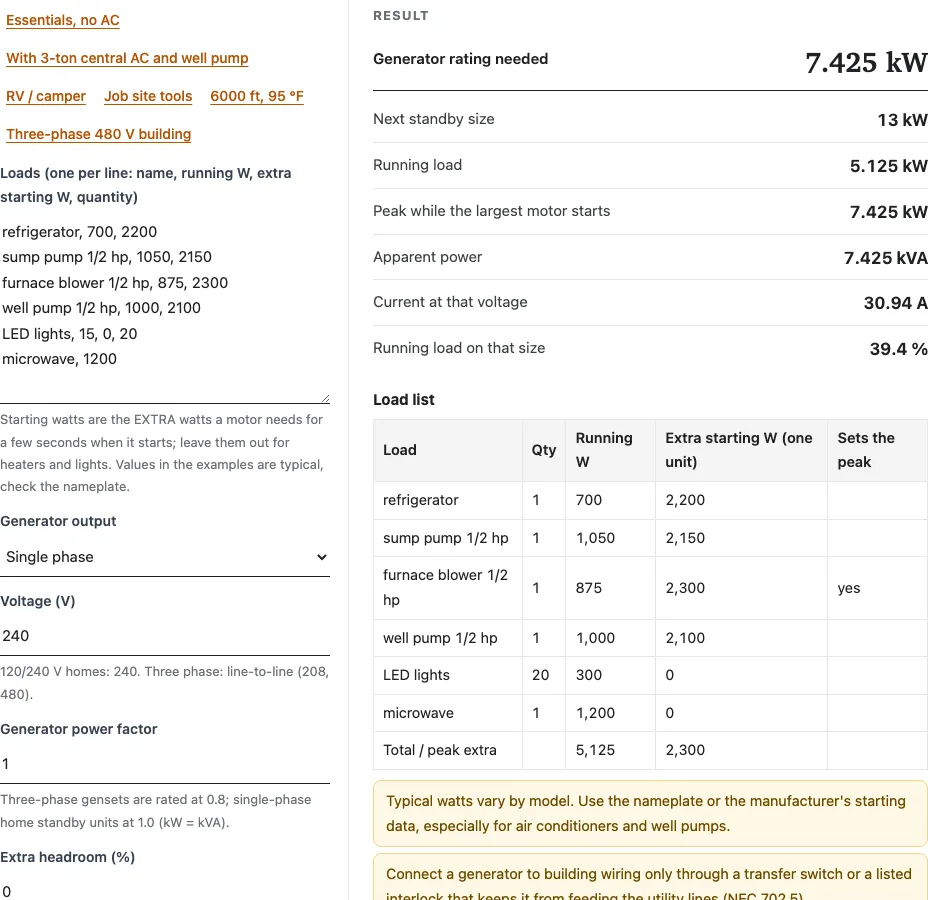
With the default list (refrigerator, sump pump, furnace blower, well pump, 20 LED bulbs and a microwave):
- Running load: 5,125 W.
- Peak: 5,125 W + 2,300 W for the furnace blower = 7,425 W.
- Rating needed with 0 % headroom and no derating: 7.425 kW.
- Current at 240 V and power factor 1: 7.425 kVA × 1000 ÷ 240 = 30.94 A.
- Next standby size: a 10 kW home standby unit (9 kW on natural gas, still above 7.425 kW). A portable generator rated at least 5,125 W running and 7,425 W starting also covers the list.
- Conductors from the 10 kW generator to its first breaker: 10,000 W ÷ 240 V = 41.67 A × 115 % = 47.92 A ampacity (NEC 445.13(A)).
Adding 20 % headroom raises the rating needed to 8.91 kW.
How much do altitude and heat reduce generator output?
Thinner air and hot intake air both cut an engine’s output. The tool’s default figures come from one residential spec sheet: 1.3 % less per 100 m above 200 m, and 3 % less per 10 °C above 25 °C (77 °F). The two cuts are added and the peak is divided by what remains.
Default list (7,425 W peak) at different sites:
| Site | Derating factor | Generator rating needed |
|---|---|---|
| Sea level, 77 °F | 1 | 7.425 kW |
| 3,000 ft | 0.9071 | 8.185 kW |
| 5,000 ft | 0.8279 | 8.969 kW |
| 95 °F at sea level | 0.97 | 7.655 kW |
| 5,000 ft and 95 °F | 0.7979 | 9.306 kW |
| 6,000 ft and 95 °F | 0.7583 | 9.792 kW |
Derating differs by model, so copy the figures from your own generator’s spec sheet into the fields under “More options”.
What is the difference between kW and kVA for a generator?
kW is the real power the loads use; kVA is the apparent power the generator must deliver, equal to kW divided by the power factor. Single-phase home standby units are rated at power factor 1, so kW equals kVA. Three-phase gensets are rated at 0.8, which makes their kVA figure 25 % higher.
The “Three-phase 480 V building” example has a 15 kW motor load (30 kW extra to start), 20 kW of heating and 5 kW of lighting. Its peak is 70 kW, which at power factor 0.8 is 87.5 kVA and 105.2 A at 480 V. If you enter a power factor above 0.8 for three phase, the tool warns that the kVA will come out smaller than the nameplate shows.
Worked examples
| Input | Result |
|---|---|
| 6 loads at 0 ft | 7.425 kW needed (5.125 kW running, 7.425 kW peak) |
| 7 loads at 0 ft | 14.63 kW needed (8.625 kW running, 14.63 kW peak) |
| 4 loads at 0 ft | 5.65 kW needed (3.25 kW running, 5.65 kW peak) |
| 3 loads at 0 ft | 70 kW needed (40 kW running, 70 kW peak) |
| 6 loads at 5000 ft | 9.306 kW needed (5.125 kW running, 7.425 kW peak) |
Calculated by the tool above; open it with the same values to see each step.
Questions, briefly answered
What will a 7500 watt generator run in a house?
It covers the default list, whose peak is 7,425 W, with 75 W to spare. The “Job site tools” example peaks at 7,700 W and would not fit.
What size generator do I need for a 1500 sq ft house?
Floor area alone does not set the size; the loads do. The What Size Generator Do I Need? page adds an NEC 220.82 whole-house estimate from floor area, which for 1,500 ft² with its default items is 10.37 kW.
How do I find the starting watts of an appliance?
Use the nameplate or the manufacturer’s starting data, especially for air conditioners and well pumps. The example values are typical figures only, and the tool warns when no item has starting watts.
What does extra headroom do?
It multiplies the rating needed by 1 plus your percentage, leaving room for loads added later. At 0 % the tool sizes your list exactly.
Why does the tool add only one starting surge?
Motors normally start one at a time, so only the largest extra starting watts lands on top of the running load. The “Sets the peak” column shows which item that is.
Can I connect the generator to my house wiring?
Only through a transfer switch or a listed interlock that keeps it from feeding the utility lines (NEC 702.5). The tool prints this reminder with every result.
Related tools
- What Size Generator Do I Need?: tick home appliances instead of typing a list.
- Electrical Load Calculator: work out a dwelling’s demand load.
- HP to Amps Calculator: find a motor’s current from its horsepower.
- Watts to Amps Calculator: convert a load’s watts into amps.
- kVA to kW Calculator: convert a genset’s kVA rating to kW.
- Wire Size Calculator: size the cable from the generator to the transfer switch.
- Transformer Sizing Calculator: size a transformer for a load fed at another voltage.
- Motor, Transformer and Generator Calculators: see the other tools in this group.