HP to Amps Calculator
Enter horsepower and voltage to get the motor current by formula and by the NEC table, then size the wire and protection.
Assumes NEC 2023 Tables 430.248/430.250 full-load currents for wire and protection (not the nameplate), copper or aluminum in the column you pick; the overload uses the nameplate current. Free, runs in your browser. Verify with your local code and a licensed electrician before you install.
Recent
Your last 10 settings, saved only in this browser. Nothing is uploaded.
How to use the HP to Amps Calculator
- Choose the size under “Motor horsepower” (1/6 hp to 200 hp).
- Set “Motor type” to “Three phase (induction)” or “Single phase”.
- Pick the “Rated motor voltage”. Single phase offers 115, 200, 208 and 230 V; three phase offers 200, 208, 230, 460 and 575 V. A 230 V motor runs on a 240 V supply, a 460 V motor on 480 V.
- If you have the motor, type its “Nameplate FLA (A, optional)”. It sets the overload and is compared with the table.
- Choose the “Service factor / temperature rise” line that matches the nameplate, the “Short-circuit protection” device (inverse-time breaker, dual-element fuse or non-time-delay fuse) and the “Conductor” metal.
- Under “More options”, enter “Efficiency for the formula (%)” and “Power factor for the formula” from the data sheet, and pick the “Ampacity column” (75 °C or 60 °C). Efficiency and power factor change only the formula result.
- Read “Full-load amps (NEC table)” first, then the wire, overload and breaker rows and the steps.
Example buttons such as “1 hp well pump, 230 V” or “10 hp fan, 460 V 3-phase” fill the form with a typical motor. “Copy result”, “Copy link” and “Print / save as PDF” keep or share the answer, and Reset restores the defaults.
Changing any field updates the results at once.
How do you convert HP to amps?
Multiply the horsepower by 745.7 to get output watts, then divide by the voltage, the efficiency and the power factor; for a three-phase motor also divide by √3 (about 1.732). The answer is the input current at full load. Because efficiency and power factor vary between motors, the result is an estimate.
- Watts: 5 hp × 745.7 = 3,728.5 W.
- Divisor for 460 V three phase at 88 % efficiency and 0.85 power factor: 1.732 × 460 × 0.88 × 0.85.
- Current: 3,728.5 ÷ that divisor = 6.256 A.
Single-phase motors use the same steps without the √3.
Why use the NEC table instead of the formula?
NEC 430.6(A)(1) requires the full-load current from Tables 430.247 to 430.250, not the nameplate or a calculated value, when sizing a motor’s conductors and its short-circuit protection. Table values are fixed for each horsepower and voltage, so two people sizing the same motor get the same answer.
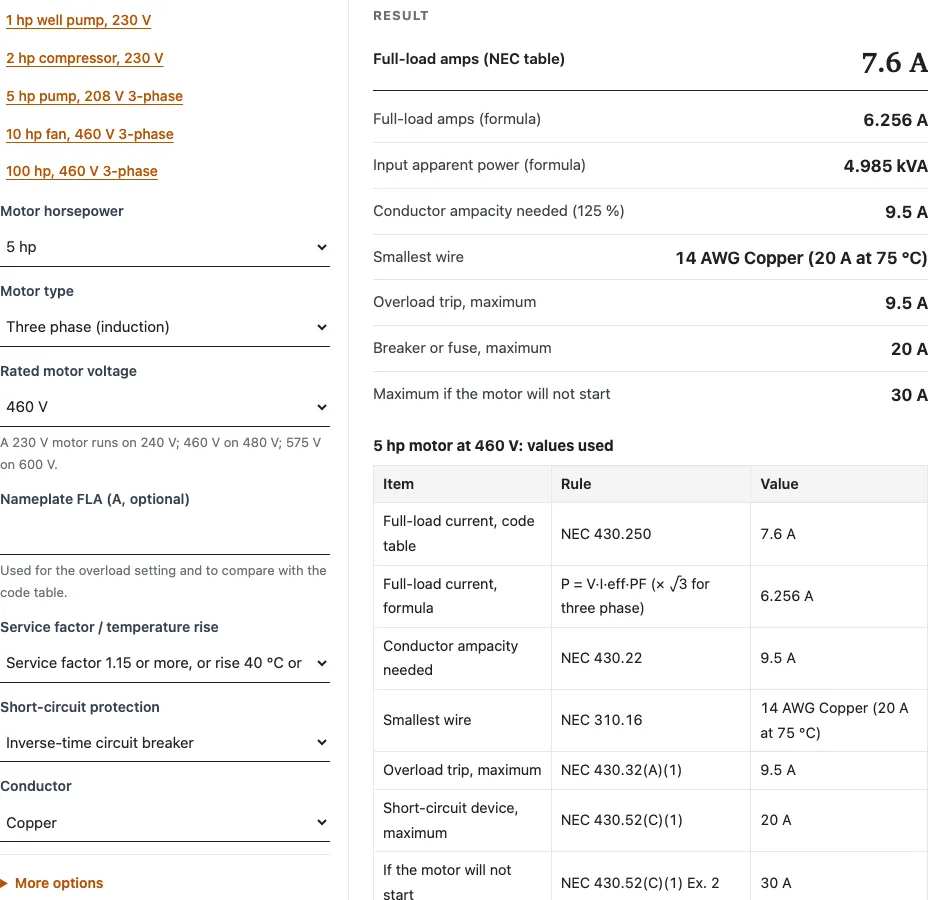
For the 5 hp, 460 V motor above, the table gives 7.6 A against 6.256 A from the formula. Table values from the tool, with the wire and inverse-time breaker it derives from them:
| Motor | NEC table FLC | Smallest copper wire (75 °C) | Breaker, maximum |
|---|---|---|---|
| 1 hp, 115 V single phase | 16 A | 14 AWG | 40 A |
| 1 hp, 230 V single phase | 8 A | 14 AWG | 20 A |
| 5 hp, 230 V single phase | 28 A | 10 AWG | 70 A |
| 5 hp, 208 V three phase | 16.7 A | 12 AWG | 45 A |
| 5 hp, 460 V three phase | 7.6 A | 14 AWG | 20 A |
| 40 hp, 460 V three phase | 52 A | 6 AWG | 150 A |
The table covers single-phase motors up to 10 hp and three-phase motors from 1/2 hp. Outside that range the tool shows only the formula current and skips the NEC sizing.
How do you size the wire and breaker for a motor?
Size the branch-circuit wire for at least 125 % of the table full-load current (NEC 430.22). Size the breaker or fuse from the same table current with the percentage for the device type in NEC 430.52(C)(1), which is 250 % for an inverse-time breaker. Set the overload from the nameplate current instead (430.32(A)(1)).
- Conductor: 7.6 A × 125 % = 9.5 A, so 14 AWG copper (20 A at 75 °C).
- Inverse-time breaker: 250 % × 7.6 A = 19 A; the next standard rating, 20 A, is permitted (Exception No. 1).
- If 20 A will not carry the starting current: up to 400 % × 7.6 A = 30.4 A, rounded down to 30 A (Exception No. 2).
- Overload: 125 % of the nameplate amps for a service factor of 1.15 or more, otherwise 115 %.
Worked examples
| Input | Result |
|---|---|
| 5 hp, 460 V three phase | 7.6 A (table); 6.26 A (formula) |
| 1 hp, 115 V single phase | 16 A (table); 10.8 A (formula) |
| 2 hp, 230 V single phase | 12 A (table); 9.54 A (formula) |
| 10 hp, 208 V three phase | 30.8 A (table); 27.1 A (formula) |
| 50 hp, 460 V three phase | 65 A (table); 57.9 A (formula) |
Calculated by the tool above; open it with the same values to see each step.
Questions, briefly answered
What is 5 HP in amps?
From the NEC table, a 5 hp motor draws 28 A at 230 V single phase, 16.7 A at 208 V three phase and 7.6 A at 460 V three phase. The formula gives 6.256 A at 460 V with 88 % efficiency and 0.85 power factor.
How many amps is 1 HP?
A 1 hp single-phase motor is 16 A at 115 V and 8 A at 230 V in the NEC table. Doubling the voltage halves the current.
How many amps is a 40 HP motor?
A 40 hp three-phase motor is 52 A at 460 V and 114 A at 208 V in the NEC table. At 460 V the tool sizes 6 AWG copper and a breaker of up to 150 A.
When do I use the nameplate amps?
Use the nameplate current to set the motor overload (NEC 430.6(A)(2), 430.32). Wire and breaker sizing use the table value even when the nameplate shows something different.
Why is the formula result lower than the table?
The default efficiency and power factor describe one particular motor, while the table gives one fixed value for each size and voltage. The tool warns when the two differ by more than 25 %.
Which motors should not use the table current?
Motors built for low speed (under 1200 rpm) or high torque. The tool’s warning points you to their nameplate current, as NEC 430.6(A)(1) requires.
Related tools
- HP to kW Converter: turn a horsepower rating into kilowatts.
- kW to HP Converter: read a metric motor rating in horsepower.
- kW to Amps Calculator: find current from a kW rating instead of hp.
- Three Phase Power Calculator: work with volts, amps and kW on a three-phase supply.
- Power Factor Calculator: find the power factor of a running motor.
- Minimum Circuit Ampacity Calculator: size a circuit for an AC unit with several motors.
- Wire Size Calculator: check voltage drop on a long motor feeder.
- Generator Size Calculator: check that a generator can start the motor.