HP to kW Converter
Convert horsepower to kilowatts for the three horsepower definitions, then find the electrical input kW and kVA of a motor.
Free · runs in your browser · nothing is uploaded
Recent
Your last 10 settings, saved only in this browser. Nothing is uploaded.
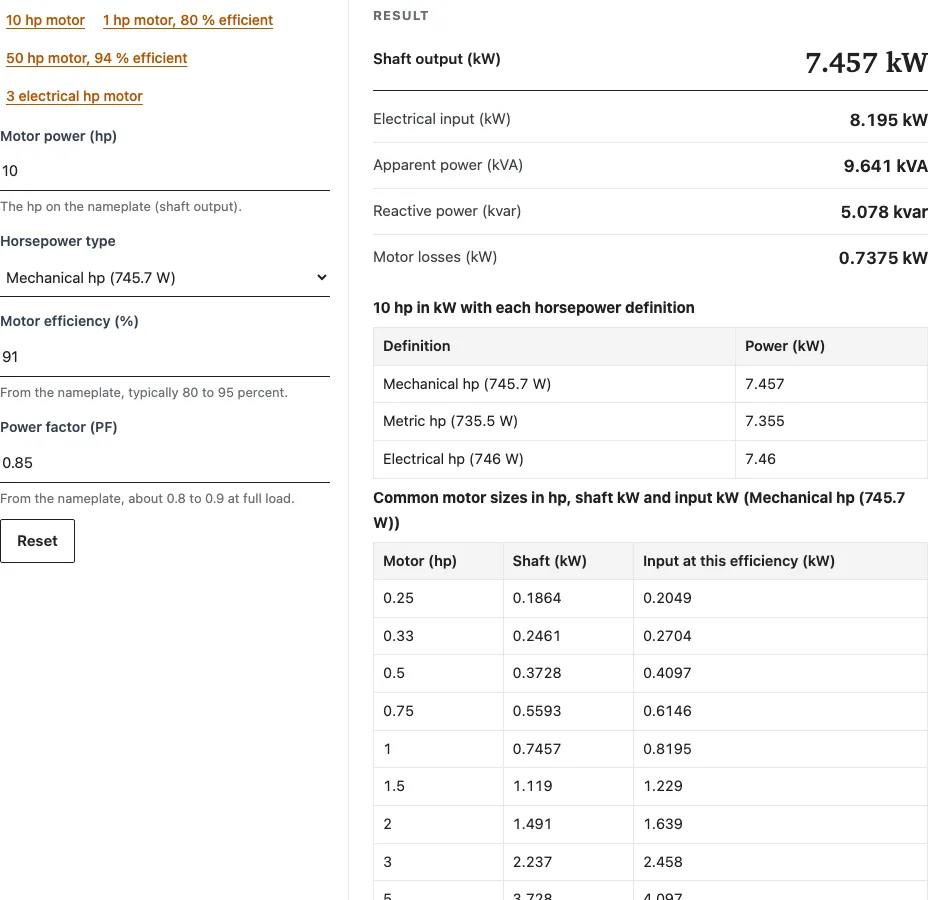
How to use the HP to kW Converter
Fill in four fields; every result refreshes as soon as a value changes.
- Type the nameplate rating into Motor power (hp). This is the mechanical output at the shaft, not the power drawn from the supply.
- Pick the definition in Horsepower type: Mechanical hp (745.7 W), Metric hp (735.5 W) or Electrical hp (746 W). Ratings given in PS or CV are metric hp.
- Enter Motor efficiency (%) from the nameplate. Full-load values are typically between 80 and 95 percent.
- Enter Power factor (PF) from the nameplate, usually about 0.8 to 0.9 at full load. A value below 0.5 triggers a warning to check it.
- Read Shaft output (kW) for the plain hp to kW answer. Electrical input (kW), Apparent power (kVA), Reactive power (kvar) and Motor losses (kW) describe what the motor takes from the supply.
- Check the calculation steps under the result to see each multiplication and division, then scroll to the two tables: the same hp under each definition, and common motor sizes at your efficiency.
The example buttons above the form (“10 hp motor”, “1 hp motor, 80 % efficient”, “50 hp motor, 94 % efficient”, “3 electrical hp motor”) load complete cases. Copy result and Copy link share the answer, Print / save as PDF keeps a record, and Reset restores the defaults.
How do you convert horsepower to kilowatts?
Multiply the horsepower by the watts in one horsepower and divide by 1,000. For mechanical hp that is 745.7 W, so kW = hp × 0.7457. Metric hp uses 735.5 W and electrical hp uses exactly 746 W. The three answers differ by about 1.4 percent at most.
For a 10 hp rating the tool returns these shaft values:
| Horsepower definition | Watts per hp | 10 hp in kW |
|---|---|---|
| Mechanical hp | 745.7 | 7.457 |
| Metric hp | 735.5 | 7.355 |
| Electrical hp | 746 | 7.46 |
Mechanical hp comes from 550 ft·lbf per second, metric hp from 75 kgf·m per second, and electrical hp is the round 746 W convention used for motors. Choosing the wrong one rarely matters for a small motor, but on a 100 hp rating the gap between mechanical and metric hp is about 1 kW.
What is the difference between shaft kW and electrical input kW?
Shaft kW is the mechanical power the motor delivers to its load, and it is what the hp rating describes. Electrical input kW is the power the motor draws from the supply. Input is always larger because part of it is lost as heat in the windings, core and bearings.
The tool finds input by dividing shaft kW by the efficiency:
- Shaft output: 10 hp × 745.7 W ÷ 1,000 = 7.457 kW.
- Electrical input at 91 percent efficiency: 7.457 ÷ 0.91 = 8.1945 kW, so the losses are 0.7375 kW.
- Apparent power at a power factor of 0.85: 8.1945 ÷ 0.85 = 9.6406 kVA, with 5.0785 kvar of reactive power.
Use input kW for energy cost estimates and kVA when you size a supply, generator or transformer. A small motor shows the effect more clearly: 1 hp at 80 percent efficiency is 0.7457 kW at the shaft but 0.9321 kW at the terminals.
How many kW is a 5 hp motor?
A 5 hp motor delivers about 3.73 kW at its shaft, because 5 × 0.7457 = 3.7285 kW. At 91 percent efficiency it draws about 4.10 kW of electrical power, and at a power factor of 0.85 that is about 4.82 kVA from the supply.
Shaft and input kW for a few other common ratings, mechanical hp at 91 percent efficiency:
| Motor (hp) | Shaft (kW) | Input (kW) |
|---|---|---|
| 1 | 0.746 | 0.819 |
| 3 | 2.237 | 2.458 |
| 15 | 11.19 | 12.29 |
| 20 | 14.91 | 16.39 |
| 50 | 37.28 | 40.97 |
The motor-size table under the tool recalculates the input column whenever you change the efficiency.
Worked examples
| Input | Result |
|---|---|
| 10 hp, Mechanical hp (745.7 W), η 91 %, PF 0.85 | 7.457 kW shaft, 8.195 kW input, 9.641 kVA |
| 1 hp, Mechanical hp (745.7 W), η 80 %, PF 0.8 | 0.7457 kW shaft, 0.9321 kW input, 1.165 kVA |
| 50 hp, Mechanical hp (745.7 W), η 94 %, PF 0.88 | 37.28 kW shaft, 39.66 kW input, 45.07 kVA |
| 3 hp, Electrical hp (746 W), η 86 %, PF 0.82 | 2.238 kW shaft, 2.602 kW input, 3.174 kVA |
Calculated by the tool above; open it with the same values to see each step.
Questions, briefly answered
How many kW in 1 HP?
One mechanical horsepower is 0.7457 kW. A metric horsepower is 0.7355 kW and an electrical horsepower is 0.746 kW, so check which definition your rating uses.
Is 1 HP equal to 1 kW?
No. One kilowatt is about 1.341 mechanical hp, so a kilowatt is roughly a third larger than a horsepower. A 1 kW motor and a 1 hp motor are not interchangeable.
How many kW is 20 HP 3 phase?
A 20 hp motor delivers about 14.91 kW at the shaft whatever its supply. The number of phases changes the current, not the hp to kW conversion; at 91 percent efficiency the input is about 16.39 kW.
How do I convert kW back to hp?
Divide kilowatts by 0.7457, or multiply by about 1.341, for mechanical hp. The separate kW to HP converter on this site does it for all three definitions.
Why does the tool ask for efficiency and power factor?
Shaft kW needs only the hp value. Efficiency is used to work out the electrical input and losses, and power factor turns that input into kVA and kvar.
Are nameplate values right at part load?
They describe full load. At part load efficiency and power factor are usually lower, so the tool prints a reminder with every result.
Related tools
- kW to HP Converter: when you start from kilowatts and need horsepower.
- HP to Amps Calculator: for the full-load current of a motor at a given voltage.
- kW to Amps Calculator: to turn the electrical input kW into current.
- kVA to Amps Calculator: to get current from the motor’s kVA.
- kVA to kW Calculator: to move between apparent and real power.
- Power Factor Calculator: when you need to find PF from measured values.
- Three Phase Power Calculator: for three-phase kW, kVA and current together.
- Generator Size Calculator: to size a generator for motor loads.
- Power conversion calculators: all power and unit converters.