Junction Box Size Calculator
Enter the raceway trade sizes on each wall to get the minimum length and width of a pull box.
Assumes NEC 2023 314.28 for raceways with conductors 4 AWG and larger; smaller conductors are sized by box fill (314.16). Free, runs in your browser. Verify with your local code and a licensed electrician before you install.
Recent
Your last 10 settings, saved only in this browser. Nothing is uploaded.
How to use the Junction Box Size Calculator
- Under “Type of pull”, choose “Straight pull (in one side, out the opposite side)”, “Angle pull (in one side, out an adjacent side)” or “U pull (in and out the same side)”.
- In “Raceways on wall A (trade sizes)”, type the conduit sizes in inches separated by commas, for example 3, 3, 2. Write fractions as 1-1/4 or 1.25.
- If the raceways sit in more than one row on that wall, separate the rows with a semicolon, for example 4, 4; 3, 3, 3.
- For a straight or angle pull, fill in “Raceways on wall B (trade sizes)” in the same order as their partners on wall A. A U pull uses wall A only, with the raceways listed in in-and-out pairs.
- Read “Minimum box” first, then the dimension rows: “Length, wall A to wall B” for a straight pull, or “Wall A to the opposite wall” and “Wall B to the opposite wall” for an angle pull, plus “Spacing between entries of the same conductors”.
- Check the drawing, the spacing table for each pair and the warnings, especially the box depth one.
Example buttons above the form, such as “Angle pull with two rows”, fill in a full case. “Copy result” copies the dimensions, “Copy link” copies a link that reopens the same inputs, “Print / save as PDF” prints the page, and “Reset” goes back to the default angle pull.
How do I size a pull box for a straight pull?
For a straight pull, where the conductors enter one wall and leave through the opposite wall, NEC 314.28(A)(1) requires a box length of at least 8 times the trade size of the largest raceway. Two 4 in conduits on each side need a box at least 32 in (812.8 mm) long.
The width is not set by that rule. It only has to fit the raceways and their locknuts or hubs, so the drawing shows it as “not set by the code”. These are the results for single raceways of common sizes:
| Largest raceway | Minimum length |
|---|---|
| 2 in | 16 in (406.4 mm) |
| 4 in | 32 in (812.8 mm) |
How do you calculate the minimum size of a pull box for an angle or U pull?
For an angle or U pull, measure from each wall with raceway entries to the wall opposite it. That distance must be at least 6 times the largest raceway in the row plus the sum of the other raceways in the same row (NEC 314.28(A)(2)). Each row is worked out separately and the largest result governs.
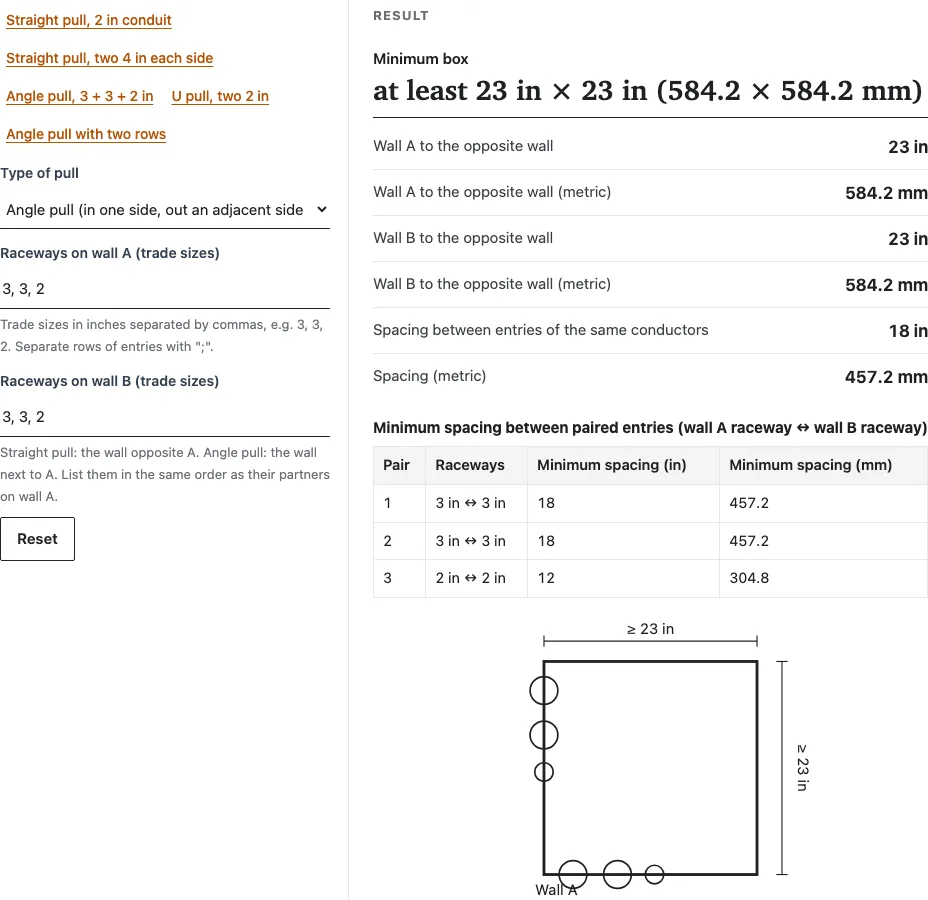
The default angle pull, three conduits of 3, 3 and 2 in on each wall, works out as:
- Wall A: 6 × 3 in + (3 + 2) in = 23 in.
- Wall B: the same raceways give 23 in.
- Spacing: entries that carry the same conductors must be 6 × 3 in = 18 in apart for the 3 in pairs and 12 in for the 2 in pair.
So the box must be at least 23 in × 23 in (584.2 × 584.2 mm). With two rows, 4, 4 above 3, 3, 3, row 1 gives 6 × 4 + 4 = 28 in and row 2 gives 6 × 3 + 6 = 24 in, so 28 in × 28 in is the minimum.
When does a junction box need 314.28 sizing instead of box fill?
The 314.28 dimension rules apply when a raceway carries conductors of 4 AWG or larger. Boxes that hold only smaller conductors are sized by volume under 314.16 instead, which gives each wire, device, clamp and group of grounds a cubic-inch allowance and compares the total with the box’s marked capacity.
The tool states this limit in its steps. It also warns that the depth toward a removable cover may follow the wire-bending space rule of 312.6(A) (314.28(A)(2) Exception), which it does not calculate.
Worked examples
| Input | Result |
|---|---|
| Straight pull, 2 / 2 | at least 16 in (406.4 mm) long |
| Straight pull, 4, 4 / 4, 4 | at least 32 in (812.8 mm) long |
| Angle pull, 3, 3, 2 / 3, 3, 2 | at least 23 in × 23 in (584.2 × 584.2 mm) |
| Angle pull, 2 / 2 | at least 12 in × 12 in (304.8 × 304.8 mm) |
| U pull, 2, 2 | at least 14 in (355.6 mm) from wall A to the opposite wall |
Calculated by the tool above; open it with the same values to see each step.
Questions, briefly answered
How do you size a junction box?
For 4 AWG and larger, list the raceway trade sizes on each wall, decide whether the pull is straight, angle or U, and apply 8 times the largest raceway (straight) or 6 times the largest plus the others in the row (angle and U). For smaller wires, size it by box fill.
What is a pull box, and why is it needed?
A pull box is an enclosure set into a conduit run so conductors can be pulled in shorter sections or turned at a corner. It cuts the pulling tension of a long or bent run and gives access to the wires later.
Why must paired raceway entries be spaced apart?
Conductors entering through one raceway and leaving through another need room to bend without damage. NEC 314.28(A)(2) sets the distance between entries enclosing the same conductors at 6 times the larger trade size, which the tool lists pair by pair.
What is the standard size of junction boxes?
There is no single standard size. Small boxes such as 4 in square or 4-11/16 in square boxes are chosen by box fill volume, while pull boxes for 4 AWG and larger conductors take their dimensions from the raceways under 314.28.
How many cubic inches is an 8X8X4 junction box?
Multiplying the inside dimensions gives 8 × 8 × 4 = 256 in³. Use the capacity marked by the maker when you run a box fill check.
Does this calculator work in metric trade sizes?
Enter the trade sizes in inches. The tool converts each result to millimetres for reference, while the code itself applies the multipliers to the metric designator.
Related tools
- Box Fill Calculator: size a box by volume for conductors smaller than 4 AWG.
- Conduit Fill Calculator: choose the raceway trade sizes you enter here.
- Conduit Bending Calculator: plan the offsets and 90s that lead into the box.
- Conduit Bending Chart: print bend multipliers for the run.
- Wire Size Calculator: confirm whether the conductors are 4 AWG or larger.
- Electrical Load Calculator: estimate the load behind the feeder conductors.
- Conduit, Box and Load Calculators: see every raceway and box tool on the site.