kVA to Amps Calculator
Convert kVA to amps for single or three phase, or enter a transformer to get primary and secondary full-load amps.
Assumes a balanced load; the transformer protection limit is NEC 2023 Table 450.3(B), primary-only protection, 1000 V or less. Free, runs in your browser. Verify with your local code and a licensed electrician before you install.
Recent
Your last 10 settings, saved only in this browser. Nothing is uploaded.
How to use the kVA to Amps Calculator
- In Calculate, pick “Current of a load” for a plain conversion, or “Transformer full-load amps and primary protection” for a transformer.
- Set Supply type to “Three phase” or “Single phase”.
- Type the rating into Apparent power (kVA), for example 75 for a 75 kVA transformer or 10 for a 10 kVA generator.
- Enter the Voltage (V). For three phase use the line-to-line voltage; for a transformer this box is the primary (supply side) voltage.
- In transformer mode, enter the Secondary voltage (V), again line-to-line for three phase.
- In load mode, read Current (I). In transformer mode, read Primary full-load current, Secondary full-load current, Maximum primary protection (before rounding) and Largest standard primary device.
- Read the steps and the scope warning. The protection figure covers primary-only protection; secondary protection, taps and motor loads are not included.
Four example buttons load typical cases, including “10 kVA at 240 V” and “75 kVA, 480 to 208 V three phase”. “Copy result” copies the figures, “Copy link” copies a link with your inputs, “Print / save as PDF” prints them, and Reset brings back the defaults.
Changing any field updates the result rows, the steps and the tables straight away, and Copy link keeps your exact inputs in the address so you can share or reopen the calculation.
What is the three-phase kVA to amps formula?
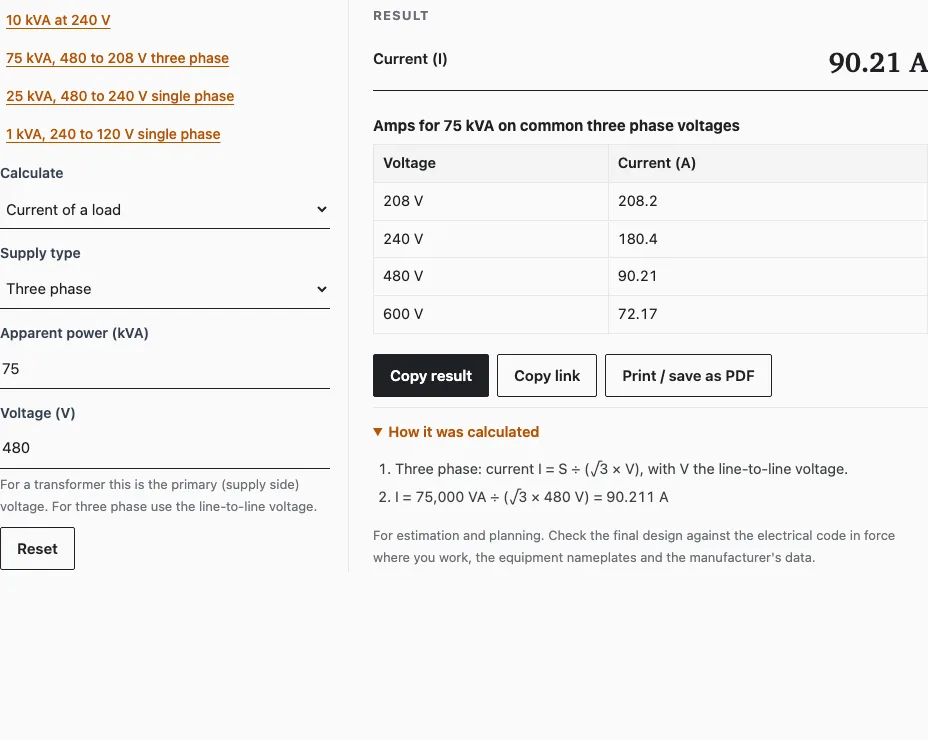
For a balanced three phase supply, I = kVA × 1,000 ÷ (√3 × V), with V the line-to-line voltage and √3 about 1.732. A 75 kVA load at 480 V gives 75,000 ÷ (1.732 × 480) = 90.21 A. Using the line-to-neutral voltage by mistake would give a current about 1.73 times too low.
The default table for 75 kVA shows how the current changes with the supply voltage:
| Voltage (three phase) | Current |
|---|---|
| 208 V | 208.18 A |
| 240 V | 180.42 A |
| 480 V | 90.21 A |
| 600 V | 72.17 A |
On single phase there is no √3: 10 kVA at 240 V is 10,000 ÷ 240 = 41.67 A.
How do I find transformer full-load amps from kVA?
Divide the rated kVA by the voltage of each winding, using √3 for three phase. The kVA is the same on both sides, so the lower-voltage side carries more current. A 75 kVA transformer from 480 V to 208 V three phase has 90.21 A on the primary and 208.18 A on the secondary.
The calculator then applies the primary-only limits of NEC 450.3(B) for transformers rated 1000 V or less:
- Primary current of 9 A or more: 125 % of it, and the next higher standard rating from NEC 240.6(A) is allowed. For 90.21 A that is 112.76 A, so 125 A.
- Below 9 A: 167 %, rounded down to a standard rating. A 1 kVA, 240 V primary draws 4.167 A, giving 6.958 A and a 6 A device.
- Below 2 A: 300 %, rounded down. A 0.25 kVA, 240 V primary draws 1.042 A, giving 3.125 A and a 3 A device.
Does power factor affect kVA to amps?
No. kVA is apparent power, so the current follows directly from kVA and voltage without a power factor. The power factor matters only when you start from real power in kW, because kVA equals kW divided by the power factor. That is why this calculator has no power factor box.
Worked examples
| Input | Result |
|---|---|
| 10 kVA, 240 V, single phase | 41.67 A |
| 50 kVA, 208 V, three phase | 138.8 A |
| 75 kVA, 480/208 V, three phase | 90.21 A / 208.2 A, max OCPD 125 A |
| 25 kVA, 480/240 V, single phase | 52.08 A / 104.2 A, max OCPD 70 A |
| 1 kVA, 240/120 V, single phase | 4.167 A / 8.333 A, max OCPD 6 A |
Calculated by the tool above; open it with the same values to see each step.
Questions, briefly answered
What is 1 kVA in amps?
On single phase, 1 kVA is 4.167 A at 240 V and 8.333 A at 120 V. On a 480 V three phase supply it is 1.203 A.
How many kVA is 30 amps?
At 240 V single phase, 30 A is 7.2 kVA; on a 240 V three phase supply it is 12.47 kVA. Multiply volts by amps (and by √3 on three phase), then divide by 1,000.
How much is 300 amps in kVA?
At 240 V single phase, 300 A is 72 kVA. At 480 V three phase, 300 A is 249.42 kVA.
Can I use kVA to amps to size a breaker?
Only as a starting point. In transformer mode the tool gives the largest primary device for primary-only protection under NEC 450.3(B), and it warns that secondary protection, taps, motor loads and local rules can change the answer.
Why does the tool warn about a step-up transformer?
If the secondary voltage is higher than the primary, the primary carries the larger current. A 5 kVA transformer from 120 V to 240 V draws 41.67 A on the primary and 20.83 A on the secondary.
What voltage should I enter for a three phase transformer?
Enter line-to-line voltages for both windings, such as 480 V primary and 208 V secondary. A 208Y/120 V secondary has 120 V from each line to neutral, but the formula needs the 208 V value. With 75 kVA that gives 208.18 A per line.
Related tools
- Transformer Sizing Calculator: choose a transformer kVA for a load.
- kVA to kW Calculator: convert apparent power to real power with a power factor.
- kW to Amps Calculator: start from real power in kW instead.
- Amps to kW Calculator: turn a current into kW, kVA and kvar.
- Three Phase Power Calculator: work through a three phase load in detail.
- Generator Size Calculator: add up loads to pick a generator kVA.
- Wire Size Calculator: pick a conductor for the current you found.
- Motor, transformer and generator calculators: all sizing tools in one list.