kVA to kW Calculator
Multiply kVA by the power factor to get kW, or go back from kW to kVA, and see the kvar on a power triangle.
Free · runs in your browser · nothing is uploaded
Recent
Your last 10 settings, saved only in this browser. Nothing is uploaded.
How to use the kVA to kW Calculator
- In Convert, keep “kVA to kW”, or choose “kW to kVA” to work the other way.
- Type the value into Apparent power (kVA), such as a generator or transformer rating. In the reverse mode this box becomes Real power (kW).
- Enter the Power factor (PF), a number above 0 and no more than 1. Use the nameplate or a measured value when you have one; the example values are planning figures only.
- Read Real power (P), or Apparent power (S) in the reverse mode.
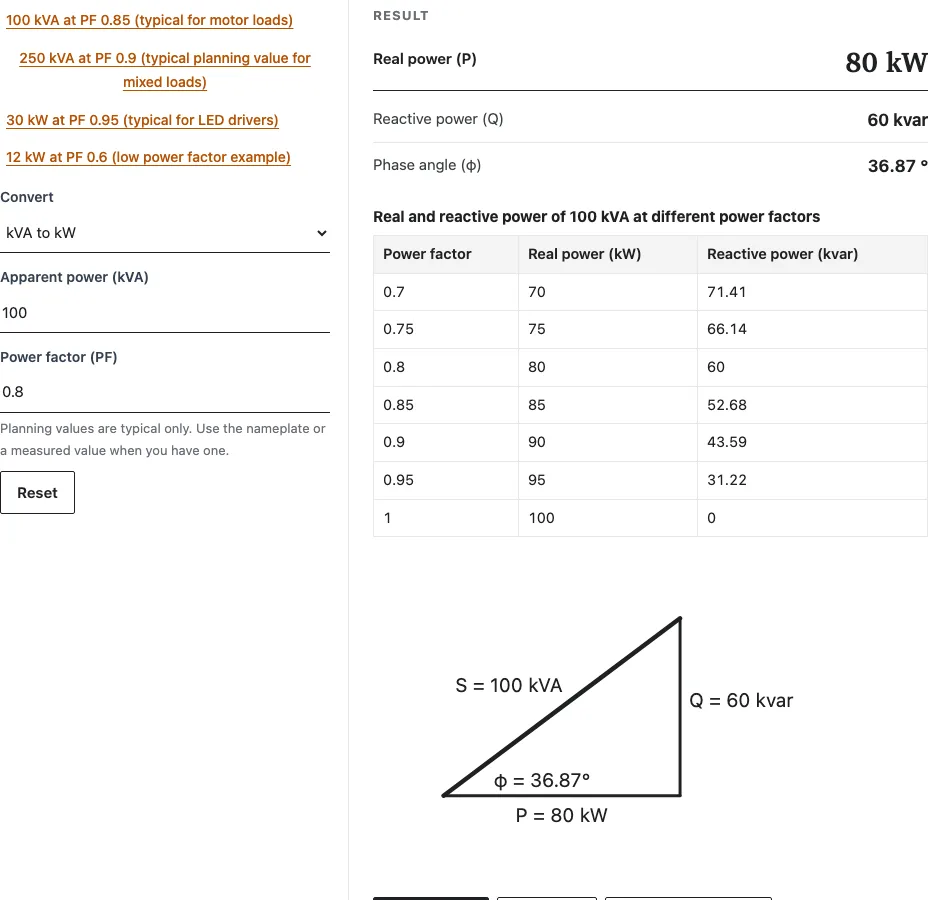
- Check Reactive power (Q) and Phase angle (φ), and look at the power triangle drawn beside the result.
- Open “How it was calculated” to see each step, for example P = 100 kVA × 0.8 = 80 kW, Q = 60 kvar and φ = 36.87°.
- Read any warning. A power factor of 1 brings a note that kW then equals kVA, and a value below 0.5 is flagged as unusually low.
Four example buttons load common cases, such as “100 kVA at PF 0.85 (typical for motor loads)” and “12 kW at PF 0.6 (low power factor example)”. “Copy result” and “Copy link” copy the figures or a link with your inputs, “Print / save as PDF” prints them, and Reset restores the defaults.
Changing any field updates the result rows, the steps and the tables straight away, and Copy link keeps your exact inputs in the address so you can share or reopen the calculation.
How do I convert kVA to kW?
Real power is the apparent power scaled by how well the load uses it, so kW = kVA × PF. Because the power factor is never more than 1, the kW figure is never larger than the kVA. To go back, divide: kVA = kW ÷ PF. A 500 kVA rating with a power factor of 0.9 gives 450 kW.
- Take the kVA from the rating plate or the load you must supply.
- Find the power factor, ideally from a nameplate or a meter reading.
- Multiply: 100 kVA × 0.8 = 80 kW.
- In reverse, divide: a 45 kW load at 0.85 needs 45 ÷ 0.85 = 52.94 kVA.
The table under the result shows how much the power factor changes the answer for 100 kVA:
| Power factor | Real power (kW) | Reactive power (kvar) |
|---|---|---|
| 0.7 | 70 | 71.41 |
| 0.8 | 80 | 60 |
| 0.85 | 85 | 52.68 |
| 0.9 | 90 | 43.59 |
| 0.95 | 95 | 31.22 |
| 1 | 100 | 0 |
What is the difference between kVA and kW?
kVA is apparent power: volts times amps, the total the supply and cables must carry. kW is real power, the part that becomes heat, light or shaft work. The ratio kW ÷ kVA is the power factor. Equipment such as generators and transformers is rated in kVA, because its current limit depends on kVA and not on kW.
The difference is reactive power, measured in kvar. Motors and transformers need it to build their magnetic fields, and it flows back and forth without doing work. The three values form a right triangle, with kVA as the long side: S² = P² + Q².
What is reactive power (kvar)?
Reactive power is the side of the power triangle that does no real work: Q = √(kVA² − kW²). For 100 kVA at PF 0.8 it is √(100² − 80²) = 60 kvar. The phase angle between voltage and current, arccos(0.8) = 36.87°, describes the same triangle in degrees.
A lower power factor means a steeper triangle. At 0.6 the angle is 53.13°, and 12 kW of real power comes with 16 kvar of reactive power. Raising the power factor with capacitors shrinks the kvar side, which is what power factor correction does.
Worked examples
| Input | Result |
|---|---|
| 100 kVA, PF 0.8 | 80 kW |
| 500 kVA, PF 0.9 | 450 kW |
| 45 kW, PF 0.85 | 52.94 kVA |
| 120 kW, PF 0.95 | 126.3 kVA |
Calculated by the tool above; open it with the same values to see each step.
Questions, briefly answered
How many kW is 1 kVA?
One kVA equals 1 kW only at a power factor of 1. At PF 0.8, 1 kVA is 0.8 kW.
What is 20 kVA in kW?
With a power factor of 0.8, 20 kVA is 16 kW; with 0.9 it is 18 kW. Enter the power factor of your own load for an exact figure.
How many kVA are in 1 kW?
You need 1 ÷ PF kVA for each kW. At PF 0.8 that is 1.25 kVA, along with 0.75 kvar of reactive power.
Can kVA and kW be the same?
Yes, when the power factor is 1, as with a purely resistive heater. The tool then shows 0 kvar and a note that kW equals kVA.
Why does a low power factor need a bigger kVA rating?
The same real power needs more apparent power. With “kW to kVA”, a 12 kW load with a power factor of 0.6 needs 20 kVA and carries 16 kvar, while the same 12 kW at 0.95 needs only 12.63 kVA.
What power factor should I enter?
Use the value on the nameplate or a measured one. The example buttons carry planning values, such as 0.85 for motor loads and 0.9 for mixed loads, which you can edit.
Why does the tool reject a power factor above 1?
Real power can never exceed apparent power, so the power factor must be greater than 0 and no more than 1. Any other value returns an error instead of a result.
Related tools
- Power Factor Calculator: find the power factor from kW and kVA or volts and amps.
- Power Factor Correction Calculator: size capacitors to raise the power factor.
- kVA to Amps Calculator: turn kVA into current, including transformer full-load amps.
- kW to Amps Calculator: find the current of a kW load.
- Generator Size Calculator: add up loads to choose a generator.
- Transformer Sizing Calculator: pick a transformer kVA for a load.
- Amps to kW Calculator: get kW, kVA and kvar from a measured current.
- Power conversion calculators: every power and current converter on the site.