kW to Amps Calculator
Enter kilowatts, voltage and power factor to get the current, or use motor shaft kW with its efficiency.
The breaker shown is the next standard rating (NEC 240.6(A)) at 125 % of a continuous load; motors are sized from the NEC motor tables instead. Free, runs in your browser. Verify with your local code and a licensed electrician before you install.
Recent
Your last 10 settings, saved only in this browser. Nothing is uploaded.
How to use the kW to Amps Calculator
- In The kW is, choose “The electrical load (input power)” for heaters, chargers and most loads, or “Motor shaft output” for a motor nameplate rating.
- Pick the Supply type: “Single phase AC”, “Three phase AC” or “DC”.
- Type the Power (kW), for example 5 for a 5,000 W load.
- Enter the Voltage (V). For three phase, use the line-to-line voltage such as 208 or 480.
- Set the Power factor (PF): 1 for heaters, roughly 0.8 to 0.9 for motors. DC hides this box.
- In motor mode, enter Motor efficiency (%) from the nameplate; industrial motors are typically 85 to 95 %.
- Under “More options”, tick Continuous load (runs 3 hours or more) when the load stays on that long.
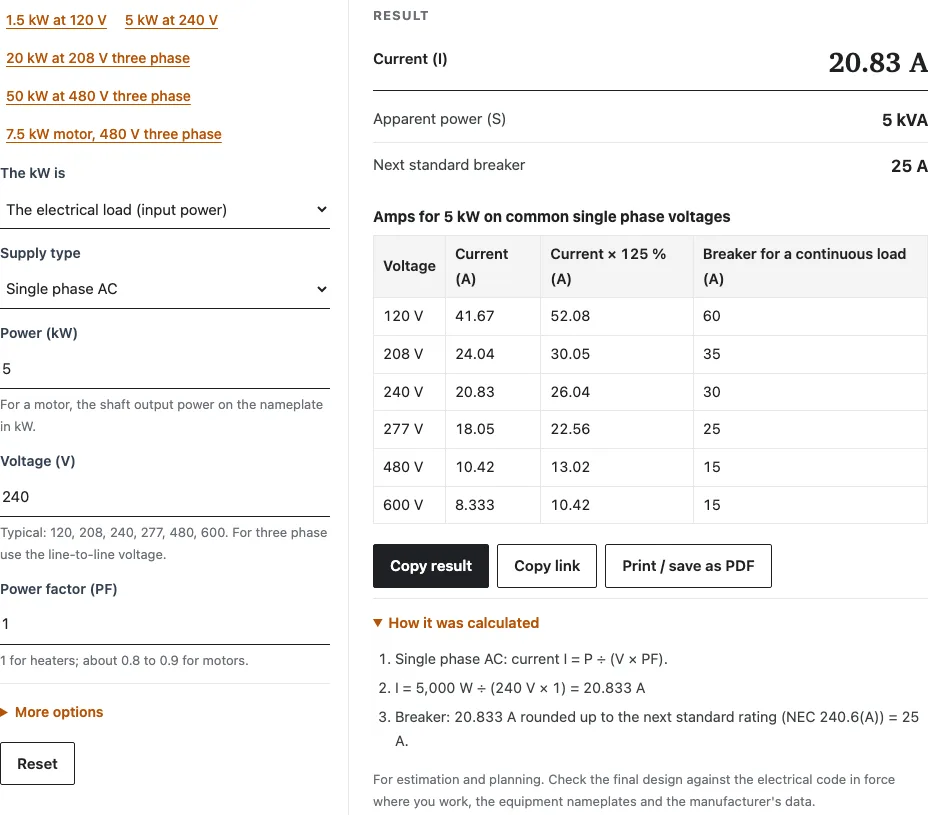
- Read Current (I), then Apparent power (S), Current at 125 % and Next standard breaker. In motor mode Electrical input power appears as well, and no breaker is suggested, because motor protection is sized from the NEC motor tables (use the HP to Amps Calculator).
Five example buttons, from “1.5 kW at 120 V” to “7.5 kW motor, 480 V three phase”, fill in the form. “Copy result” and “Copy link” copy the answer or a link with your inputs, “Print / save as PDF” prints it, and Reset restores the defaults.
Changing any field updates the result rows, the steps and the tables straight away, and Copy link keeps your exact inputs in the address so you can share or reopen the calculation.
What is the kW to amps formula?
Turn kilowatts into watts, then divide. DC uses I = P ÷ V. On a single phase AC supply, divide by volts times power factor, I = P ÷ (V × PF). Three phase AC uses I = P ÷ (√3 × V × PF), where V is the line-to-line voltage. The calculator then rounds the current up to the next standard breaker rating listed in NEC 240.6(A).
- Convert: 5 kW × 1,000 = 5,000 W.
- Divide: 5,000 W ÷ (240 V × 1) = 20.833 A.
- Round up: the next standard breaker is 25 A.
- Continuous load: 20.833 A × 125 % = 26.04 A under NEC 210.20(A), so the breaker becomes 30 A.
For a motor, divide the shaft output by the efficiency first. A 7.5 kW motor at 90 % takes 8.333 kW of electrical input, which at 480 V three phase and PF 0.85 is 11.79 A. The tool then warns that motor circuits are sized from the code’s motor full-load current tables, not from this figure.
How many amps is 1 kW?
On single phase with a power factor of 1, 1 kW draws 8.333 A at 120 V and 4.167 A at 240 V. On a three phase supply the current per line is lower, because the √3 factor spreads the load: 1 kW at 480 V draws 1.203 A. A lower power factor raises every value.
| Supply | Voltage | Current for 1 kW |
|---|---|---|
| Single phase, PF 1 | 120 V | 8.333 A |
| Single phase, PF 1 | 240 V | 4.167 A |
| Single phase, PF 0.8 | 240 V | 5.208 A |
| Three phase, PF 1 | 208 V | 2.776 A |
| Three phase, PF 1 | 480 V | 1.203 A |
How many amps is 10 kW?
At 240 V single phase with a power factor of 1, 10 kW draws 41.67 A, and the next standard breaker is 45 A. On 120 V the same 10 kW draws 83.33 A. Large loads like this are usually put on 240 V or three phase circuits because the current is so much lower.
The table under the result shows the same comparison for any power you enter, with the current, the current at 125 % and the breaker for a continuous load on each voltage.
Worked examples
| Input | Result |
|---|---|
| 5 kW, 240 V, single phase, PF 1 | 20.83 A |
| 1.5 kW, 120 V, single phase, PF 1 | 12.5 A |
| 7.5 kW shaft, 90 %, 480 V, three phase, PF 0.85 | 11.79 A |
| 50 kW, 208 V, three phase, PF 0.9 | 154.2 A |
| 2 kW, 48 V, DC | 41.67 A |
Calculated by the tool above; open it with the same values to see each step.
Questions, briefly answered
What is 5 kW in amps?
At 240 V single phase with PF 1, 5 kW is 20.83 A, the calculator’s default. At 120 V it is 41.67 A, and at 208 V it is 24.04 A.
How many kW equal 1 amp?
One amp carries 0.12 kW at 120 V and 0.24 kW at 240 V with a power factor of 1. On AC with a lower power factor, the real power per amp is smaller.
How many amps make 1 kWh?
Amps cannot be turned into kWh directly, because kWh is energy over time. You need the voltage and the hours as well: 10 A at 230 V with PF 1 for one hour is 2.3 kWh.
Why does power factor matter?
A load with a power factor below 1 draws more current for the same real power. For example, 50 kW at 208 V three phase with PF 0.9 draws 154.2 A, and the apparent power is 55.56 kVA.
Is a kilowatt the same as an amp?
No. A kilowatt is a unit of power and an amp is a unit of current. Voltage links the two, which is why the calculator needs it.
Should I size a motor breaker from this result?
No. The calculated current is a planning figure. For motors, the tool itself warns that the branch circuit and its protection come from the code’s motor full-load current tables and rules.
Related tools
- Amps to kW Calculator: reverse the conversion and see kVA and kvar.
- Watts to Amps Calculator: start from watts or horsepower instead of kW.
- HP to Amps Calculator: estimate motor current from horsepower.
- kVA to Amps Calculator: convert kVA ratings, including transformers.
- kVA to kW Calculator: convert between kVA and kW with the power factor.
- Three Phase Power Calculator: check a three phase load in more detail.
- Wire Size Calculator: choose the conductor for the current you found.
- Power conversion calculators: every power and current converter on the site.