kW to HP Converter
Convert kilowatts to horsepower with the definition you need, or turn motor output kW into input kW with efficiency.
Free · runs in your browser · nothing is uploaded
Recent
Your last 10 settings, saved only in this browser. Nothing is uploaded.
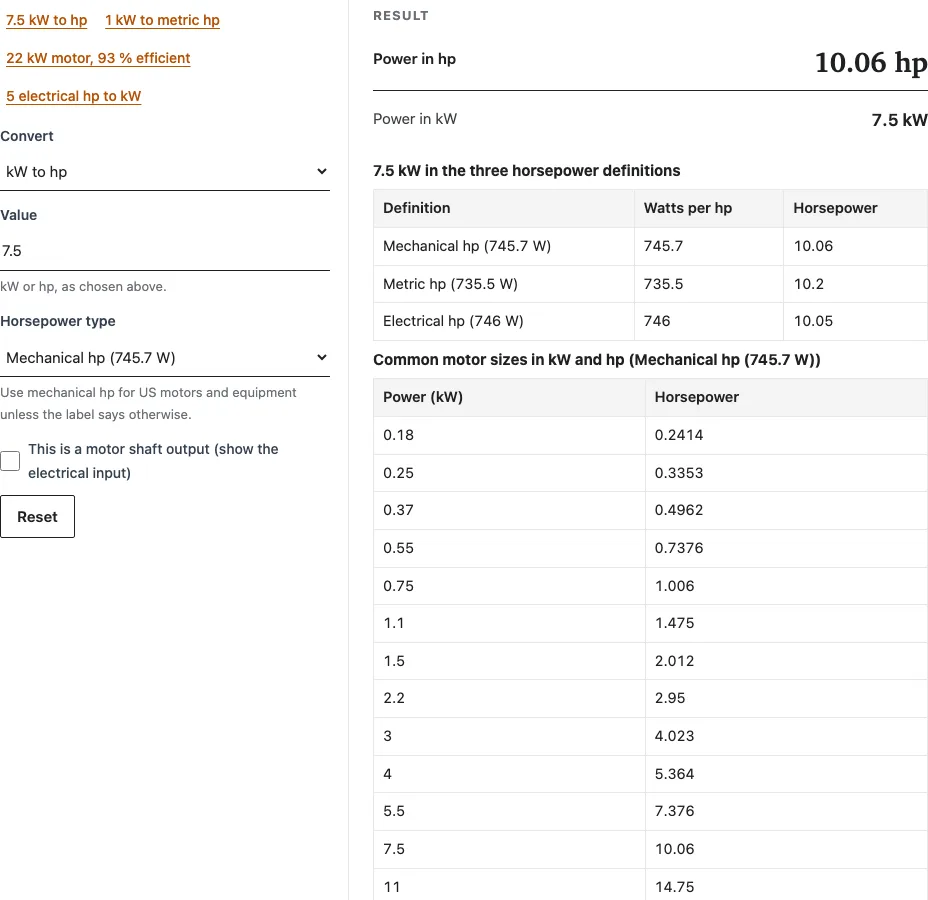
How to use the kW to HP Converter
- In Convert, keep “kW to hp”, or choose “hp to kW” if you start from horsepower.
- Type the number into Value. It is read as kW or hp, depending on the choice above.
- Pick the Horsepower type: “Mechanical hp (745.7 W)”, “Metric hp (735.5 W)” or “Electrical hp (746 W)”. Use mechanical for US motors and equipment unless the label says otherwise.
- If the number is a motor’s shaft output, tick This is a motor shaft output (show the electrical input).
- Enter the Motor efficiency (%) from the nameplate. The box appears only after the tick.
- Read Power in hp (or Power in kW in the reverse mode). With the motor box ticked, Electrical input power and Electrical input in hp are added.
- Look at the two tables: your value in all three horsepower definitions, and 26 common motor sizes from 0.18 kW to 200 kW.
Four example buttons load cases such as “7.5 kW to hp” and “22 kW motor, 93 % efficient”. “Copy result” copies the answer, “Copy link” copies a link with your inputs, “Print / save as PDF” prints it, and Reset brings back the defaults.
Changing any field updates the result rows, the steps and the tables straight away, and Copy link keeps your exact inputs in the address so you can share or reopen the calculation.
How do you convert kW to hp?
Multiply the kilowatts by 1,000 to get watts, then divide by the watts in one horsepower. For mechanical horsepower that number is 745.69987 W, which makes 1 kW equal to 1.341 hp. A 7.5 kW motor works out to 7,500 ÷ 745.69987 = 10.058 hp, and a 22 kW motor to 29.5 hp.
- Write the power in kW, for example 7.5.
- Multiply by 1,000: 7,500 W.
- Divide by the watts per hp of the definition you need.
- Round as needed. The tool shows 10.06 hp for this input.
To go from hp to kW, reverse the steps: multiply the horsepower by the watts per hp and divide by 1,000. One mechanical hp is 0.7457 kW.
How many kW are in 1 hp?
One mechanical horsepower is 0.7457 kW (745.7 W). A metric horsepower is 0.7355 kW, and an electrical horsepower is 0.746 kW. The three are within about 1.4 % of each other, but the gap matters when you compare a European engine rating with a US motor.
The tool’s table for 1 kW and 7.5 kW shows how far apart they are:
| Definition | Watts per hp | hp in 1 kW | hp in 7.5 kW |
|---|---|---|---|
| Mechanical hp | 745.69987 | 1.341 | 10.058 |
| Metric hp | 735.49875 | 1.360 | 10.197 |
| Electrical hp | 746 | 1.340 | 10.054 |
Whichever definition you use, a kilowatt is the larger unit: 1 kW is about one and a third horsepower, so a motor’s hp figure is always higher than its kW figure.
What does a kW to hp conversion table show?
A conversion table lists standard motor sizes in kW next to their horsepower. The table under the result covers 26 sizes from 0.18 kW to 200 kW in the definition you picked. A few rows in mechanical hp, as the tool computes them:
| Motor size (kW) | Horsepower |
|---|---|
| 0.75 | 1.006 |
| 1.5 | 2.012 |
| 3 | 4.023 |
| 7.5 | 10.058 |
| 15 | 20.115 |
| 37 | 49.618 |
| 75 | 100.58 |
The column changes when you switch the horsepower type, so the same table also works for metric hp.
Worked examples
| Input | Result |
|---|---|
| 7.5 kW, Mechanical hp (745.7 W) | 10.06 hp |
| 1 kW, Metric hp (735.5 W) | 1.36 hp |
| 22 kW, Mechanical hp (745.7 W) | 29.5 hp |
| 5 hp, Electrical hp (746 W) | 3.73 kW |
Calculated by the tool above; open it with the same values to see each step.
Questions, briefly answered
What does kW mean?
kW stands for kilowatt, a unit of power equal to 1,000 watts. Motor nameplates outside the US usually state output in kW, while US nameplates often use hp.
Which horsepower type should I pick?
Use “Mechanical hp (745.7 W)” for US motors and equipment unless the label says otherwise. Choose metric hp when a spec sheet gives PS or CV, and electrical hp only when the document names it.
How does the motor option work?
Tick the motor box and enter the efficiency. The tool divides the shaft output by the efficiency, so a 22 kW motor at 93 % needs 23.66 kW of electrical input, or 31.72 hp.
Can I convert hp back to kW?
Yes. Set Convert to “hp to kW” and enter the horsepower. For example, 5 electrical hp is 3.73 kW.
Why is the kW of a motor different from the power it draws?
The nameplate kW is the mechanical output at the shaft. The motor draws more from the supply because some energy is lost as heat, which is why the efficiency matters.
When do you need to convert kW to hp?
Mostly when two documents use different units, for example a motor rated in kW and a pump or gearbox catalog rated in hp. Converting both to one unit lets you compare them directly.
Why does the tool use 745.69987 W instead of 745.7?
Mechanical horsepower is defined as 550 foot-pounds per second, which is 745.69987 W. The label rounds it to 745.7 W, but the calculation uses the exact figure.
Related tools
- HP to kW Converter: start from horsepower and get kilowatts.
- HP to Amps Calculator: estimate the current of a motor from its horsepower.
- kW to Amps Calculator: find the current of a kW load or motor.
- Watts to Amps Calculator: enter power in W, kW or hp and get amps.
- kVA to kW Calculator: convert apparent power at a power factor.
- Three Phase Power Calculator: work through a three phase motor load.
- Motor, transformer and generator calculators: all motor and sizing tools.
- Power conversion calculators: every power and current converter on the site.