Minimum Circuit Ampacity Calculator
Enter compressor and motor loads to get the MCA, the maximum overcurrent protection, or check a circuit from a nameplate.
Assumes NEC 2023 Article 440 (MCA 125 % of the largest compressor, MOCP 175 % up to 225 %) and NEC 310.16 copper or aluminum in the terminal column you pick; the equipment nameplate MCA and MOCP govern. Free, runs in your browser. Verify with your local code and a licensed electrician before you install.
Recent
Your last 10 settings, saved only in this browser. Nothing is uploaded.
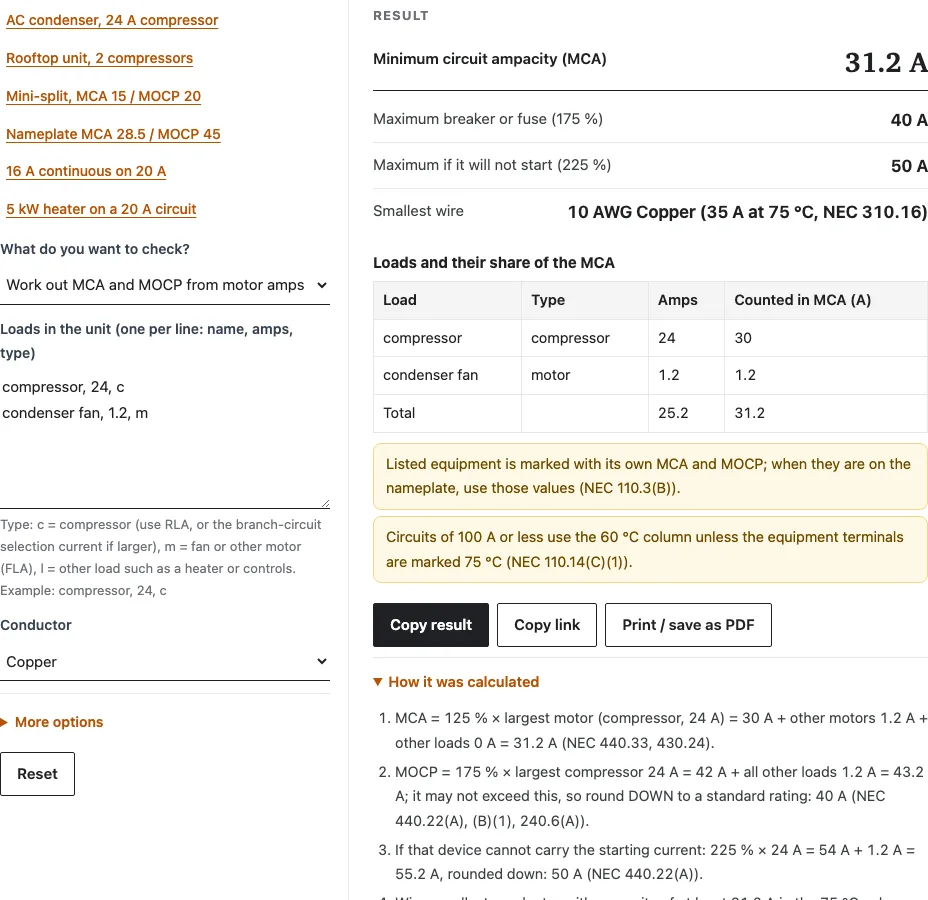
How to use the Minimum Circuit Ampacity Calculator
- Under “What do you want to check?”, pick “Work out MCA and MOCP from motor amps”, “Wire and breaker from the unit’s nameplate” or “Can I run this load on this circuit?”.
- For motor amps, type one load per line in “Loads in the unit (one per line: name, amps, type)”. The type is c for a compressor (RLA), m for a fan or other motor (FLA) or l for another load such as a heater, for example: compressor, 24, c.
- If heaters or other non-motor loads run 3 hours or more, open “More options” and tick “Other (non-motor) loads run 3 hours or more: take them at 125 %”.
- For a nameplate, enter “MCA on the nameplate (A)” and “MOCP / max fuse or breaker on the nameplate (A)”. Add “Breaker you plan to use (A, optional)” for a check.
- For a circuit check, enter “Load current (A)” and “Circuit breaker rating (A)”, and tick “Continuous load (runs 3 hours or more)” when it applies.
- Set “Conductor” to Copper or Aluminum. Under “More options”, the “Ampacity column (terminal / insulation rating)” defaults to 75 °C; pick 60 °C if the terminals are not marked 75 °C.
- Read the result rows, steps and warnings.
Example buttons such as “AC condenser, 24 A compressor” load sample inputs. “Copy result”, “Copy link” and “Print / save as PDF” keep or share the answer, and Reset clears the form.
How do you calculate minimum circuit ampacity?
Minimum circuit ampacity is 125 % of the largest motor or compressor current plus 100 % of every other motor and load in the unit (NEC 440.33, 430.24). Use the compressor’s rated-load amps, or its branch-circuit selection current when that is larger, and the full-load amps of each fan. The supply wire needs at least this ampacity.
- List each load with its amps and type.
- Multiply the largest motor current by 1.25.
- Add the other motors and loads at 100 %. Non-motor loads that run 3 hours or more count at 125 % (NEC 210.19(A)(1)).
- Pick the smallest conductor whose NEC 310.16 ampacity in the chosen column is at least the MCA.
With the default inputs, a 24 A compressor and a 1.2 A condenser fan, the tool returns:
| Result | Calculation | Value |
|---|---|---|
| MCA | 125 % × 24 A + 1.2 A | 31.2 A |
| Max breaker or fuse (175 %) | 175 % × 24 A + 1.2 A = 43.2 A, rounded down | 40 A |
| Max if it will not start (225 %) | 225 % × 24 A + 1.2 A = 55.2 A, rounded down | 50 A |
| Copper wire, 75 °C column | at least 31.2 A | 10 AWG (35 A) |
| Copper wire, 60 °C column | at least 31.2 A | 8 AWG (40 A) |
How is MOCP (maximum overcurrent protection) calculated?
MOCP is 175 % of the largest compressor’s current plus the sum of all other loads, rounded down to a standard breaker or fuse rating because the rule sets a ceiling (NEC 440.22(A), (B)(1), 240.6(A)). If a device of that size cannot carry the starting current, the limit may be raised to 225 %.
For a rooftop unit with two 16.3 A compressors, two 3.5 A condenser fans, a 10.9 A supply fan and a 5.5 A power exhaust, the tool gives an MCA of 60.075 A (6 AWG copper, 65 A at 75 °C). The 175 % sum is 68.225 A, rounded down to 60 A; at 225 % it is 76.375 A, rounded down to 70 A. Because 60 A is below the MCA, the tool warns you to use the MOCP marked by the manufacturer.
The tool calculates no MOCP when no compressor is entered, or when a fan or other motor is larger than the largest compressor (NEC 440.22(B)(2)). Use the nameplate in those cases.
What is the difference between MCA and MOP?
MCA is the minimum ampacity of the wire that feeds the unit, while MOP (also written MOCP) is the largest fuse or breaker allowed to protect it. The wire must be rated at least the MCA, and the breaker must not be above the MOP. A standard breaker between the two values passes the tool’s check.
| Nameplate MCA / MOCP | Breaker you plan to use | Tool’s answer |
|---|---|---|
| 15 A / 20 A | 15 A | Yes, 14 AWG copper |
| 28.5 A / 45 A | 40 A | Yes, 10 AWG copper (NEC 240.4(G) allows it) |
| 28.5 A / 45 A | 25 A | Allowed, but below the MCA, so it may trip in normal use |
| 28.5 A / 45 A | 50 A | No: above the 45 A marked on the unit |
Worked examples
| Input | Result |
|---|---|
| 2 loads from the unit | MCA 31.2 A, max breaker 40 A |
| 6 loads from the unit | MCA 60.08 A, max breaker 60 A |
| 2 loads from the unit | MCA 23.4 A, max breaker 30 A |
| Nameplate MCA 28.5 A, MOCP 45 A | 10 AWG Copper (35 A at 75 °C, NEC 310.16) |
| 16 A load on a 20 A circuit | Yes: 16 A is within the 16 A that a 20 A circuit may carry. |
Calculated by the tool above; open it with the same values to see each step.
Questions, briefly answered
What does MCA mean on an AC unit?
MCA stands for minimum circuit ampacity: the smallest ampacity the branch-circuit wires feeding the unit may have. Nameplates print it as “Min. circuit ampacity” or “Minimum circuit amps”.
Can I run 12 amps on a 15 amp circuit?
Yes. Even for a continuous load, a 15 A breaker may carry 80 %, which is 12 A, and the tool suggests 14 AWG copper. A non-continuous load may use the full 15 A.
Can I use a breaker smaller than the MOP?
Yes, the MOP is a maximum, not a target. A breaker below the MCA, though, may trip in normal use; the nameplate mode flags this when you fill in “Breaker you plan to use (A, optional)”.
Should I use the nameplate values or calculate them?
Use the nameplate. Listed equipment is marked with its own MCA and MOCP, and NEC 110.3(B) requires following those markings. Calculate from motor amps only when the marked values are missing or unreadable.
Why does the 60 °C column give a bigger wire?
Circuits of 100 A or less use the 60 °C column unless the equipment terminals are marked 75 °C (NEC 110.14(C)(1)). For a 31.2 A MCA that means 8 AWG copper instead of 10 AWG.
Why can the breaker be larger than the wire’s ampacity?
Air-conditioning and refrigeration conductors protected under Article 440 are exempt from the usual small-conductor limits (NEC 240.4(G)). A 40 A breaker on 10 AWG copper is therefore accepted when the nameplate MOCP allows 40 A.
Related tools
- HP to Amps Calculator: find a motor’s full-load current from its horsepower.
- Wire Ampacity Calculator: see how many amps a given wire size can carry.
- Wire Size Calculator: size a conductor for any load, including voltage drop.
- Wire Size for 30 Amp Circuit: check the usual wire for a 30 A condenser circuit.
- Voltage Drop Calculator: check a long run to an outdoor unit.
- Electrical Load Calculator: add a new AC unit to a whole-house load.
- Generator Size Calculator: see whether a generator can start the unit.
- Motor, Transformer and Generator Calculators: browse the other motor tools.