Ohms Law Calculator
Enter any two of voltage, current, resistance and power to get the other two, with series and parallel resistors.
Free · runs in your browser · nothing is uploaded
Recent
Your last 10 settings, saved only in this browser. Nothing is uploaded.
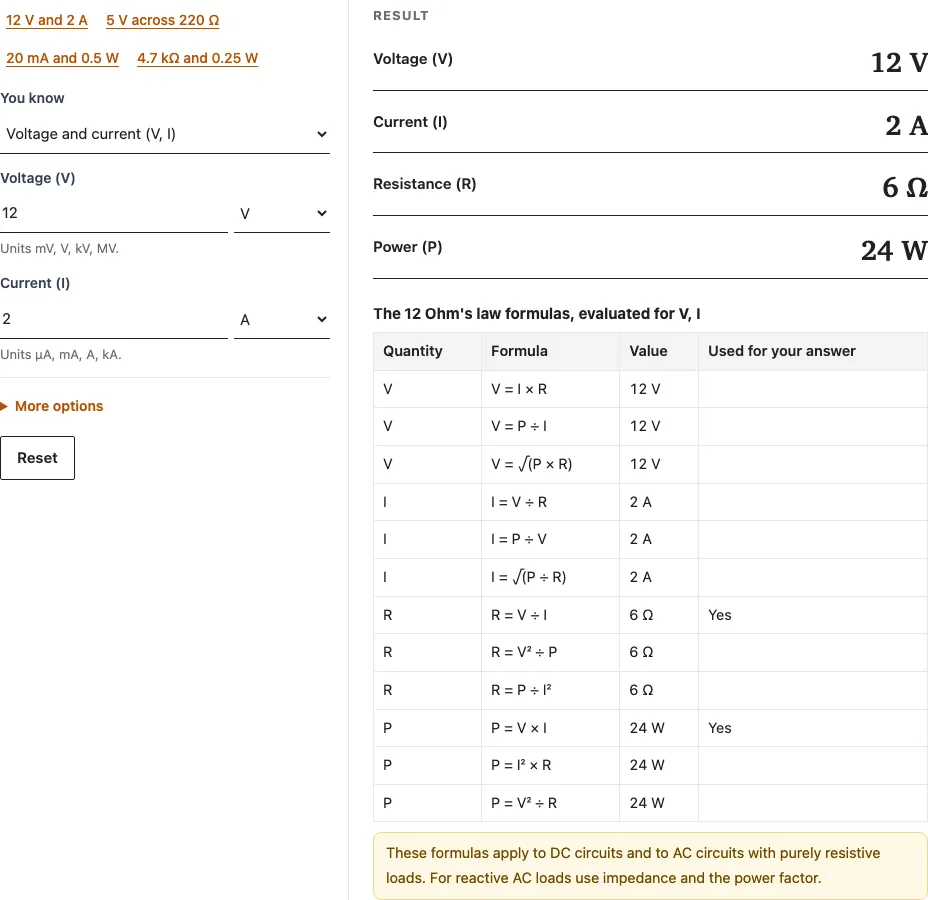
How to use the Ohm’s Law Calculator
Only the two boxes that match your chosen pair are shown.
- Open You know and pick your pair: Voltage and current (V, I), Voltage and resistance (V, R), Voltage and power (V, P), Current and resistance (I, R), Current and power (I, P) or Resistance and power (R, P).
- Type the first value and choose its unit beside it. Voltage (V) offers mV, V, kV and MV; Current (I) offers µA, mA, A and kA.
- Type the second value and its unit. Resistance (R) offers mΩ, Ω, kΩ and MΩ, and Power (P) offers mW, W, kW and MW.
- Read the four result rows, Voltage (V), Current (I), Resistance (R) and Power (P).
- For a resistor network, open Resistors for series and parallel (optional) and type up to 8 values separated by commas or spaces, such as 100, 4.7k, 1M. The Series resistance and Parallel resistance rows appear; they do not change the V, I, R and P answer above them.
- Read the steps and the formula table under the result to see which equations produced each number.
Example buttons (“12 V and 2 A”, “5 V across 220 Ω”, “20 mA and 0.5 W”, “4.7 kΩ and 0.25 W”) fill the form in one click. Copy result and Copy link share the answer, Print / save as PDF keeps a copy, and Reset goes back to the defaults.
What is the formula for Ohm’s law?
Ohm’s law says that the voltage across a resistance equals the current through it times the resistance: V = I × R. Rearranged, current is I = V ÷ R and resistance is R = V ÷ I. Combined with the power law P = V × I, it links all four quantities.
Each of the four quantities can be written three ways, which makes 12 formulas in total:
| Quantity | Formula 1 | Formula 2 | Formula 3 |
|---|---|---|---|
| Voltage V | I × R | P ÷ I | √(P × R) |
| Current I | V ÷ R | P ÷ V | √(P ÷ R) |
| Resistance R | V ÷ I | V² ÷ P | P ÷ I² |
| Power P | V × I | I² × R | V² ÷ R |
The table under the tool shows every formula with its value for your inputs. Georg Simon Ohm described the relationship between voltage, current and resistance in 1827.
How do I calculate Ohm’s law?
Pick the formula that contains the unknown value and the two values you already know, convert prefixes to base units, then multiply or divide. For 9 V and 15 mA, resistance is 9 ÷ 0.015 = 600 Ω and power is 9 × 0.015 = 0.135 W, or 135 mW.
The same steps work for any pair:
- Convert the prefixes: 15 mA is 0.015 A, 4.7 kΩ is 4,700 Ω and 0.5 W stays 0.5 W.
- Find the missing quantity with the matching formula. For a 120 V heater rated 1,500 W, I = P ÷ V = 12.5 A.
- Find the last one with the result: R = V² ÷ P = 9.6 Ω for the same heater.
- Check the answer with a second formula. 12.5 A × 9.6 Ω gives back 120 V.
Some pairs need a square root. A 4.7 kΩ resistor rated 0.25 W reaches its power limit at √(0.25 × 4,700) = 34.278 V, with 7.2932 mA flowing through it.
How do you calculate series and parallel resistance?
Resistors in series add: R = R1 + R2 + R3. Resistors in parallel combine through their reciprocals: 1/R = 1/R1 + 1/R2 + 1/R3. A series total is always larger than the largest resistor, and a parallel total is always smaller than the smallest one.
Results from the optional resistor box:
| Resistors entered | Series | Parallel |
|---|---|---|
| 100, 220, 470 Ω | 790 Ω | 59.977 Ω |
| 1k, 2.2k, 1M | 1.0032 MΩ | 687.03 Ω |
In the second row the 1 MΩ resistor dominates the series total but hardly changes the parallel one, which stays close to the value of 1 kΩ and 2.2 kΩ alone.
Worked examples
| Input | Result |
|---|---|
| V = 12 V, I = 2 A | R = 6 Ω, P = 24 W |
| V = 5 V, R = 220 Ω | I = 22.727 mA, P = 113.64 mW |
| I = 20 mA, P = 0.5 W | V = 25 V, R = 1.25 kΩ |
| R = 4.7 kΩ, P = 0.25 W | V = 34.278 V, I = 7.2932 mA |
| V = 9 V, I = 15 mA | R = 600 Ω, P = 135 mW |
Calculated by the tool above; open it with the same values to see each step.
Questions, briefly answered
What is 1 Ω equal to?
One ohm is the resistance that lets 1 ampere flow when 1 volt is applied, so 1 Ω = 1 V ÷ 1 A. A kilohm is 1,000 Ω and a megohm is 1,000,000 Ω.
Does Ohm’s law apply to AC or DC circuits?
The formulas here hold for DC circuits and for AC circuits with purely resistive loads such as heaters. Motors, coils and capacitors need impedance and power factor, and the tool prints that reminder with every result.
How much current flows through a 220 Ω resistor at 5 V?
I = 5 ÷ 220 = 22.727 mA, and the resistor dissipates 113.64 mW. Choose Voltage and resistance (V, R) to get both values.
What are the Ohm’s law formulas for three-phase circuits?
Each phase still obeys V = I × R, but total three-phase power is P = √3 × V × I × PF with line voltage and line current. This calculator uses the single-phase form, so use the three-phase power calculator for those circuits.
How is Ohm’s law used in real life?
It is used to pick a resistor value and power rating, to work out the current a heater or lamp draws, and to check whether a measured resistance matches a reading of volts and amps.
How many formulas does Ohm’s law have?
Twelve once power is included. Voltage, current, resistance and power can each be written from the other quantities in three ways, and the tool shows the formulas it used for your pair.
Related tools
- Ohm’s Law Wheel: to look up the 12 formulas on a wheel and solve from the chart.
- Watts to Amps Calculator: when you know power and voltage of a load.
- Amps to Watts Calculator: to find power from current and voltage.
- Volts to Watts Calculator: to get power from a voltage and current reading.
- Power Factor Calculator: for AC loads that are not purely resistive.
- Three Phase Power Calculator: for three-phase power with the √3 factor.
- Voltage Drop Calculator: to apply Ohm’s law to the resistance of a wire run.
- Power conversion calculators: all power and unit converters.