Ohms Law Wheel
Tap two known quantities on the wheel to see the matching formulas and the other two values calculated.
Free · runs in your browser · nothing is uploaded
Recent
Your last 10 settings, saved only in this browser. Nothing is uploaded.
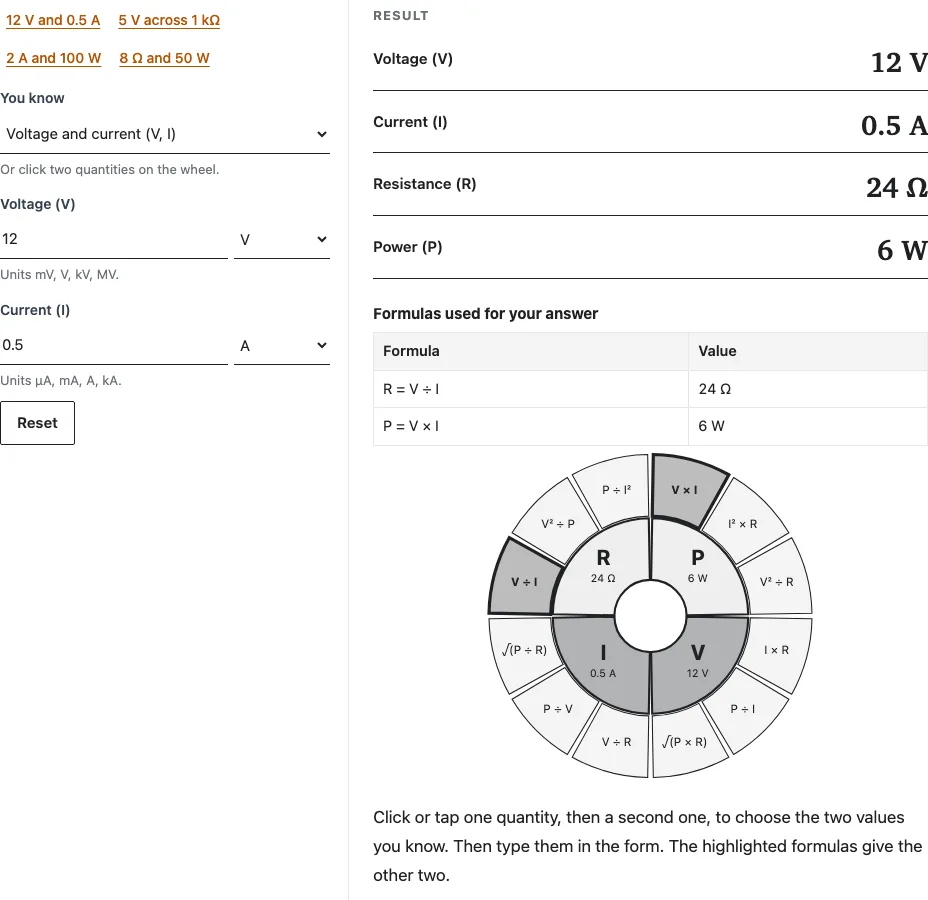
How to use the Ohm’s Law Wheel
You can set the known pair on the wheel or in the form; both stay in step.
- Click or tap one quantity on the inner ring of the wheel, then a second one. The You know menu switches to that pair and the cursor moves to its first box. Clicking the same quantity twice cancels the choice.
- Or open You know directly and pick a pair such as Voltage and current (V, I) or Resistance and power (R, P).
- Type the two values. Voltage (V) takes mV, V, kV or MV; Current (I) takes µA, mA, A or kA; Resistance (R) takes mΩ, Ω, kΩ or MΩ; Power (P) takes mW, W, kW or MW.
- Read Voltage (V), Current (I), Resistance (R) and Power (P) in the results. The same values appear in the inner ring of the wheel.
- Look at the outer ring: the two formulas used for your answer are drawn bold and shaded. The steps and the “Formulas used for your answer” table under the result show them with their numbers.
Four example buttons (“12 V and 0.5 A”, “5 V across 1 kΩ”, “2 A and 100 W”, “8 Ω and 50 W”) load a complete case. Copy result and Copy link share the answer, Print / save as PDF keeps a copy, and Reset returns to the defaults.
How to read the Ohm’s law wheel?
Find the quantity you want in the inner ring, then pick the one formula in its outer sector that uses only the two values you know. The inner ring holds P, V, I and R; each outer sector holds the three formulas that solve for the quantity beside it.
The outer ring prints only the right-hand side of each formula, because the left-hand side is the quantity in the inner ring next to it:
| Inner ring | Formulas in its outer sector |
|---|---|
| V | I × R, P ÷ I, √(P × R) |
| I | V ÷ R, P ÷ V, √(P ÷ R) |
| R | V ÷ I, V² ÷ P, P ÷ I² |
| P | V × I, I² × R, V² ÷ R |
To read a paper wheel by hand:
- Note the two values you have, for example V = 120 V and P = 60 W.
- Go to the sector of the unknown, here I, and choose the formula that uses only V and P: P ÷ V.
- Work it out: 60 ÷ 120 = 0.5 A.
- Repeat for the last unknown. In the R sector, V² ÷ P gives 14,400 ÷ 60 = 240 Ω.
The live wheel does steps 2 to 4 for you and highlights the two formulas it chose.
What are the 3 Ohm’s law formulas?
The three Ohm’s law formulas are V = I × R, I = V ÷ R and R = V ÷ I. They are one relationship rearranged three ways, so any one of voltage, current and resistance can be found from the other two. The other nine formulas on the wheel bring in power.
Examples the tool returns for each of the three:
| Formula | You know | Result |
|---|---|---|
| V = I × R | 2.5 A and 8 Ω | 20 V |
| I = V ÷ R | 5 V and 1 kΩ | 5 mA |
| R = V ÷ I | 12 V and 0.5 A | 24 Ω |
The power formulas follow from P = V × I. Replacing V with I × R gives P = I² × R, and replacing I with V ÷ R gives P = V² ÷ R. That is how a resistor of 8 Ω dissipating 50 W must carry 2.5 A at 20 V.
Worked examples
| Input | Result |
|---|---|
| V = 12 V, I = 0.5 A | R = 24 Ω, P = 6 W |
| V = 5 V, R = 1 kΩ | I = 5 mA, P = 25 mW |
| I = 2 A, P = 100 W | V = 50 V, R = 25 Ω |
| R = 8 Ω, P = 50 W | V = 20 V, I = 2.5 A |
Calculated by the tool above; open it with the same values to see each step.
Questions, briefly answered
What is the Ohm’s law wheel?
It is a chart that arranges the 12 formulas for voltage, current, resistance and power in a circle, three per quantity, so you can find the right equation from any two known values at a glance.
What is 1 Ω equal to?
One ohm is one volt per ampere: 1 V across 1 Ω drives 1 A. A kilohm is 1,000 Ω and a megohm is 1,000,000 Ω, and both are in the Resistance (R) unit list.
Can I use the page without the wheel?
Yes. The You know menu and the value boxes give the same results, and the wheel only changes which pair is selected.
What does a highlighted formula mean?
It is one of the two formulas the tool used for your answer. They are also listed with their values in the “Formulas used for your answer” table.
Does the wheel work for AC circuits?
Only for DC circuits and AC loads that are purely resistive, such as heaters. Motors and other reactive loads need impedance and power factor.
Why are there 12 formulas and not 3?
The three Ohm’s law forms cover V, I and R only. Adding power gives a fourth quantity, and each of the four can be solved from three different pairs.
Related tools
- Ohm’s Law Calculator: adds series and parallel resistance and the full table of all 12 formulas.
- Watts to Amps Calculator: to find current from power and voltage.
- Amps to Watts Calculator: to find power from current and voltage.
- Volts to Watts Calculator: to get power from a voltage reading.
- Power Factor Calculator: for AC loads that are not purely resistive.
- Voltage Drop Calculator: to apply Ohm’s law to the resistance of a wire run.
- Power conversion calculators: all power and unit converters.