Power Factor Calculator
Find the power factor from kW and kVA, from volts, amps and kW, or from the phase angle, with a power triangle.
Free · runs in your browser · nothing is uploaded
Recent
Your last 10 settings, saved only in this browser. Nothing is uploaded.
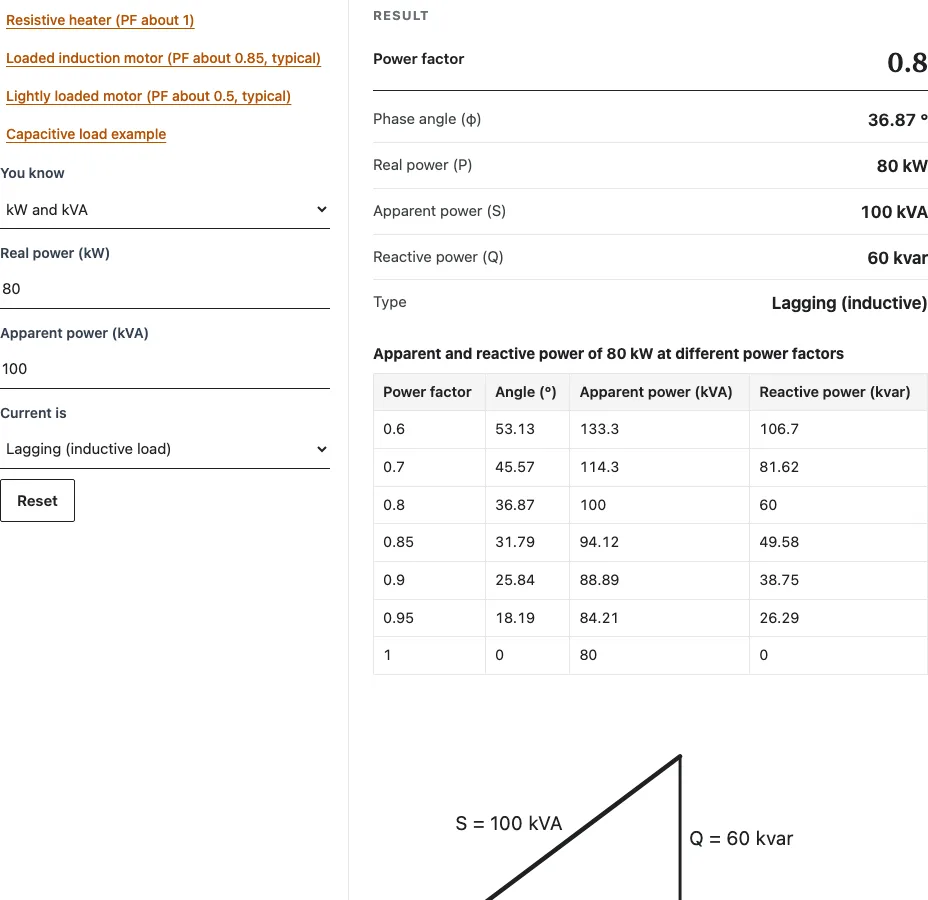
How to use the Power Factor Calculator
- Under You know, pick kW and kVA, Voltage, current and kW, or Phase angle. Only the boxes for that choice are shown.
- Type Real power (kW). It is needed in every mode; with Phase angle it sets the size of the triangle.
- For kW and kVA, add Apparent power (kVA). Real power larger than apparent power is rejected with an error.
- For Voltage, current and kW, set Supply type to Single phase or Three phase, then enter Voltage (V) (line-to-line for three phase) and Current (A). The tool works out kVA as V × I, or √3 × V × I.
- For Phase angle, enter Phase angle φ (degrees), from 0 up to but not including 90.
- Set Current is to Lagging (inductive load) or Leading (capacitive load) to match your load.
- Read Power factor, Phase angle (φ), Real power (P), Apparent power (S), Reactive power (Q) and Type, then the drawn triangle and the steps.
Four example buttons load typical cases: “Resistive heater (PF about 1)”, “Loaded induction motor (PF about 0.85, typical)”, “Lightly loaded motor (PF about 0.5, typical)” and “Capacitive load example”. They are illustrations, not standard values. Copy result and Copy link share the answer, Print / save as PDF keeps a copy, and Reset restores the defaults.
What is the power factor formula?
Power factor is real power divided by apparent power, PF = P ÷ S, with P in kW and S in kVA. It is also the cosine of the phase angle between voltage and current, PF = cos φ. The result has no unit and lies between 0 and 1; 80 kW ÷ 100 kVA gives 0.8.
The three quantities form a right triangle, which is the triangle the tool draws:
- Real power P (kW) is the base: the power that does work.
- Reactive power Q (kvar) is the upright side: Q = √(S² − P²). For 100 kVA and 80 kW, Q = 60 kvar.
- Apparent power S (kVA) is the hypotenuse, and the angle between S and P is φ = arccos(PF), 36.87° at PF 0.8.
On a single-phase circuit S = V × I, so a 240 V, 50 A load has 12 kVA; if it uses 9.6 kW, PF = 9.6 ÷ 12 = 0.8 and Q = 7.2 kvar.
How to calculate PF in 3-phase?
Work out apparent power as √3 × line-to-line voltage × line current, then divide the real power by it: PF = kW × 1,000 ÷ (√3 × V × I). A load drawing 120 A on 480 V has 99.77 kVA, so 80 kW of real power gives a power factor of 0.8019.
Steps the tool prints for that case:
- S = √3 × 480 V × 120 A = 99.766 kVA.
- PF = 80 kW ÷ 99.766 kVA = 0.80188.
- Q = √(99.766² − 80²) = 59.609 kvar, and φ = 36.69°.
Use the line-to-line voltage (480 V, not 277 V) and the current of one line. The formula assumes a balanced load.
How do I convert kW to kVAR?
Divide kW by the power factor to get kVA, then take the square root of kVA² minus kW². Equivalently, kvar = kW × tan(arccos PF). At a power factor of 0.85, 100 kW corresponds to 117.65 kVA and about 61.97 kvar of reactive power.
The table under the tool gives the full picture for 100 kW:
| Power factor | Angle (°) | Apparent power (kVA) | Reactive power (kvar) |
|---|---|---|---|
| 0.6 | 53.13 | 166.67 | 133.33 |
| 0.7 | 45.57 | 142.86 | 102.02 |
| 0.8 | 36.87 | 125 | 75 |
| 0.85 | 31.79 | 117.65 | 61.97 |
| 0.9 | 25.84 | 111.11 | 48.43 |
| 0.95 | 18.19 | 105.26 | 32.87 |
| 1 | 0 | 100 | 0 |
Reactive power falls quickly as the power factor rises: going from 0.8 to 0.95 removes more than half of the kvar.
Worked examples
| Input | Result |
|---|---|
| 80 kW, 100 kVA, Lagging (inductive) | PF 0.8, 60 kvar, φ 36.87° |
| 45 kW, 52.9 kVA, Lagging (inductive) | PF 0.8507, 27.81 kvar, φ 31.72° |
| 240 V, 50 A, 9.6 kW, Lagging (inductive) | PF 0.8, 7.2 kvar, φ 36.87° |
| 25°, 60 kW, Lagging (inductive) | PF 0.9063, 27.98 kvar, φ 25° |
| 208 V, 85 A, 25 kW, Leading (capacitive) | PF 0.8164, 17.68 kvar, φ 35.28° |
Calculated by the tool above; open it with the same values to see each step.
Questions, briefly answered
What is a good power factor?
The closer to 1 the better, because less current carries the same real power. Many facilities aim for about 0.95, but the target that matters is the one in your utility tariff or design brief.
What is the 0.95 power factor?
It means real power is 95 percent of apparent power. A 100 kVA load at PF 0.95 uses 95 kW and carries 31.22 kvar, at a phase angle of 18.19°.
What does a power factor of 0.75 mean?
Real power is 75 percent of apparent power, and the phase angle is 41.41°. A 100 kVA load at 0.75 delivers 75 kW and carries 66.14 kvar, and for the same kW it draws a third more current than at PF 1.
What is the difference between lagging and leading power factor?
Lagging means the current lags the voltage, as in motors, transformers and other inductive loads. Leading means it leads, as in capacitors. The numbers are the same; set Current is to match your load.
What is the power factor unit?
It has none. Power factor is a ratio of two powers, written as a decimal such as 0.85 or as a percentage such as 85 percent.
Why can’t real power be larger than apparent power?
Apparent power is the hypotenuse of the power triangle, so it is always at least as large as real power. The tool shows an error when kW exceeds kVA.
What is the power factor in an AC circuit?
It is the cosine of the angle between the voltage and current waveforms. Purely resistive loads have an angle of 0° and a power factor of 1.
Related tools
- Power Factor Correction Calculator: to size the capacitor kvar that raises PF to a target.
- kVA to kW Calculator: to get real power from kVA and a known PF.
- Three Phase Power Calculator: for kW, kVA and line current of a balanced load.
- kW to Amps Calculator: to see how PF changes the current of a kW load.
- kVA to Amps Calculator: to turn apparent power into current.
- HP to kW Converter: to get motor input kW and kVA from the nameplate.
- Power conversion calculators: all power and unit converters.