Power Factor Correction Calculator
Enter the load and target power factor to get the capacitor kvar, the current reduction and the kVA saved.
Free · runs in your browser · nothing is uploaded
Recent
Your last 10 settings, saved only in this browser. Nothing is uploaded.
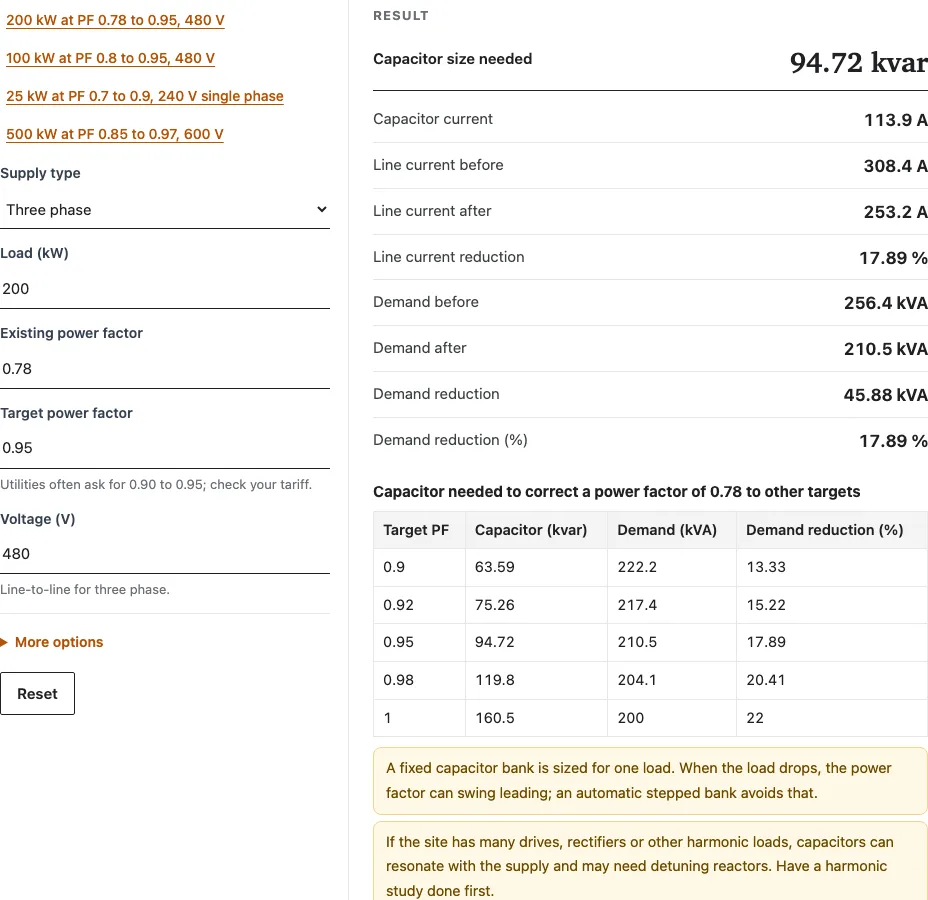
How to use the Power Factor Correction Calculator
- Choose Supply type: Three phase or Single phase.
- Enter Load (kW), the real power of the machine or site at the load you want to correct.
- Enter Existing power factor from a meter, a power quality log or your utility bill, for example 0.78.
- Enter Target power factor. The help text notes that utilities often ask for 0.90 to 0.95. The target must be higher than the existing value and no more than 1, or the tool shows an error.
- Enter Voltage (V), line-to-line for three phase. It sets the capacitor current and the line currents.
- Optionally open Demand charge per kVA per month (optional) and type your own tariff rate. There is no default price; leave it empty to skip the saving.
- Read Capacitor size needed and Capacitor current, then Line current before, Line current after, Line current reduction, Demand before, Demand after, Demand reduction, Demand reduction (%) and, with a rate, Estimated monthly saving.
- Read the warnings, which cover load changes, harmonics and capacitors placed at motors.
Example buttons load four cases, from “200 kW at PF 0.78 to 0.95, 480 V” to “500 kW at PF 0.85 to 0.97, 600 V”. Copy result and Copy link share the numbers, Print / save as PDF keeps a copy, and Reset restores the defaults.
How do you calculate the capacitor size for power factor correction?
Multiply the load in kW by the difference between the tangents of the two phase angles: Qc = P × (tan φ1 − tan φ2), where φ = arccos(PF). The result is the kvar the capacitors must supply. For 200 kW from PF 0.78 to 0.95 that is 200 × (0.80228 − 0.32868) = 94.719 kvar.
The tool’s steps for that case on 480 V three phase:
- tan φ1 = 0.80228 at PF 0.78 and tan φ2 = 0.32868 at PF 0.95.
- Qc = 200 kW × 0.4736 = 94.719 kvar.
- Demand: 200 ÷ 0.78 = 256.41 kVA before, 200 ÷ 0.95 = 210.53 kVA after.
- Line current: 308.41 A before, 253.22 A after, 17.89 percent less.
- Capacitor current: 94,719.5 var ÷ (√3 × 480 V) = 113.93 A.
The higher the target, the more capacitance each extra step costs. For the same 200 kW at PF 0.78:
| Target PF | Capacitor (kvar) | Demand (kVA) | Demand reduction (%) |
|---|---|---|---|
| 0.90 | 63.59 | 222.22 | 13.33 |
| 0.92 | 75.26 | 217.39 | 15.22 |
| 0.95 | 94.72 | 210.53 | 17.89 |
| 0.98 | 119.84 | 204.08 | 20.41 |
| 1 | 160.46 | 200 | 22 |
Going from 0.95 to 1 adds 65.74 kvar for about 4 percent more demand reduction, and correcting all the way to 1 leaves no margin before the power factor turns leading.
Why does low power factor matter?
A low power factor means the same kW needs more kVA, so more current flows in cables, transformers and switchgear. That current heats conductors, uses capacity you could give to other loads, and can raise your bill where the utility charges for kVA demand or for power factor below a set value.
How much the current drops depends only on the ratio of the two power factors, 1 − PF1 ÷ PF2, whatever the voltage:
| Case | Capacitor (kvar) | Line current reduction |
|---|---|---|
| 100 kW, 0.8 to 0.95, 480 V three phase | 42.13 | 15.8 % |
| 25 kW, 0.7 to 0.9, 240 V single phase | 13.4 | 22.2 % |
| 500 kW, 0.85 to 0.97, 600 V three phase | 184.6 | 12.4 % |
With a demand charge of 8 per kVA per month, the 500 kW case removes 72.771 kVA of demand and saves an estimated 582.17 per month in the currency of your tariff.
Worked examples
| Input | Result |
|---|---|
| 200 kW, PF 0.78 → 0.95, 480 V three phase | 94.72 kvar, line current −17.9 % |
| 100 kW, PF 0.8 → 0.95, 480 V three phase | 42.13 kvar, line current −15.8 % |
| 25 kW, PF 0.7 → 0.9, 240 V single phase | 13.4 kvar, line current −22.2 % |
| 500 kW, PF 0.85 → 0.97, 600 V three phase | 184.6 kvar, line current −12.4 % |
Calculated by the tool above; open it with the same values to see each step.
Questions, briefly answered
What is power factor correction in simple terms?
Motors need reactive current that does no useful work but still flows through the supply. Capacitors near the load provide that current locally, so the supply delivers less current for the same output.
Does power factor correction work?
Yes, for current and kVA. In the 200 kW example line current falls by 17.89 percent, while the real power the load uses stays at 200 kW.
Does power factor correction save energy?
It lowers resistive losses in wiring and transformers, which rise with the square of the current, but the load’s own kWh do not change. The main saving is usually in kVA demand or power factor charges.
Which target power factor should I enter?
Use the value in your utility tariff or design brief, often 0.90 to 0.95. Targets close to 1 need much more capacitance and risk a leading power factor when the load drops.
Should I use a fixed or an automatic capacitor bank?
A fixed bank suits a load that stays nearly constant, such as one motor. When the load varies, an automatic stepped bank switches capacitance in and out so the power factor does not swing leading.
Can capacitors cause problems with drives?
Yes. Sites with many variable speed drives, rectifiers or other harmonic loads can see capacitors resonate with the supply. A harmonic study comes first, and the bank may need detuning reactors.
Related tools
- Power Factor Calculator: to find the existing PF from kW and kVA or volts and amps.
- Three Phase Power Calculator: for line current and kVA of the load before and after.
- kVA to kW Calculator: to convert demand in kVA to real power.
- kVA to Amps Calculator: to check current at the corrected kVA.
- Transformer Sizing Calculator: to see how lower kVA changes the transformer you need.
- HP to kW Converter: to get a motor’s input kW and kVA from its nameplate.
- Power conversion calculators: all power and unit converters.