Single Phase vs Three Phase Calculator
Enter one load and see the amps, wire size, voltage drop and copper needed on a single-phase and a three-phase supply.
Assumes stranded copper or aluminum at the conductor temperature you enter and sizes by voltage drop only; check ampacity with the Wire Size Calculator. Free, runs in your browser. Verify with your local code and a licensed electrician before you install.
Recent
Your last 10 settings, saved only in this browser. Nothing is uploaded.
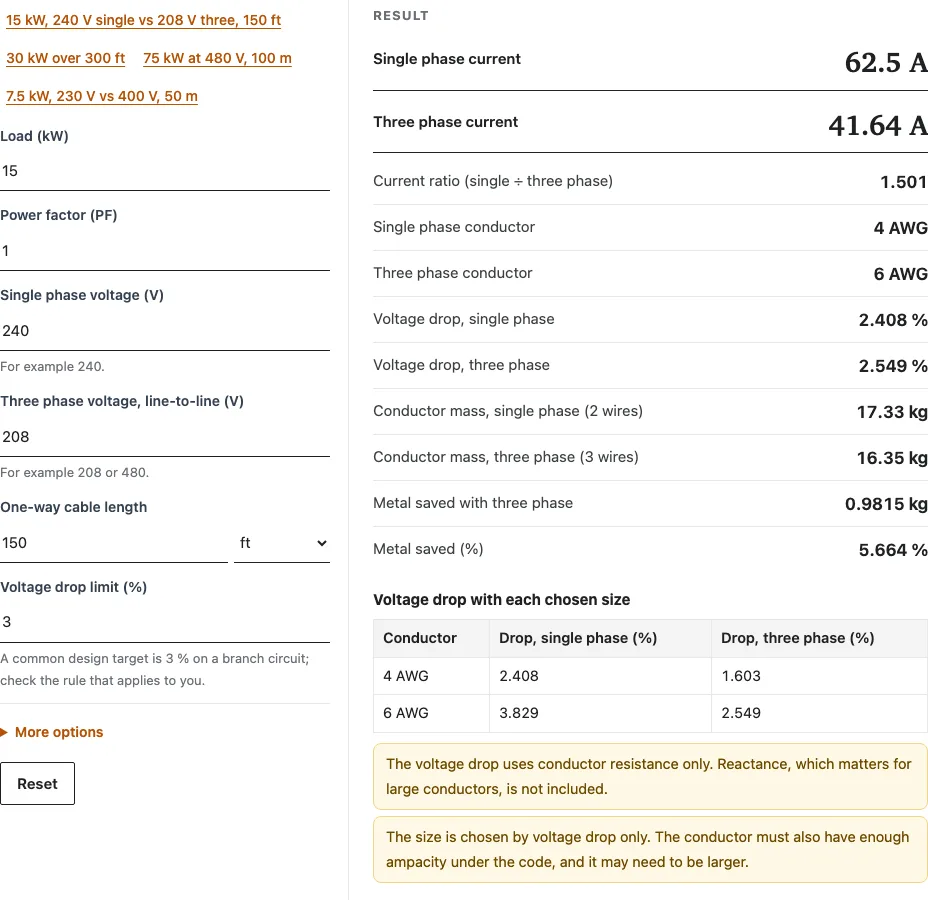
How to use the Single Phase vs Three Phase Calculator
- Type the load into Load (kW) and its Power factor (PF); use 1 for heaters and other resistive loads.
- Enter Single phase voltage (V), for example 240, and Three phase voltage, line-to-line (V), for example 208 or 480.
- Type the One-way cable length and choose ft or m.
- Set Voltage drop limit (%). The help text notes that 3 % on a branch circuit is a common design target.
- Optionally open the advanced fields: Conductor material (Copper or Aluminium), Conductor temperature (°C) for the resistance correction, and Stranded conductor (adds 2 % to resistance).
- Read Single phase current, Three phase current and the Current ratio, then Single phase conductor and Three phase conductor with their voltage drops.
- Compare Conductor mass, single phase (2 wires) with Conductor mass, three phase (3 wires), and read Metal saved with three phase and Metal saved (%). The table “Voltage drop with each chosen size” shows both supplies on both sizes.
Four example buttons load complete cases, from “15 kW, 240 V single vs 208 V three, 150 ft” to “7.5 kW, 230 V vs 400 V, 50 m”. Copy result and Copy link share the comparison, Print / save as PDF keeps a copy, and Reset restores the defaults.
Changing any field updates the results at once.
Is there a difference between a single-phase system and a three-phase system?
Yes. A single-phase system delivers power on one alternating voltage, while a three-phase system uses three voltages a third of a cycle apart. For the same kW, three phase spreads the current over three conductors, so each carries less: I = P ÷ (√3 × V × PF) instead of I = P ÷ (V × PF).
The default case, 15 kW at PF 1 over 150 ft of copper with a 3 % limit:
| Result | Single phase 240 V | Three phase 208 V |
|---|---|---|
| Current | 62.5 A | 41.636 A |
| Smallest conductor by drop | 4 AWG | 6 AWG |
| Voltage drop | 2.408 % | 2.549 % |
| Conductor mass | 17.329 kg (2 wires) | 16.347 kg (3 wires) |
Three phase saves only 0.98 kg here, 5.66 percent, because 208 V is lower than 240 V and it needs a third wire. The mass counts the current-carrying conductors only, with no neutral or ground.
Why does three-phase power need less copper?
At the same voltage, three phase carries the load with 1/√3 of the single-phase current per wire, and its voltage drop formula uses √3 instead of 2 for the go-and-return path. The conductors can be much smaller, which outweighs the extra third wire on longer or heavier runs.
How the saving grows with the case, from the tool:
| Case | Single phase | Three phase | Metal saved |
|---|---|---|---|
| 15 kW, 240 V vs 208 V, 150 ft | 4 AWG | 6 AWG | 5.66 % |
| 30 kW, 240 V vs 208 V, 300 ft | 3/0 AWG | 1/0 AWG | 5.66 % |
| 75 kW, PF 0.9, 480 V both, 100 m, 2 % | 3/0 AWG | 1 AWG | 25.19 % |
| 7.5 kW, PF 0.9, 230 V vs 400 V, 50 m | 6 AWG | 14 AWG | 76.53 % |
The 480 V row shows the pure effect of three phase: the current ratio is exactly 1.732. The 400 V row adds a higher voltage as well, so the current falls to a third. In some cases the three-phase run needs more metal, and the tool then says so in a warning.
How to tell if it’s 3-phase or single-phase?
Read the nameplate on the equipment or the label in the service panel first; both normally state the phase and voltage. A three-phase panel or disconnect has three ungrounded (hot) conductors and three-pole breakers, while a typical North American single-phase service has two hot conductors and a neutral.
Typical voltage pairs help confirm it: 120/240 V is single phase, while 120/208 V, 277/480 V and 230/400 V are three-phase systems. Leave live voltage measurements to a qualified electrician.
Worked examples
| Input | Result |
|---|---|
| 15 kW, 240 V 1φ vs 208 V 3φ, 150 ft | 62.5 A vs 41.64 A; 4 AWG vs 6 AWG; 0.982 kg saved |
| 30 kW, 240 V 1φ vs 208 V 3φ, 300 ft | 125 A vs 83.27 A; 3/0 AWG vs 1/0 AWG; 7.89 kg saved |
| 75 kW, 480 V 1φ vs 480 V 3φ, 100 m | 173.6 A vs 100.2 A; 3/0 AWG vs 1 AWG; 38.4 kg saved |
| 7.5 kW, 230 V 1φ vs 400 V 3φ, 50 m | 36.23 A vs 12.03 A; 6 AWG vs 14 AWG; 9.12 kg saved |
Calculated by the tool above; open it with the same values to see each step.
Questions, briefly answered
Is 240V single-phase or 3-phase?
In North American homes, 240 V is single phase, measured between the two hot legs of a 120/240 V service. Some three-phase delta systems also have 240 V between lines, so check the panel label.
Can you convert single-phase to three-phase?
Not by rewiring alone. You need a three-phase service from the utility, or a phase converter or a drive that produces three phases for a specific motor.
Does the tool check ampacity?
No. Sizes are chosen by voltage drop only, and the tool warns that each conductor must also have enough ampacity under the code, which can call for a larger size.
Why is the saving small for 240 V versus 208 V?
The three-phase voltage is lower, so the current ratio is only 1.501 instead of 1.732. Enter the same voltage for both supplies to see the effect of the phase count alone.
Is the neutral or ground wire included in the mass?
No. The single-phase mass counts 2 conductors and the three-phase mass counts 3. Add the neutral and equipment ground yourself if the run needs them.
Does the voltage drop include reactance?
No. It uses conductor resistance corrected to the temperature you enter. Reactance matters for large conductors, so their real drop on AC can be somewhat higher.
Related tools
- Three Phase Power Calculator: for kW, kVA, line current and unbalance of a three-phase load.
- Voltage Drop Calculator: to check one chosen wire size in detail.
- Wire Size Calculator: to size a conductor by ampacity and drop together.
- kW to Amps Calculator: for the current of a kW load on either supply.
- Watts to Amps Calculator: for single-phase loads given in watts.
- Power Factor Calculator: to find the PF to enter here.
- Wire and cable calculators: all wire, cable and drop tools.