Three Phase Power Calculator
Calculate kW, kVA, kvar and line current of a three-phase load, or check the current unbalance of a motor.
Free · runs in your browser · nothing is uploaded
Recent
Your last 10 settings, saved only in this browser. Nothing is uploaded.
How to use the Three Phase Power Calculator
- Set Calculate to “Power, voltage and current” for a load, or to “Current unbalance and neutral current” for three measured currents.
- In power mode, pick what you have under You know: Real power (kW), Apparent power (kVA) or Line current (A), and type it into Value.
- Enter Voltage (V) and set The voltage is to Line-to-line or Line-to-neutral. A 277 V line-to-neutral reading is converted to about 480 V line-to-line.
- Enter Power factor (PF), about 0.8 to 0.9 for motors and 1 for heaters.
- Choose Connection, Wye (star) or Delta. It changes only the Phase voltage and Phase current rows.
- Read Real power (P), Apparent power (S), Reactive power (Q), Line current, the two system voltages and the phase values, then the steps that show each formula.
- In unbalance mode, type Line current L1 (A), Line current L2 (A) and Line current L3 (A) and read Current unbalance, Average current, Largest deviation from average and, for wye, Neutral current (4-wire wye).
Example buttons load four cases: “50 kW at 480 V”, “75 kVA at 208 V”, “Currents 102, 98, 90 A” and “Currents 60, 45, 30 A”. Copy result and Copy link share the answer, Print / save as PDF keeps a copy, and Reset restores the defaults.
How do I calculate 3-phase power using amps and volts?
Multiply the line current by the line-to-line voltage and by √3 (about 1.732) to get apparent power in VA, then multiply by the power factor for real power in watts: P = √3 × V × I × PF. At 208 V and 100 A with PF 0.9 that is 36.03 kVA and 32.42 kW.
The calculator works through these steps:
- Apparent power: S = √3 × 208 V × 100 A = 36,027 VA, or 36.03 kVA.
- Real power: P = 36.03 kVA × 0.9 = 32.42 kW.
- Reactive power: Q = √(36.03² − 32.42²) = 15.70 kvar.
If you only have a line-to-neutral reading, convert it first. 40 A on 277 V line-to-neutral is 479.78 V line-to-line, which gives 33.24 kVA and, at PF 0.8, 26.59 kW.
How do I convert kW to amps for a three-phase load?
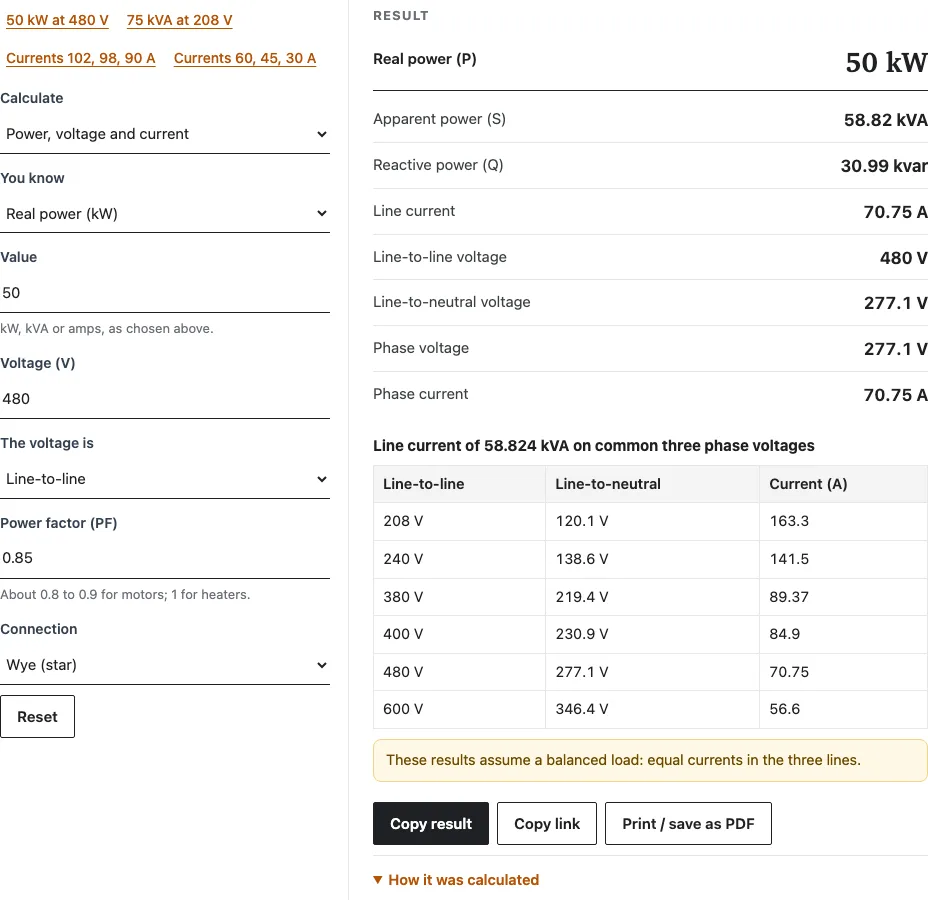
Divide the power in watts by √3 times the line-to-line voltage times the power factor: I = kW × 1,000 ÷ (1.732 × V × PF). A 50 kW load at 480 V and PF 0.85 draws 50,000 ÷ (1.732 × 480 × 0.85) = 70.75 A on each line.
The same 58.82 kVA on other common voltages, from the table under the tool:
| Line-to-line | Line-to-neutral | Current (A) |
|---|---|---|
| 208 V | 120.1 V | 163.3 |
| 240 V | 138.6 V | 141.5 |
| 400 V | 230.9 V | 84.9 |
| 480 V | 277.1 V | 70.75 |
| 600 V | 346.4 V | 56.6 |
Current falls in proportion as voltage rises, one reason large loads are often supplied at 480 V rather than 208 V.
What’s the difference between line and phase values in three-phase systems?
Line values are measured on the supply conductors; phase values are across or through one winding of the load. In a wye connection the phase voltage is the line-to-neutral voltage and phase current equals line current. In a delta connection the phase voltage is the line-to-line voltage and phase current is line current ÷ √3.
For the 50 kW, 480 V example:
| Value | Wye (star) | Delta |
|---|---|---|
| Phase voltage | 277.13 V | 480 V |
| Phase current | 70.754 A | 40.85 A |
| Line current | 70.754 A | 70.754 A |
Total power is the same either way. The connection matters when you choose winding ratings or a heater element voltage, and a wye system with a neutral also serves single-phase loads between line and neutral.
Worked examples
| Input | Result |
|---|---|
| 50 kW, 480 V L-L, PF 0.85 | 50 kW, 58.82 kVA, 70.75 A |
| 75 kVA, 208 V L-L, PF 0.9 | 67.5 kW, 75 kVA, 208.2 A |
| 40 A, 277 V L-N, PF 0.8 | 26.59 kW, 33.24 kVA, 40 A |
| 102 A, 98 A, 90 A | 6.9 % unbalance, neutral 10.58 A |
| 30 A, 30 A, 30 A | 0 % unbalance, neutral 0 A |
Calculated by the tool above; open it with the same values to see each step.
Questions, briefly answered
Why do you multiply by 1.73 for three phases?
1.73 is √3, rounded. In a balanced system the line-to-line voltage is √3 times the line-to-neutral voltage, so three phases of V_LN × I add up to √3 × V_LL × I.
What’s the limit on three-phase voltage imbalance?
NEMA MG 1 calls for derating a motor when voltage unbalance exceeds 1 percent. The tool applies the same percentage formula to currents and warns above 10 percent current unbalance.
How is current unbalance calculated?
It is the largest deviation of a line current from the average, divided by the average. Currents of 102, 98 and 90 A average 96.67 A, so the unbalance is 6.67 ÷ 96.67 = 6.9 percent.
How much current flows in the neutral of a wye system?
With currents 120 degrees apart, the neutral carries the phasor sum of the three. Equal currents give 0 A; 60, 45 and 30 A give 25.98 A, and the tool warns when the neutral exceeds half the average line current.
What power factor should I use for different types of loads?
Use the nameplate value when you have it. Motors typically run at about 0.8 to 0.9 at full load, while resistive heaters and incandescent lighting are close to 1.
Can I use this calculator for motor starting current?
No. It works with running values of a balanced load. Starting current is several times the full-load current and depends on the motor design and starter.
Related tools
- Single Phase vs Three Phase Calculator: to compare the current of one load on each supply.
- kW to Amps Calculator: for a quick kW to current conversion on any phase.
- kVA to Amps Calculator: when equipment is rated in kVA.
- Power Factor Calculator: to find PF from measured kW and kVA or amps.
- Power Factor Correction Calculator: to size capacitors that reduce kvar.
- HP to Amps Calculator: for motor full-load current from horsepower.
- Transformer Sizing Calculator: to choose a transformer kVA for the load.
- Voltage Drop Calculator: to check the feeder for the line current found here.
- Power conversion calculators: all power and unit converters.