Transformer Sizing Calculator
Enter your load and growth margin to get the transformer kVA, the next standard size and the primary and secondary amps.
Assumes NEC 2023 Table 450.3(B) for transformers of 1000 V or less and the standard kVA ratings listed; the fault current ignores utility impedance. Free, runs in your browser. Verify with your local code and a licensed electrician before you install.
Recent
Your last 10 settings, saved only in this browser. Nothing is uploaded.
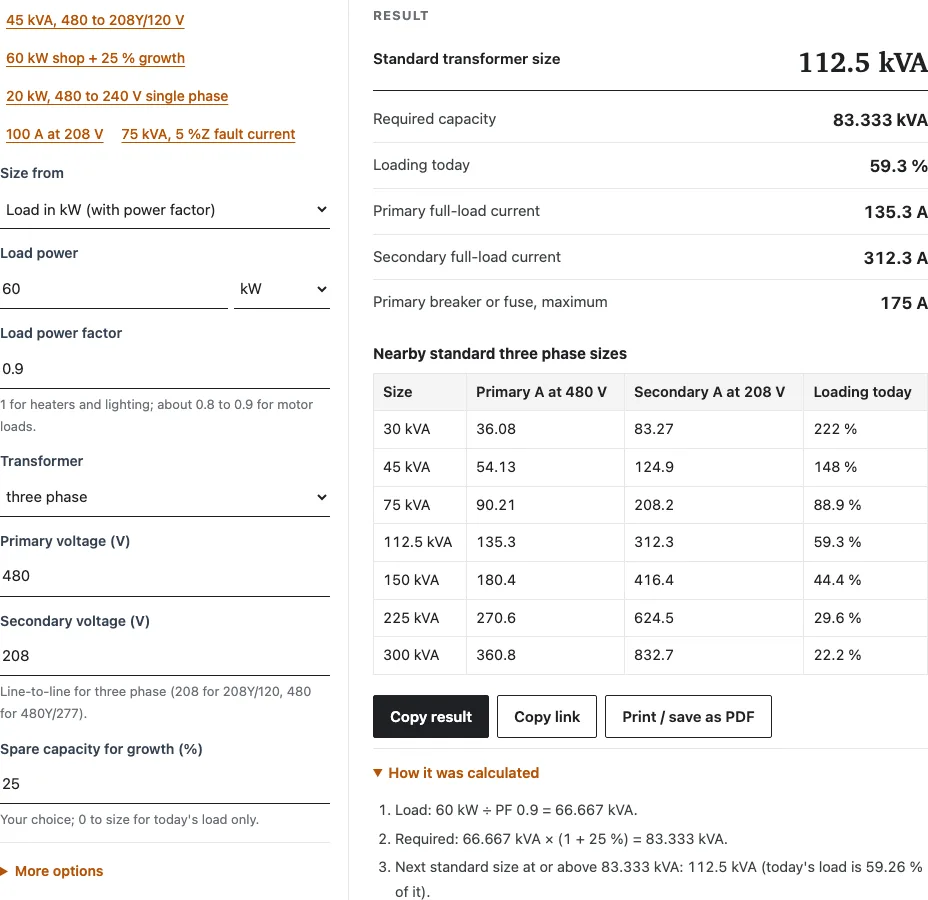
How to use the Transformer Sizing Calculator
- In “Size from”, choose “Load in kW (with power factor)”, “Load in kVA” or “Load current on the secondary”.
- For kW, enter “Load power” (kW or W) and the “Load power factor”: 1 for heaters and lighting, about 0.8 to 0.9 for motor loads. Otherwise fill in “Load (kVA)” or “Load current at the secondary voltage (A)”.
- Set “Transformer” to “three phase” or “single phase”.
- Enter “Primary voltage (V)” and “Secondary voltage (V)”. For three phase use line-to-line values, such as 208 for 208Y/120 or 480 for 480Y/277.
- Type the “Spare capacity for growth (%)” you want, or 0 to size for today’s load only.
- Under “More options”, pick the “Overcurrent protection” scheme (“Primary only” or “Primary and secondary”) and, if you know it, the “Transformer impedance %Z (nameplate, optional)”.
- Read “Standard transformer size” and the rows under it, then the steps and the “Nearby standard three phase sizes” (or single phase) table.
The example buttons above the form, such as “45 kVA, 480 to 208Y/120 V” or “75 kVA, 5 %Z fault current”, fill in typical jobs. “Copy result”, “Copy link” and “Print / save as PDF” keep or share the answer, and Reset returns to the defaults.
Changing any field updates the result rows, the steps and the tables straight away, and Copy link keeps your exact inputs in the address so you can share or reopen the calculation.
How do you calculate a transformer size?
Convert the load to kVA (kW ÷ power factor, or volts × amps ÷ 1000 with √3 for three phase), multiply by one plus your growth margin, and pick the next standard kVA rating at or above the result. Then find each winding’s full-load current from that rating and its voltage.
With the default inputs (60 kW at power factor 0.9, 25 % growth, 480 V to 208 V three phase):
- Load: 60 kW ÷ 0.9 = 66.667 kVA.
- Required: 66.667 kVA × 1.25 = 83.333 kVA.
- Next standard three-phase size: 112.5 kVA, loaded to 59.26 % today.
- Full-load current: 112.5 × 1000 ÷ (√3 × 480) = 135.3 A primary and 312.3 A at 208 V secondary.
Single-phase sizes run 1 to 333 kVA in the tool’s list; three-phase sizes run 3 to 5000 kVA.
What size transformer do I need for a 400 amp service?
For 400 A at 208 V three phase the load is 144.1 kVA, so a 150 kVA transformer fits with no margin. At 480 V the same 400 A is 332.6 kVA, and the next standard size is 500 kVA. Adding growth moves the 208 V case up a size.
| Secondary load | Growth | Required | Standard size | Loading today |
|---|---|---|---|---|
| 400 A at 208 V | 0 % | 144.1 kVA | 150 kVA | 96.07 % |
| 400 A at 208 V | 25 % | 180.1 kVA | 225 kVA | 64.05 % |
| 400 A at 480 V | 0 % | 332.6 kVA | 500 kVA | 66.51 % |
A 400 A service rating is the most the service can carry, not its actual load, so sizing from a calculated load often gives a smaller transformer.
How do you size transformer overcurrent protection?
Under NEC Table 450.3(B), a transformer protected on the primary only may have a primary device of up to 125 % of its rated primary current (9 A or more), and the next standard rating is permitted. With protection on both sides, the primary may go to 250 % and the secondary to 125 % of their currents.
For the 112.5 kVA, 480 to 208 V transformer above:
| Scheme | Primary maximum | Secondary maximum |
|---|---|---|
| Primary only | 135.3 A × 125 % = 169.1 A → 175 A | none required by 450.3(B) |
| Primary and secondary | 135.3 A × 250 % = 338.3 A → 300 A | 312.3 A × 125 % = 390.3 A → 400 A |
With primary-only protection the secondary conductors still need protection under NEC 240.21(C). Below 9 A the limits are 167 % (and 300 % on a primary under 2 A) with no rounding up. Above 1000 V, Table 450.3(A) applies instead, and the tool warns you.
Worked examples
| Input | Result |
|---|---|
| 60 kW at PF 0.9 | 112.5 kVA: 135.3 A primary, 312.3 A secondary |
| 45 kVA | 45 kVA: 54.13 A primary, 124.9 A secondary |
| 100 A at 208 V | 45 kVA: 54.13 A primary, 124.9 A secondary |
| 20 kW at PF 1 | 25 kVA: 52.08 A primary, 104.2 A secondary |
| 400 kW at PF 0.85 | 750 kVA: 104.1 A primary, 902.1 A secondary |
Calculated by the tool above; open it with the same values to see each step.
Questions, briefly answered
How many amps is a 2000 kVA transformer good for?
At full load a 2000 kVA three-phase transformer carries 2,406 A at 480 V and 5,551 A at 208 V. On a 4160 V primary its current is 277.6 A.
What happens to the current in a step-up transformer?
It drops as the voltage rises. A 45 kVA three-phase unit fed at 208 V and stepping up to 480 V carries 124.9 A on the primary and 54.13 A on the secondary.
What is the turns ratio of a transformer?
It is the number of primary turns divided by the number of secondary turns, and in practice it is close to the voltage ratio. A 480 V to 240 V transformer is 2:1. The calculator works from the two voltages, so you never enter turns.
How do I find the fault current at the secondary?
Enter the nameplate %Z under “More options”. A 75 kVA, 480 to 208 V transformer at 5 %Z gives 4,164 A, or 4,626 A allowing for a −10 % impedance tolerance. Both figures ignore the utility and wiring impedance, so the real value is lower.
How much spare capacity should I add?
It is your choice, which is why the growth field defaults to 25 % but accepts 0. The tool warns when today’s load is below 30 % of the chosen size, a sign the margin may be too generous.
Does kVA or kW size a transformer?
kVA. A transformer heats with current, which depends on apparent power, so a 60 kW load at power factor 0.9 needs 66.667 kVA of capacity.
Related tools
- kVA to Amps Calculator: find the current of any kVA rating at a given voltage.
- kVA to kW Calculator: convert between real and apparent power.
- Three Phase Power Calculator: work out kW, kVA and amps on a three-phase circuit.
- Power Factor Calculator: find the power factor to enter for the load.
- Electrical Load Calculator: total the load before choosing a transformer.
- Wire Size Calculator: size the primary and secondary conductors.
- HP to Amps Calculator: get motor currents for the load list.
- Motor, Transformer and Generator Calculators: see the other tools in this group.