Volts to Watts Calculator
Convert volts to watts from the current or from the resistance, and see all four Ohm's law values at once.
Free · runs in your browser · nothing is uploaded
Recent
Your last 10 settings, saved only in this browser. Nothing is uploaded.
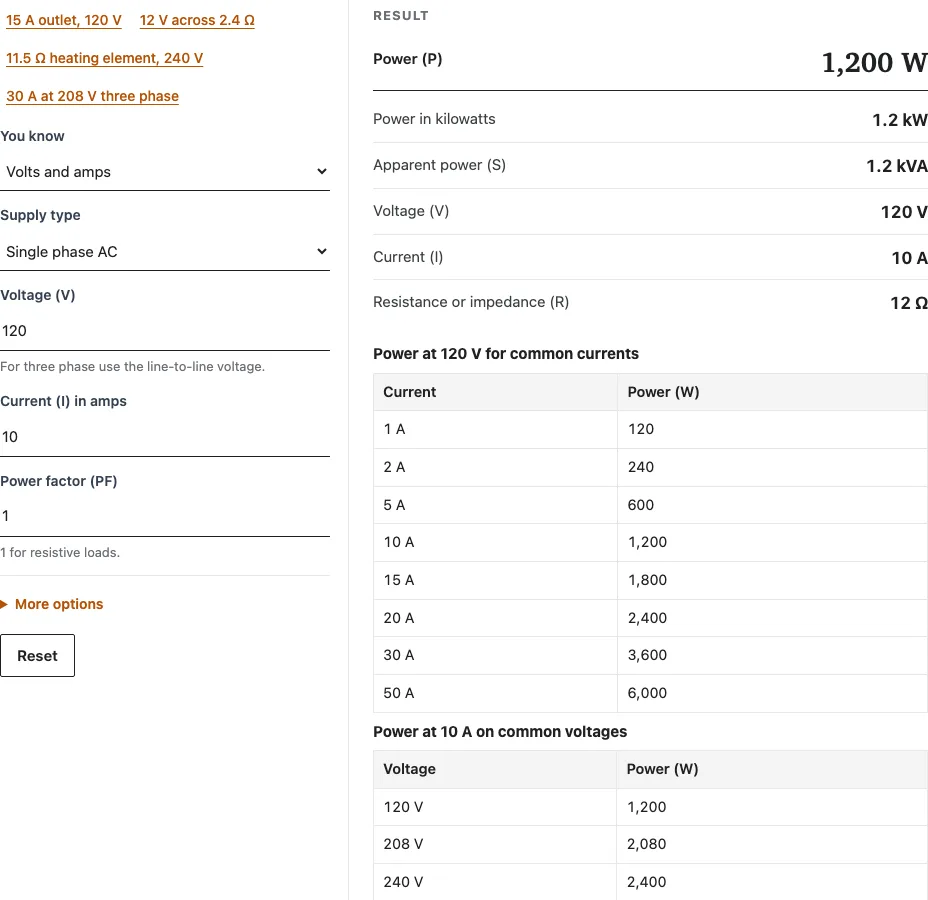
How to use the Volts to Watts Calculator
- In You know, choose “Volts and amps” or “Volts and ohms”.
- Pick the Supply type: “Single phase AC”, “Three phase AC” or “DC”.
- Enter the Voltage (V). For three phase, this is the line-to-line voltage, such as 208 or 480.
- Enter Current (I) in amps, or, in the ohms mode, Resistance or impedance (Ω). For AC the ohms value is the impedance of the load, and for three phase it is the impedance of one phase.
- Set the Power factor (PF): 1 for resistive loads such as heating elements. The box is hidden for DC.
- For three phase in the ohms mode, open “More options” and choose “Wye (star)” or “Delta” under Three phase connection. The connection decides the voltage across each phase.
- Read Power (P) and Power in kilowatts, then Apparent power (S), Current (I) and Resistance or impedance (R), and look at any warning.
The example buttons load four cases, including “15 A outlet, 120 V” and “11.5 Ω heating element, 240 V”. “Copy result” copies the figures, “Copy link” copies a link with your inputs, “Print / save as PDF” prints them, and Reset returns to the defaults.
Changing any field updates the result rows, the steps and the tables straight away, and Copy link keeps your exact inputs in the address so you can share or reopen the calculation.
How do you convert volts to watts?
Multiply the volts by the current in amps: P = V × I. On AC, multiply by the power factor too, and on three phase add a factor of √3. When you know the resistance instead of the current, square the voltage and divide by the ohms: P = V² ÷ R. Both routes give the same watts.
- Decide which second value you have: amps or ohms.
- With amps, multiply. 120 V × 10 A = 1,200 W.
- With ohms, square and divide. 120 V squared is 14,400, and 14,400 ÷ 14.4 Ω = 1,000 W.
- For a three phase load, use the line-to-line voltage. 30 A at 208 V with PF 0.9 gives √3 × 208 × 30 × 0.9 = 9,727 W.
The tool also fills in the value you did not enter, so the 120 V, 10 A case shows 12 Ω.
How many watts is 120 volts?
There is no single answer, because the watts depend on how much current flows. At 120 V with a power factor of 1, every amp adds 120 W. A 10 A load uses 1,200 W, and a 15 A circuit at full current carries 1,800 W, which is why the 15 A outlet example reads 1,800 W.
| Current | Power at 120 V |
|---|---|
| 1 A | 120 W |
| 5 A | 600 W |
| 10 A | 1,200 W |
| 15 A | 1,800 W |
| 20 A | 2,400 W |
| 30 A | 3,600 W |
How many watts is 12 volts?
On a 12 V DC system, watts equal 12 times the current. A 10 A load is 120 W and a 30 A load is 360 W. If you know the resistance instead, a 2.4 Ω load at 12 V draws 5 A and uses 60 W, the result of the “12 V across 2.4 Ω” example.
Doubling the voltage on the same resistance quadruples the power, because the voltage is squared. That is why a heating element must match its rated voltage: an 11.5 Ω element on 240 V gives 5,008.7 W.
Worked examples
| Input | Result |
|---|---|
| 120 V, 10 A, single phase | 1,200 W (1.2 kW) |
| 120 V, 14.4 Ω, single phase | 1,000 W (1 kW) |
| 12 V, 2.4 Ω, DC | 60 W (0.06 kW) |
| 208 V, 30 A, three phase | 9,727 W (9.727 kW) |
Calculated by the tool above; open it with the same values to see each step.
Questions, briefly answered
Is 1000 watts 1 volt?
No. Volts measure electrical pressure and watts measure power, so the two cannot be equal. At 120 V, 1,000 W needs 8.333 A, which matches a 14.4 Ω load.
What is the difference between a volt and a watt?
A volt is the unit of electrical potential difference, the push behind the current. A watt is the unit of power, one joule of energy per second.
Why does wye or delta change the result?
In the ohms mode the impedance is per phase. With a wye connection each phase sees the line-to-line voltage divided by √3; with delta it sees the full line voltage. A 10 Ω per-phase load on 208 V gives 4,326.4 W in wye and 12,979 W in delta.
Why does the tool warn about impedance on AC?
On AC, the ohms you enter are treated as the impedance of the load. A load with a power factor below 1 also draws reactive power, so the real watts are the apparent power times the power factor.
Does a higher voltage always mean more watts?
Only when the current or the resistance stays the same. The second table under the result shows this for a fixed current: at 10 A, 120 V gives 1,200 W, 240 V gives 2,400 W and 480 V gives 4,800 W. A device with a fixed wattage draws fewer amps at a higher voltage instead.
How many watts does a 36 V battery give at 10 A?
Choose “DC”, enter 36 V and 10 A, and the result is 360 W. The tool also shows the equivalent resistance, 3.6 Ω.
Related tools
- Ohm’s Law Calculator: solve any pair of volts, amps, ohms and watts.
- Ohm’s Law Wheel: see the twelve Ohm’s law formulas on one wheel.
- Amps to Watts Calculator: add hours of use and your price per kWh.
- Watts to Amps Calculator: find the current and breaker for a wattage.
- Three Phase Power Calculator: look at a three phase load in more detail.
- Amps to kW Calculator: get kilowatts, kVA and kvar from a current.
- DC Voltage Drop Calculator: check the wire for a battery or solar circuit.
- Power conversion calculators: all power and current converters in one list.