Watts to Amps Calculator
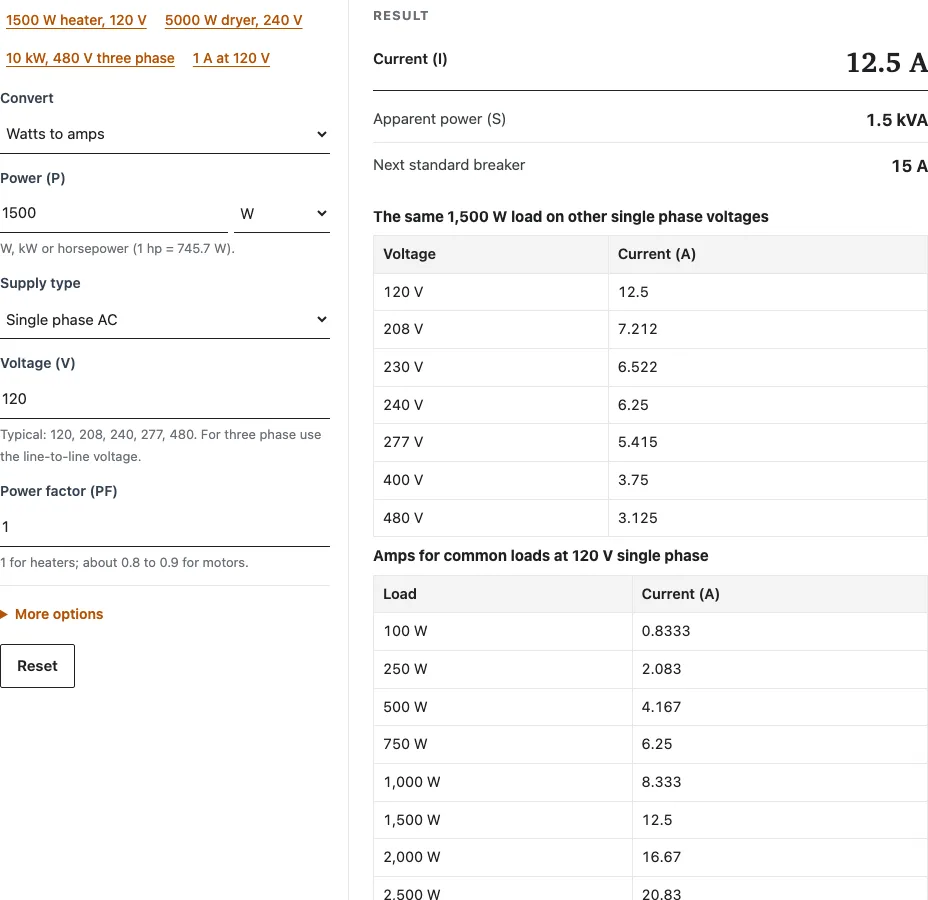
Enter watts, voltage and power factor to get the amps, then see the breaker size and the same load at other voltages.
The breaker shown is the next standard rating (NEC 240.6(A)) at 125 % of a continuous load; the wire must be sized for that breaker. Free, runs in your browser. Verify with your local code and a licensed electrician before you install.
Recent
Your last 10 settings, saved only in this browser. Nothing is uploaded.
How to use the Watts to Amps Calculator
- In Convert, leave “Watts to amps”, or choose “Amps to watts” if you already know the current. In that mode the power box is replaced by Current (I) in amps.
- Type the load into Power (P) and pick W, kW or hp from its unit list. Horsepower is converted at 1 hp = 745.7 W.
- Choose a Supply type: “Single phase AC”, “Three phase AC” or “DC”.
- Enter the Voltage (V). For three phase, use the line-to-line voltage, such as 208 or 480.
- Set the Power factor (PF): 1 for heaters and resistive loads, or roughly 0.8 to 0.9 for motors. The box disappears for DC.
- Under “More options”, tick Continuous load (runs 3 hours or more) if the load stays on that long. The breaker is then sized at 125 % of the current.
- Read Current (I), Apparent power (S) and Next standard breaker, then open “How it was calculated” to see each step and check any warning.
The example buttons above the form load ready-made cases, such as “1500 W heater, 120 V” or “10 kW, 480 V three phase”. “Copy result” and “Copy link” put the answer or a link to these inputs on the clipboard, “Print / save as PDF” prints the result, and Reset restores the defaults.
How to convert watts to amps at 240V?
At 240 V single phase with a power factor of 1, divide the watts by 240. A 3000 W water heater element draws 3000 ÷ 240 = 12.5 A, and a 5000 W dryer draws 20.83 A. For a motor, divide by 240 times the power factor, which makes the current higher for the same wattage.
- Convert the rating to watts: multiply kW by 1000, or hp by 745.7.
- Divide by the voltage, then by the power factor for an AC motor load.
- Compare the current with the breaker. The calculator rounds up to the next standard rating listed in NEC 240.6(A).
- If the load runs for 3 hours or more, the breaker is chosen at 125 % of the current, per NEC 210.20(A).
Values from the tool at 240 V, single phase, power factor 1:
| Load | Current | Next standard breaker |
|---|---|---|
| 1500 W | 6.25 A | 15 A |
| 3000 W | 12.5 A | 15 A |
| 3000 W, continuous | 12.5 A (15.63 A design) | 20 A |
| 5000 W | 20.83 A | 25 A |
| 10 kW | 41.67 A | 45 A |
What is the formula for watts to amps in three phase?
For three phase AC, current equals power divided by the square root of 3 (about 1.732), the line-to-line voltage and the power factor: I = P ÷ (√3 × V × PF). Spreading the load over three conductors is why a three phase supply draws less current per wire than single phase for the same power.
Ten kilowatts at a power factor of 0.9 shows how much the voltage matters:
| Supply | Current |
|---|---|
| 480 V three phase | 13.36 A |
| 208 V three phase | 30.84 A |
The tool prints the apparent power next to the current. For this load it is 11.11 kVA, because the real power of 10 kW is divided by the power factor of 0.9.
How are amps, volts and watts related?
Watts measure power, volts measure electrical pressure and amps measure the flow of current. For DC or a purely resistive load, watts equal volts times amps, so knowing two values gives you the third. AC loads with motors or electronics add a power factor, which raises the current needed for the same watts.
Ohm’s law, I = V ÷ R, links the same quantities to resistance. Nameplates usually give power rather than resistance, which is why this page starts from watts. Low power factor has a large effect: 1200 W at 120 V and PF 0.3 works out to 33.33 A, and the tool warns that such a low value is unusual for a real load.
Worked examples
| Input | Result |
|---|---|
| 1500 W, 120 V, single phase, PF 1 | 12.5 A |
| 3000 W, 240 V, single phase, PF 1 | 12.5 A |
| 10 kW, 480 V, three phase, PF 0.9 | 13.36 A |
| 2000 W, 230 V, single phase, PF 1 | 8.696 A |
| 1 A, 120 V, single phase, PF 1 | 120 W (0.12 kW) |
Calculated by the tool above; open it with the same values to see each step.
Questions, briefly answered
How many amps is 1500 watts?
At 120 V, 1500 W draws 12.5 A; at 240 V it draws 6.25 A, both with a power factor of 1. The tool gives 15 A as the next standard breaker in both cases.
Is 1000 watts 1 amp?
No. At 120 V, 1000 W draws 8.333 A, and at 240 V it draws 4.167 A. A load of 1000 W would only draw 1 A at 1000 V with a power factor of 1.
What is 20 amps in watts?
At 120 V, 20 A is 2400 W (2.4 kW); at 240 V it is 4800 W (4.8 kW), assuming a power factor of 1. Choose “Amps to watts” in Convert to check other currents.
Can I enter horsepower instead of watts?
Yes. Pick hp in the unit list of Power (P) and the tool multiplies by 745.7 W per hp. A 2 hp motor at 240 V single phase with PF 0.85 works out to 7.311 A.
Why does the breaker size change when I tick continuous load?
A load that runs 3 hours or more is sized at 125 % of its current under NEC 210.20(A). A 3000 W load at 240 V draws 12.5 A, so the design current becomes 15.63 A and the next standard breaker rises from 15 A to 20 A.
Does the calculator work for DC?
Yes. Choose “DC” as the Supply type and the power factor box is hidden, because DC current is simply I = P ÷ V. A 100 W load on 12 V DC draws 8.333 A.
Related tools
- Amps to Watts Calculator: turn a measured current into watts, kWh per day and running cost.
- kW to Amps Calculator: find the current of a load or motor rated in kilowatts.
- Volts to Watts Calculator: get power from volts and amps, or volts and ohms.
- kVA to Amps Calculator: convert a kVA rating, including transformer full-load amps.
- HP to Amps Calculator: estimate motor current from its horsepower rating.
- Three Phase Power Calculator: work out kW, kVA and amps on a three phase supply.
- Ohm’s Law Calculator: solve for voltage, current, resistance or power.
- Wire Size Calculator: pick a conductor once you know the current.
- Power conversion calculators: all watt, amp, kVA and horsepower converters.