What Size Generator Do I Need?
Tick the appliances you want to run to find out whether a portable or a standby generator fits and how many kW.
Assumes typical appliance watts from manufacturer charts (editable), motors started one at a time, and a whole-house estimate by NEC 220.82. Free, runs in your browser. Verify with your local code and a licensed electrician before you install.
Recent
Your last 10 settings, saved only in this browser. Nothing is uploaded.
How to use the What Size Generator Do I Need Calculator
- Enter “House size (for the whole-house estimate)” in ft² or m², measured as living area by outside dimensions.
- Tick the items to keep running, such as “Refrigerator”, “Sump pump (1/2 hp)”, “Gas or oil furnace blower (1/2 hp)”, “Well pump (1/2 hp)” or “Electric water heater”.
- Under “Central air conditioner”, pick None or 2, 3 or 4 ton; the outdoor unit’s label shows it (12,000 BTU/h per ton).
- Fill in “Window air conditioners (how many)”, “LED bulbs on at the same time” and “EV charger current (A, 0 = none)”.
- Under “More options”, you can set “Usable propane in the tank (gallons, optional)”, “Altitude”, “Highest outdoor temperature” and, with the range ticked, “Range nameplate for the whole-house estimate (kW)”. The same panel holds running and extra starting watts for each ticked item; leave them blank to use the typical value.
- Read “Generator for the items ticked” and “Type”, then the whole-house rows and the “Items and typical watts” table.
Example buttons such as “Ride out a winter outage”, “Keep the 3-ton AC running” and “House with an EV charger” fill in a full setup you can change. “Copy result”, “Copy link” and “Print / save as PDF” keep or share the answer, and Reset restores the defaults.
What size generator do I need?
Add the running watts of every item you will run together, then add the extra starting watts of the single largest motor, since motors start one at a time. If the total is 12 kW or less, a portable generator can cover it; above that, a standby generator is the practical choice.
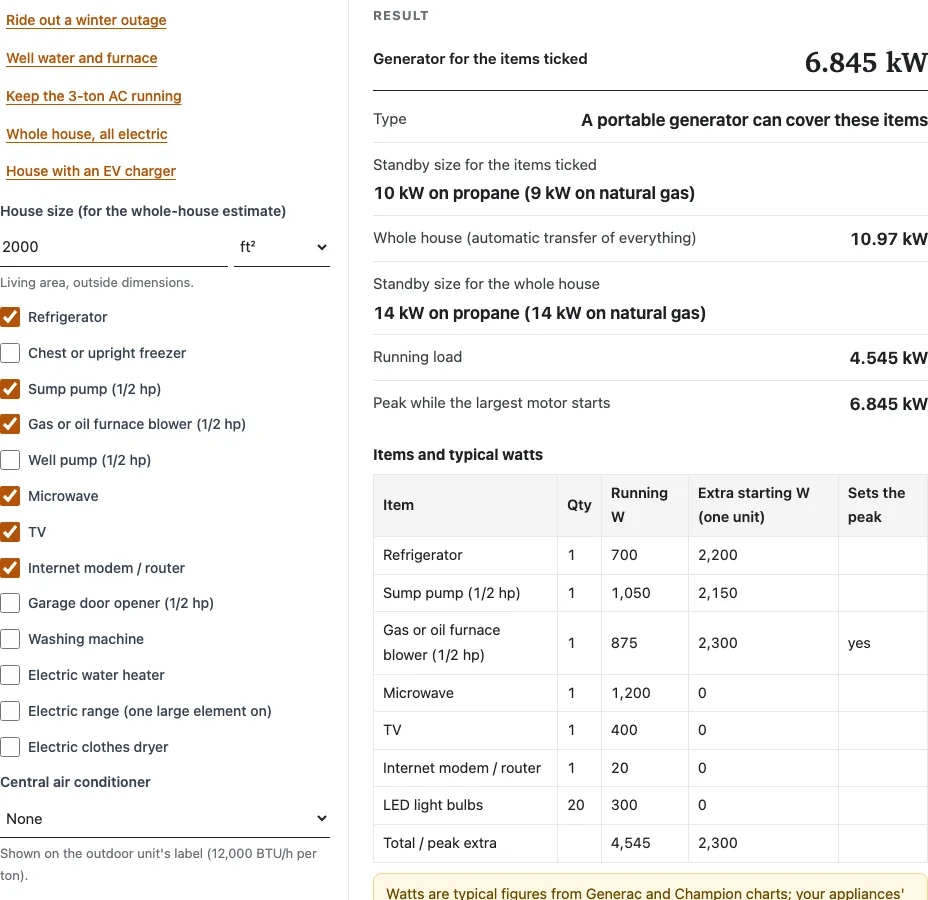
With the default items (refrigerator, sump pump, furnace blower, microwave, TV, router and 20 LED bulbs):
- Running load: 4,545 W.
- Peak: 4,545 W + 2,300 W for the furnace blower = 6,845 W.
- 6.845 kW fits a portable generator up to 12 kW.
- Standby size for those items: 10 kW on propane (9 kW on natural gas).
Altitude and heat lower a generator’s output, so a site at height or in a hot climate needs a larger rating.
What size generator do I need for a 2,000 sq ft house?
Floor area only drives the whole-house estimate. With the default items, a 2,000 ft² house needs 6.845 kW for the ticked items but 10.97 kW for the whole house by NEC 220.82, which points to a 14 kW standby unit. Adding a 3-ton central AC raises both figures to about 14 kW.
| Example | Items ticked | Whole house | Standby for whole house |
|---|---|---|---|
| 2,000 ft², default items | 6.845 kW, portable | 10.97 kW | 14 kW |
| 1,500 ft², default items | 6.845 kW, portable | 10.37 kW | 14 kW |
| Keep the 3-ton AC running (2,000 ft²) | 14.045 kW, standby | 14.47 kW | 18 kW |
| Whole house, all electric (2,500 ft²) | 33.82 kW, standby | 25.97 kW | 30 kW |
| House with an EV charger (2,200 ft²) | 34.325 kW, standby | 26.782 kW | 30 kW |
The whole-house figure counts 3 VA per ft², two 1,500 VA small-appliance circuits, a 1,500 VA laundry circuit and the fixed appliances, takes the first 10,000 VA at 100 % and the rest at 40 %, then adds the AC. NEC 702.4(A)(2) requires a standby unit with automatic transfer of the whole house to carry this load unless a load-management system sheds loads. When every ticked item at once exceeds the whole-house figure, as in the last two rows, the tool says so.
What is the difference between running watts and starting watts?
Running watts are what an appliance draws while it works. Starting watts are the extra power a motor takes for a few seconds as it starts, so pumps, compressors and blowers have them while heaters, lights and TVs do not. A generator must carry the running total plus the largest single starting surge.
In the default list the furnace blower (875 W running, 2,300 W extra to start) sets the peak, which the “Sets the peak” column marks. If none of the ticked items has starting watts, the tool warns you.
Worked examples
| Input | Result |
|---|---|
| 2000 ft², 7 items | 6.85 kW for the items, portable; whole house 11 kW |
| 2000 ft², 10 items | 19.5 kW for the items, standby; whole house 16.7 kW |
| 1500 ft², 6 items | 5.65 kW for the items, portable; whole house 9.88 kW |
| 3000 ft², 15 items | 40.9 kW for the items, standby; whole house 29.6 kW |
| 2000 ft², 7 items | 8.3 kW for the items, portable; whole house 13 kW |
Calculated by the tool above; open it with the same values to see each step.
Questions, briefly answered
What will a 7500 watt generator run in a house?
It covers the default items, whose peak is 6,845 W, and the “Ride out a winter outage” example at 7,195 W. Adding a 3-ton central AC raises the peak to 14,045 W, well beyond it.
What size house can a 10,000 watt generator run?
House size alone does not decide it. For a 2,000 ft² house with the default items, 10 kW covers the ticked items (6.845 kW) but not the 10.97 kW whole-house estimate.
Can I run my whole house with a 6500 watt generator?
Usually not with automatic transfer: even a 1,500 ft² house comes out at 10.37 kW by NEC 220.82. With a manual transfer switch you choose which loads to run, and 6.5 kW can cover a short list.
Can I run my central air conditioner on a generator?
Yes, if the generator covers the AC’s starting surge. Choose its tonnage under “Central air conditioner”; when the result still fits a portable unit, the tool advises checking the unit’s LRA or a soft starter.
How long will a propane tank run a standby generator?
Enter “Usable propane in the tank (gallons, optional)”. For the default house, 250 gallons runs the 14 kW whole-house unit about 138 hours at half load, or roughly 5.76 days.
Can I plug a generator into a wall outlet?
No. Connect it only through a transfer switch or a listed interlock that keeps it from feeding the utility lines (NEC 702.5).
Related tools
- Generator Size Calculator: type your own load list, or size a three-phase genset.
- Electrical Load Calculator: run the full dwelling load calculation for the service.
- HP to Amps Calculator: find the current of a well or sump pump motor.
- Watts to Amps Calculator: convert an appliance’s watts into amps.
- Amps to Watts Calculator: turn a nameplate’s amps into running watts.
- Wire Size Calculator: size the cable to the transfer switch.
- Minimum Circuit Ampacity Calculator: read an AC unit’s nameplate MCA and MOCP.
- Motor, Transformer and Generator Calculators: see the other tools in this group.