Wire Ampacity Calculator
Pick a conductor and see its allowable amps after the temperature column, ambient and conductor-count adjustments.
Assumes NEC 2023 Table 310.16 (copper or aluminum, 60/75/90 °C insulation columns, conductors in a raceway, cable or earth) with the ambient, bundling and terminal rules you set. Free, runs in your browser. Verify with your local code and a licensed electrician before you install.
Recent
Your last 10 settings, saved only in this browser. Nothing is uploaded.
How to use the Wire Ampacity Calculator
- Under Calculate, choose “Ampacity of a wire size” to check a size you have, or “Smallest wire for a load” to find one.
- In the first mode, pick a Wire size from 14 AWG to 2000 kcmil.
- In the second mode, type the Load current (A), tick Continuous load (3 hours or more) if it applies, and optionally enter a Breaker rating (A, optional). Left empty, the tool uses the next standard rating above the design current.
- Choose the Conductor: Copper or Aluminum. Aluminum starts at 12 AWG.
- Set the Insulation temperature rating: 60 °C for NM-B or UF-B, 75 °C for THW, THWN or XHHW, 90 °C for THHN, THWN-2 or XHHW-2.
- Leave Terminal temperature rating on Auto, or pick 75 °C only when the breaker and equipment are listed for it.
- Enter the Ambient temperature and set the Ambient unit to °C or °F. 30 °C (86 °F) needs no correction.
- Enter the number of Current-carrying conductors in the raceway or cable. The ground is never counted.
- Read Allowed ampacity, Deciding limit and Largest standard breaker for this wire (a standard NEC 240.6(A) rating not above the ampacity), plus Next size up allowed by NEC 240.4(B) when the ampacity is not a standard rating, then the warnings.
The example buttons above the form load typical cases, such as “10 AWG THHN in a 50 °C attic” or “4/0 aluminum SER”. Copy result, Copy link and Print / save as PDF keep the answer with its steps, and Reset restores the defaults.
How do I calculate the ampacity of a wire?
Take the NEC 310.16 value for the size, metal and insulation column, multiply it by the ambient correction and the bundling adjustment, then keep the smaller of that and the terminal column value. Small sizes have one more check: NEC 240.4(D) limits the breaker on small conductors such as 14, 12 and 10 AWG copper.
The example “12 AWG copper, 90 °C insulation, 40 °C ambient, six conductors, 75 °C terminals” runs like this in the tool:
- NEC 310.16, 90 °C column: 30 A.
- Ambient correction at 40 °C: 0.91 (NEC 310.15(B)(1)).
- Six current-carrying conductors: 0.8 (NEC 310.15(C)(1)).
- Corrected: 30 A × 0.91 × 0.8 = 21.84 A; the 75 °C terminal value is 25 A, so 21.84 A is allowed.
- NEC 240.4(D): 12 AWG may be protected at no more than 20 A, so the largest standard breaker is 20 A.
When the allowed ampacity is not a standard rating, for example 55 A for 6 AWG copper in the 60 °C column, the largest standard breaker is the rating below it (50 A). NEC 240.4(B) lets you go to the next standard size up (60 A) only when the circuit is not a multioutlet branch circuit for cord-and-plug loads and the breaker is 800 A or less; the tool shows that value on its own row.
How many amps will #4 THHN wire carry?
THHN is a 90 °C insulation, so 4 AWG copper starts at 95 A in the 90 °C column. What you can use depends on the terminals. With Auto, a 4 AWG conductor is held to the 60 °C column, 70 A, at 30 °C with three conductors. With terminals listed for 75 °C it is 85 A.
| Terminal temperature rating | Allowed ampacity, 4 AWG copper THHN | Deciding limit |
|---|---|---|
| Auto (60 °C for 14 to 1 AWG) | 70 A | terminal temperature |
| 75 °C (listed equipment) | 85 A | terminal temperature |
The 90 °C value still matters: it is the starting point for derating, so a hot or crowded run of THHN loses less than a 75 °C wire would. The tool warns that the result cannot exceed the terminal value.
How much does a hot attic reduce wire ampacity?
Heat lowers ampacity through the ambient correction factor, and the drop is steeper for lower-rated insulation. At 50 °C, a 90 °C conductor keeps 82 % of its table value, a 75 °C conductor 75 % and a 60 °C conductor 58 %. Enter the real air temperature along the run, not the room below it.
| Case at 50 °C | Table value | Factor | Allowed ampacity |
|---|---|---|---|
| 10 AWG THHN, 75 °C terminals | 40 A | 0.82 | 32.8 A (breaker 30 A, NEC 240.4(D)) |
| 8 AWG THHN, 75 °C terminals | 55 A | 0.82 | 45.1 A |
| 10 AWG, 75 °C insulation, Auto | 35 A | 0.75 | 26.25 A |
| 12 AWG NM-B (60 °C) | 20 A | 0.58 | 11.6 A |
Worked examples
| Input | Result |
|---|---|
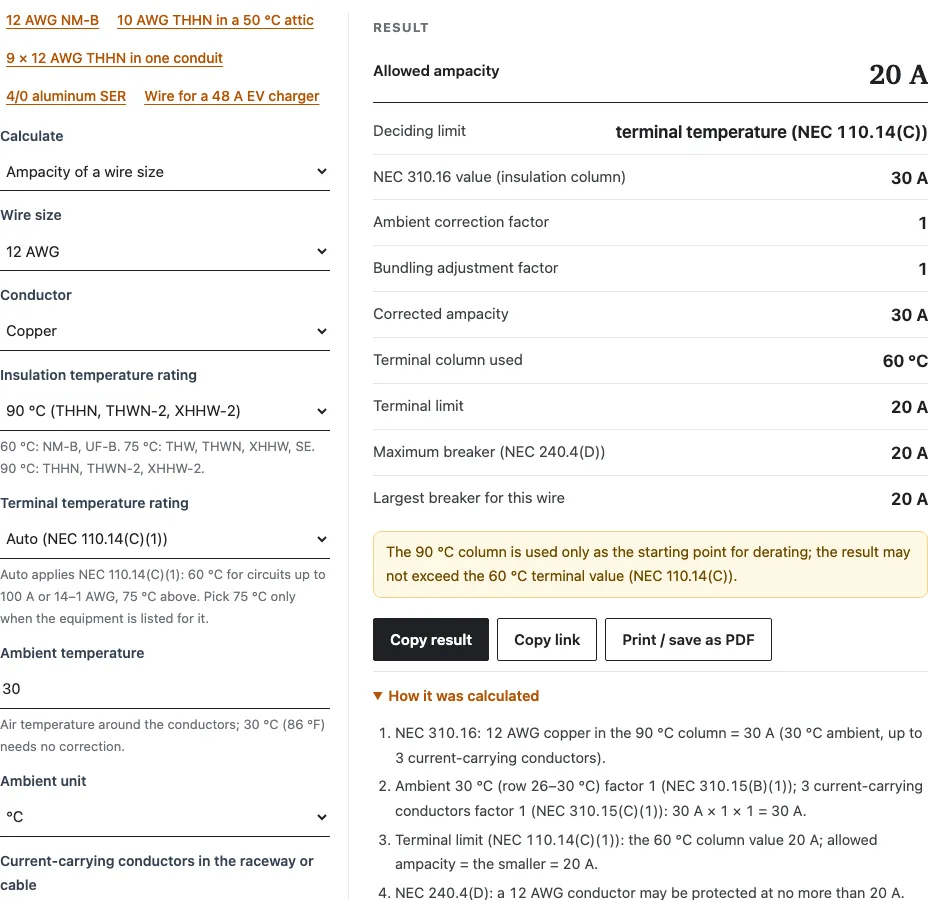
| 12 AWG copper 90 °C, 30 °C, 3 conductors | 20 A |
| 12 AWG copper 90 °C, 40 °C, 6 conductors | 21.84 A |
| 6 AWG copper 60 °C, 30 °C, 3 conductors | 55 A |
| 4/0 AWG aluminum 75 °C, 30 °C, 3 conductors | 180 A |
| 40 A continuous, copper 75 °C, 30 °C, 3 conductors | 8 AWG (50 A) |
Calculated by the tool above; open it with the same values to see each step.
Questions, briefly answered
What size wire do I need for 100 amps?
For a 100 A non-continuous load with Auto terminals, the tool returns 1 AWG copper (110 A in the 60 °C column). With 75 °C insulation and terminals listed for 75 °C, it returns 3 AWG copper or 1 AWG aluminum, both 100 A.
What size wire do I need for a 60-amp circuit?
With 75 °C insulation and Auto terminals, the 60 °C column applies and the answer is 4 AWG copper (70 A). If the terminals are listed for 75 °C, 6 AWG copper at 65 A is enough.
How many amps can I run through a 12 gauge wire?
12 AWG copper is allowed 20 A at 30 °C with up to three conductors, the same as its 240.4(D) breaker limit. Heat or bundling reduce it: in NM-B at 50 °C it falls to 11.6 A.
Do I count the neutral as a current-carrying conductor?
A neutral that carries only the unbalanced current of the other conductors of its circuit is not counted, and a grounding conductor never is (NEC 310.15(E), (F)). A neutral of a two-wire circuit carries the full load current, so it counts.
When is aluminum acceptable instead of copper?
The NEC allows aluminum and it is common for feeders and services. It needs a larger size for the same current: 4/0 aluminum with 75 °C terminals is 180 A. Use connectors and devices marked for aluminum.
Can I use the 90 °C column because my wire is THHN?
Only as the starting point for derating. The final ampacity cannot exceed the terminal column value under NEC 110.14(C), which is 60 °C or 75 °C for most equipment.
How do I size wire for a 48 A EV charger?
Choose “Smallest wire for a load”, enter 48 A and tick the continuous box. The design current is 60 A, and with 75 °C insulation and terminals the tool returns 6 AWG copper at 65 A.
Related tools
- Wire Size Calculator: ampacity and voltage drop together for a full circuit.
- Voltage Drop Calculator: check the drop once the ampacity is right.
- Minimum Circuit Ampacity Calculator: MCA for motors and HVAC equipment.
- Wire Size for 30 Amp Circuit: dryers, water heaters and other 30 A circuits.
- Wire Size for 50 Amp Circuit: ranges, EV chargers and subpanels.
- Wire Size for 60 Amp Circuit: subpanels and large heaters.
- Conduit Fill Calculator: how many conductors fit in a raceway.
- Wire Gauge Chart: diameter, area and resistance by size.
- Wire and Cable Calculators: every wire tool on the site.