Wire Gauge Chart
Look up any AWG or kcmil size: diameter, cross-section, resistance at your temperature and weight per length.
Free · runs in your browser · nothing is uploaded
Recent
Your last 10 settings, saved only in this browser. Nothing is uploaded.
How to use the Wire Gauge Chart
- Open the Wire size list and choose a size, from 18 AWG up to 2000 kcmil.
- Set Conductor to Copper or Aluminum. The table below the result switches to the same metal.
- Enter the Temperature for the resistance column (°C). 20 °C is the reference; 75 °C is a typical loaded wire.
- Under More options, tick Stranded conductor (+2 % resistance) if you want the resistance of a stranded conductor rather than a solid rod.
- Read the result rows: Diameter (inches), Diameter (mm), Cross-section, Area in circular mils, the four resistance rows and the two Weight of the metal rows.
- Scroll to the table to compare all 30 sizes side by side. The row of your chosen size is marked with an arrow.
- Open the calculation steps to see the diameter formula, the area, the resistivity used and the temperature correction.
The example buttons above the form load “14 AWG copper”, “12 AWG at 75 °C”, “6 AWG at 75 °C”, “4/0 aluminum” and “500 kcmil at 90 °C”. Copy result and Copy link share the numbers for the selected size, Print / save as PDF prints the result with the full table, and Reset goes back to 12 AWG copper at 75 °C. If you change only the temperature, the whole table updates, which is the quickest way to compare cold and loaded resistance for every gauge at once.
What does the AWG number mean?
AWG (American Wire Gauge) numbers run backwards: a larger number is a thinner wire. Each step of three gauges roughly doubles or halves the area. The diameter is defined by d = 0.127 mm × 92^((36 − n) ÷ 39), so 36 AWG is 0.127 mm (0.005 in) and 0000 (4/0) AWG is 0.46 in.
Sizes above 4/0 are named by area in thousands of circular mils (kcmil) instead. One circular mil is the area of a circle 1 mil (0.001 in) across, so 500 kcmil is 500,000 cmil, or 253.4 mm². For kcmil sizes the chart gives the diameter of a solid rod of that area; a stranded cable is wider, and the tool notes this in a warning.
How thick is 12 gauge wire?
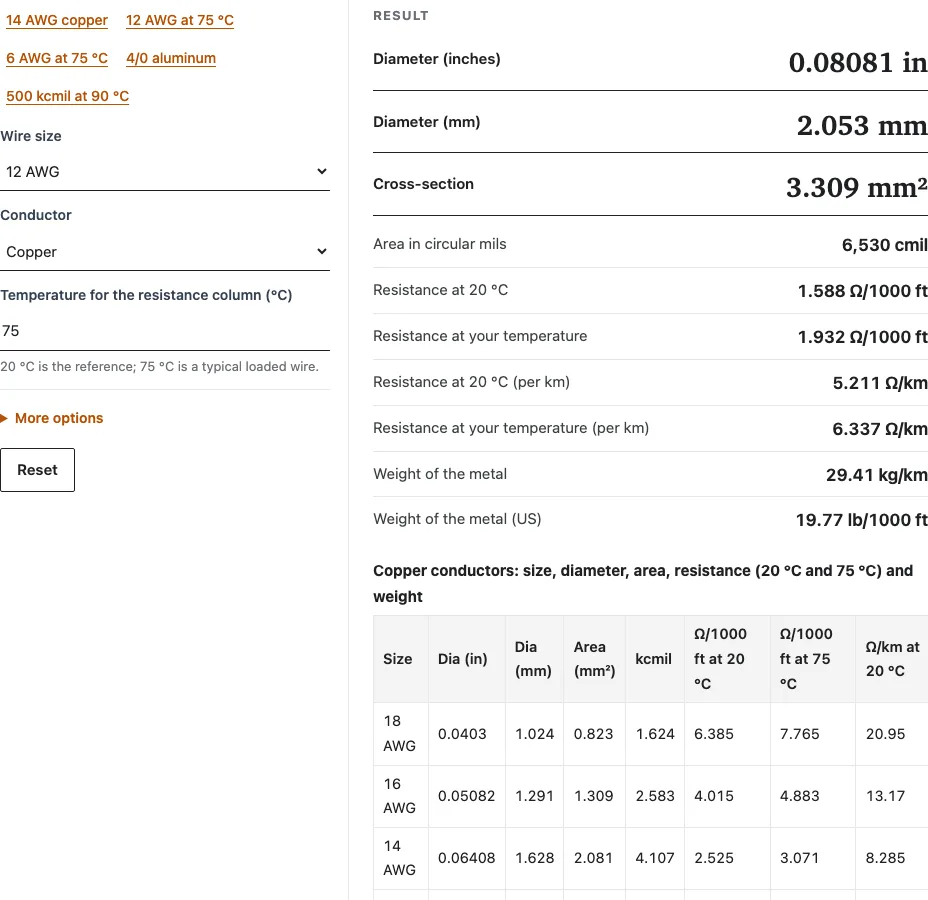
12 AWG is 0.08081 in (2.053 mm) across, with a cross-section of 3.309 mm² or 6,530 circular mils. The same formula gives every other gauge, and the area grows about 26 % with each step down in number. Common building-wire sizes from the chart:
| Size | Dia (in) | Dia (mm) | Area (mm²) | kcmil |
|---|---|---|---|---|
| 14 AWG | 0.06408 | 1.628 | 2.081 | 4.107 |
| 12 AWG | 0.08081 | 2.053 | 3.309 | 6.530 |
| 10 AWG | 0.1019 | 2.588 | 5.261 | 10.38 |
| 8 AWG | 0.1285 | 3.264 | 8.366 | 16.51 |
| 6 AWG | 0.1620 | 4.115 | 13.30 | 26.25 |
| 4 AWG | 0.2043 | 5.189 | 21.15 | 41.74 |
| 1/0 AWG | 0.3249 | 8.251 | 53.48 | 105.5 |
| 4/0 AWG | 0.4600 | 11.68 | 107.2 | 211.6 |
These are bare conductor sizes. Insulation adds to the outside diameter, which matters for conduit fill but not for resistance.
How does resistance change with wire gauge and temperature?
Resistance equals resistivity divided by area, so it drops as the wire gets thicker: 12 AWG copper is 1.588 Ω per 1000 ft at 20 °C and 10 AWG is 0.9988. Warming the wire raises it by about 0.393 % per °C for copper, which is why the chart lets you choose the temperature.
For 12 AWG copper the tool prints:
- 0.017241 Ω·mm²/m ÷ 3.3088 mm² = 5.211 Ω/km = 1.588 Ω per 1000 ft at 20 °C (100 % IACS, NBS Handbook 100).
- At 75 °C: × (1 + 0.00393 × 55) = 6.337 Ω/km = 1.932 Ω per 1000 ft.
Aluminum uses 0.028264 Ω·mm²/m and a coefficient of 0.00403, so the same size has about 1.64 times the resistance of copper. It is far lighter, though: 4/0 aluminum weighs 290.0 kg/km of metal against 953.2 kg/km for 4/0 copper.
Worked examples
| Input | Result |
|---|---|
| 14 AWG copper, 20 °C | 1.628 mm, 2.081 mm², 2.525 Ω/1000 ft |
| 12 AWG copper, 20 °C | 2.053 mm, 3.309 mm², 1.588 Ω/1000 ft |
| 10 AWG copper, 20 °C | 2.588 mm, 5.261 mm², 0.9988 Ω/1000 ft |
| 4/0 AWG aluminum, 20 °C | 11.68 mm, 107.2 mm², 0.08035 Ω/1000 ft |
| 500 kcmil copper, 75 °C | 17.96 mm, 253.4 mm², 0.02523 Ω/1000 ft |
Calculated by the tool above; open it with the same values to see each step.
Questions, briefly answered
Does the chart show how much current a wire can carry?
No. Ampacity depends on insulation, terminals and installation and comes from NEC 310.16, so it is not part of a physical chart. Use the Wire Ampacity Calculator for that.
How many mm² is 10 AWG?
10 AWG is 5.261 mm² (10,380 circular mils), and its diameter is 2.588 mm.
What does kcmil mean?
Thousands of circular mils. It names sizes larger than 4/0 AWG by their area, so 250 kcmil is 250,000 cmil, or 126.7 mm².
Why are there two resistance values?
The 20 °C value is the reference used by data sheets. The second uses the temperature you enter, because a loaded conductor runs warm and its resistance rises with it.
Does the weight include the insulation?
No. Weight of the metal is the bare copper or aluminum only, from its density (8.89 g/cm³ for copper, 2.705 g/cm³ for aluminum). 12 AWG copper is 29.41 kg/km, or 19.77 lb per 1000 ft.
Should I tick the stranded conductor box?
Tick it for stranded wire. The tool adds 2 % to the resistance, the low end of the 2 to 5 % that concentric stranding adds over a solid rod of the same size.
Why does the wire gauge chart have no ampacity column?
Ampacity depends on the insulation temperature, the ambient temperature, bundling and the code in force, so it is not a property of the wire size alone. Use the wire ampacity calculator for a value with those factors applied.
Related tools
- AWG to mm2 Converter: convert one size between AWG, mm² and circular mils.
- Wire Ampacity Calculator: how many amps a size can carry after derating.
- Wire Size Calculator: the size a load and run length need.
- Voltage Drop Calculator: the drop a size gives over a run.
- Extension Cord Gauge Chart: cord gauge by amps and length.
- Battery Cable Size Calculator: cable for a battery bank or inverter.
- Conduit Fill Calculator: how many insulated wires fit in a conduit.
- Wire and Cable Calculators: every wire tool on the site.