Wire Size Calculator
Enter the load, voltage and run length to get the wire size that satisfies both ampacity and voltage drop.
Assumes NEC 2023 Table 310.16: copper or aluminum as chosen, up to 3 current-carrying conductors in a raceway or cable, 30 °C ambient unless changed, 60 °C terminals for circuits of 100 A or less (110.14(C)), breaker = next standard rating. Free, runs in your browser. Verify with your local code and a licensed electrician before you install.
Recent
Your last 10 settings, saved only in this browser. Nothing is uploaded.
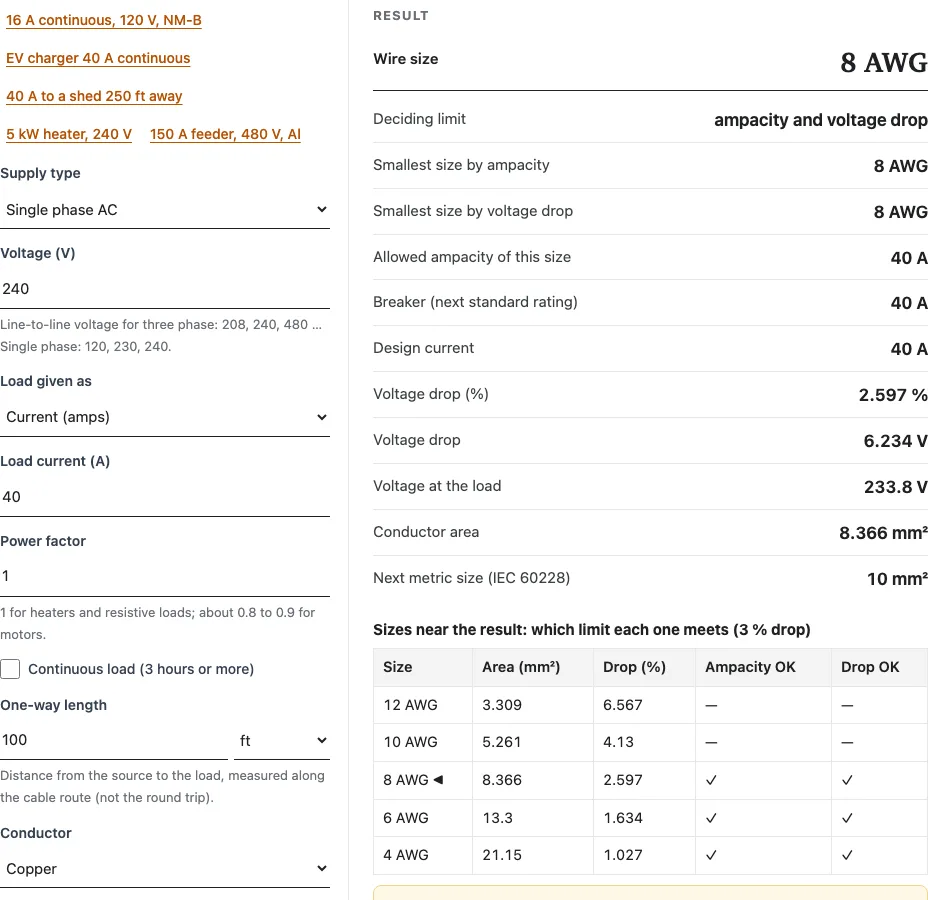
How to use the wire size calculator
- Choose the Supply type: Single phase AC, Three phase AC or DC.
- Enter the Voltage (V); for three phase, the line-to-line value such as 208 or 480.
- Set Load given as. With “Current (amps)”, type the Load current (A). With “Power (watts)”, enter the Load power in W, kW or hp and, for AC, the Power factor.
- Tick Continuous load (3 hours or more) for loads such as an EV charger that run that long.
- Enter the One-way length in ft or m along the cable route.
- Select the Conductor (Copper or Aluminum) and the Insulation temperature rating: 60 °C for NM-B and UF-B, 75 °C for THW, THWN and XHHW, 90 °C for THHN, THWN-2 and XHHW-2.
- Set the Allowed voltage drop (%), 3 by default.
- Under More options, change the Terminal temperature rating, the Ambient temperature and its unit, the Current-carrying conductors in the raceway or cable, the Conductor temperature for the drop (°C) or the Stranded conductor (+2 % resistance) box when your installation differs from the defaults.
- Read Wire size, Deciding limit and Breaker (next standard rating), then the warnings.
Example buttons such as “EV charger 40 A continuous” fill in a typical case. Copy result, Copy link and Print / save as PDF keep the answer with its steps, and Reset restores the defaults.
How do you calculate wire size?
Work out the design current, find the smallest wire whose ampacity covers it, then check that the voltage drop over the run stays within your limit. If the drop is too high, step up until it fits. The larger of the two sizes is the one to install, and the calculator prints each value it used.
The default case, 40 A non-continuous at 240 V single phase over 100 ft of 75 °C copper, runs like this:
- Design current: 40 A; breaker = next standard rating, 40 A (NEC 240.6(A)). A continuous load would be multiplied by 125 % first (NEC 210.19(A)(1)(a)).
- Ampacity: 8 AWG copper in the 75 °C column is 50 A; at 30 °C and three conductors both correction factors are 1 (NEC 310.15(B)(1), 310.15(C)(1)).
- Terminal limit: the circuit is 100 A or less, so the 60 °C column applies under NEC 110.14(C)(1), giving 40 A. That is enough for the load.
- Voltage drop: 8 AWG gives 6.234 V, or 2.6 %, within 3 %.
- Both limits give 8 AWG.
Which limit decides the wire size?
Short runs are usually set by ampacity and long runs by voltage drop. The tool reports both sizes in Smallest size by ampacity and Smallest size by voltage drop, then picks the larger one. These preset runs show each case:
| Preset | Wire size | Deciding limit | Drop |
|---|---|---|---|
| 16 A continuous, 120 V, NM-B, 50 ft | 12 AWG | both | 2.63 % |
| EV charger 40 A continuous, 60 ft | 6 AWG | ampacity (50 A design) | 0.98 % |
| 40 A to a shed 250 ft away | 4 AWG | voltage drop (ampacity alone: 8 AWG) | 2.57 % |
| 5 kW heater, 240 V, 80 ft | 10 AWG | ampacity (26.04 A design, 30 A breaker) | 1.72 % |
For NM-B cable the tool sizes from the 60 °C column, as NEC 334.80 requires, and says so in a warning.
How do I calculate wire size for 3 phase?
Set Supply type to Three phase AC and enter the line-to-line voltage. Ampacity is checked the same way as single phase, but the drop uses √3 instead of 2, so a three phase run loses about 13 % less voltage than a single phase run with the same wire, current and length. The tool applies the factor for you.
| Case | Size | Deciding limit | Drop |
|---|---|---|---|
| 40 A, 208 V single phase, 150 ft, copper | 6 AWG | voltage drop | 2.83 % |
| 40 A, 208 V three phase, 150 ft, copper | 6 AWG | voltage drop | 2.45 % |
| 150 A feeder, 480 V, aluminum 90 °C, 75 °C terminals, 200 ft | 3/0 AWG | ampacity (drop alone: 1 AWG) | 1.37 % |
In the feeder case, 3/0 aluminum is 175 A in the 90 °C column, but the 75 °C terminals hold it to 155 A.
Worked examples
| Input | Result |
|---|---|
| 40 A, 240 V Single phase AC, 100 ft, copper 75 °C | 8 AWG (ampacity and voltage drop, 2.6 %) |
| 16 A continuous, 120 V Single phase AC, 50 ft, copper 60 °C | 12 AWG (ampacity and voltage drop, 2.63 %) |
| 48 A continuous, 240 V Single phase AC, 60 ft, copper 75 °C | 4 AWG (ampacity (NEC 310.16), 0.74 %) |
| 40 A, 240 V Single phase AC, 250 ft, copper 75 °C | 4 AWG (voltage drop, 2.57 %) |
| 150 A, 480 V Three phase AC, 200 ft, aluminum 90 °C | 3/0 AWG (ampacity (NEC 310.16), 1.37 %) |
Calculated by the tool above; open it with the same values to see each step.
Questions, briefly answered
How do you use this electrical wire size calculator?
Enter the supply type, voltage, load and one-way length, choose the conductor and insulation, and read Wire size with its Deciding limit. Start from an example button if your circuit is close to one of them.
Does the wire size include the ground wire?
No. The tool reminds you that the equipment grounding conductor is not included; size it from the breaker rating with NEC Table 250.122.
Why does a continuous load need a bigger wire?
A load that runs 3 hours or more is sized at 125 % of its current. The EV charger preset draws 40 A, is sized for 50 A and needs 6 AWG; the same 40 A non-continuous load needs 8 AWG.
Can I size a wire in mm²?
The size search uses AWG and kcmil. The result also shows the Conductor area in mm² and the Next metric size (IEC 60228); the default 8 AWG is 8.366 mm², next metric size 10 mm².
Can I use this calculator for DC circuits?
Yes. Set Supply type to DC; the drop uses the factor 2 and the power factor field is hidden. 30 A at 48 V over 50 ft of copper gives 4 AWG, set by voltage drop.
What do ambient temperature and conductor count change?
They lower the ampacity under NEC 310.15(B)(1) and 310.15(C)(1). When either is above the default (30 °C, three conductors), the tool applies the factor and warns you to check conditions along the whole run.
Related tools
- Wire Ampacity Calculator: the allowed current of one size after derating.
- Voltage Drop Calculator: the drop for a size you already have, or the longest run.
- Cable Size Calculator: sizing in mm².
- Wire Size for 50 Amp Circuit: ranges, EV chargers and subpanels on 50 A.
- Wire Size for 30 Amp Circuit: dryers, water heaters and 30 A circuits.
- Wire Size for 60 Amp Circuit: subpanels and large heaters.
- Minimum Circuit Ampacity Calculator: MCA for motors and HVAC units.
- Wire Gauge Chart: diameters and areas of every AWG size.
- Wire and Cable Calculators: every wire tool on the site.