Wire Size for 30 Amp Circuit
Find the wire gauge for a 30 amp breaker and see how far it can run before the voltage drop is too high.
Assumes NEC 2023 Table 310.16: copper or aluminum, up to 3 current-carrying conductors in a raceway or cable, 30 °C ambient, 60 °C terminals for a 30 A circuit (110.14(C)), 3 % drop target; ground wire not included. Free, runs in your browser. Verify with your local code and a licensed electrician before you install.
Recent
Your last 10 settings, saved only in this browser. Nothing is uploaded.
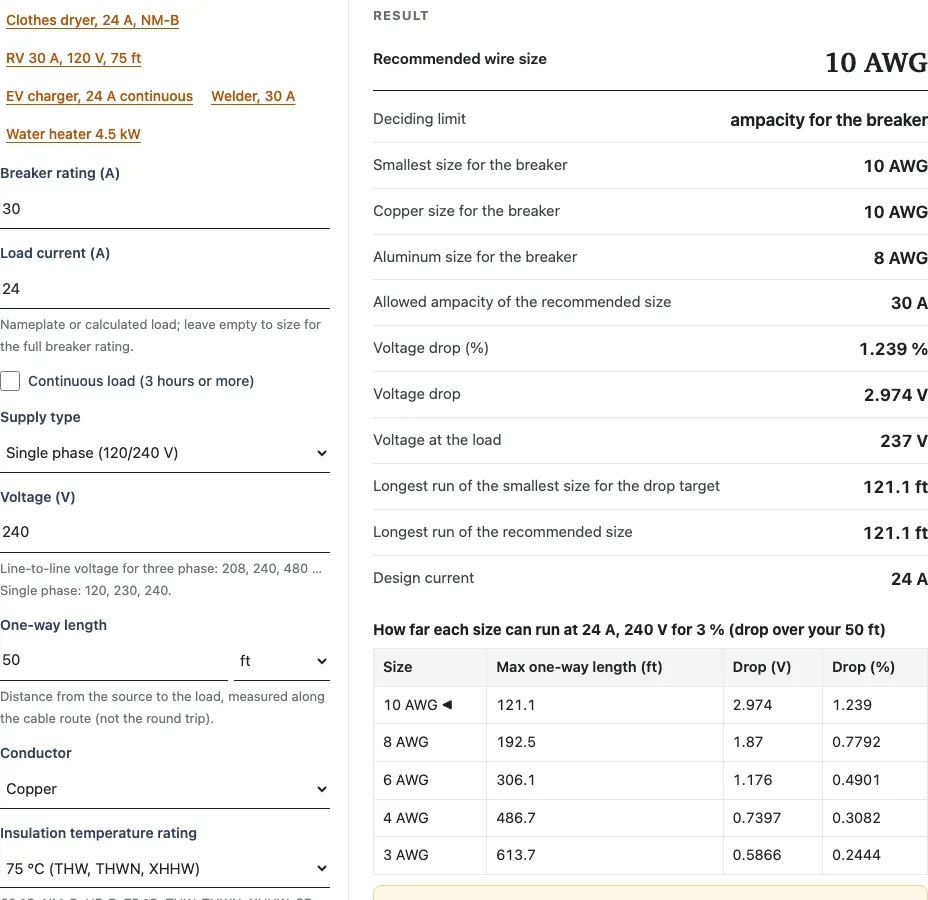
How to use the 30 Amp Wire Size Calculator
- Keep 30 in “Breaker rating (A)”, or enter the rating of your breaker.
- Put the nameplate or calculated current in “Load current (A)”. An empty box sizes the wire for the whole 30 A.
- Tick “Continuous load (3 hours or more)” for a water heater, an EV charger or any load that runs that long.
- Choose the “Supply type” and enter “Voltage (V)”: 240 for a dryer or water heater, 120 for a TT-30 RV outlet.
- Enter the “One-way length” in ft or m, from the panel to the load along the cable route.
- Choose Copper or Aluminum under “Conductor”.
- Pick the “Insulation temperature rating” printed on the cable: 60 °C for NM-B or UF-B, 75 °C for THWN, 90 °C for THHN.
- Leave “Allowed voltage drop (%)” at 3 unless you work to another limit.
- Change “Terminal temperature rating”, “Ambient temperature” or “Current-carrying conductors in the raceway or cable” only when your installation differs from the defaults.
- Read “Recommended wire size” and “Deciding limit”, then the steps and warnings.
The example buttons above the form fill in a clothes dryer, a 120 V RV hookup, an EV charger, a welder or a 4.5 kW water heater. Use “Copy result” or “Copy link” to pass the answer on, “Print / save as PDF” to keep it, and Reset to start again.
What is the wire size for a 30 amp breaker?
The minimum is 10 AWG copper or 8 AWG aluminum. NEC 240.4(D) lets a 10 AWG copper conductor sit on a breaker of 30 A at most, and the calculator confirms that 10 AWG copper keeps 30 A even with 60 °C terminals. Aluminum carries less current per size, so it moves up to 8 AWG.
The steps for the starting values show where the number comes from:
- 10 AWG copper is 35 A in the 75 °C column of NEC 310.16.
- The ambient and conductor-count factors are 1 at 30 °C with three current-carrying conductors.
- The 60 °C terminal limit of 110.14(C)(1) caps it at 30 A.
- 240.4(D) also limits a 10 AWG conductor to a 30 A breaker, so changing the terminal setting to 75 °C does not make 12 AWG acceptable.
How far will #10 wire carry 30 amps?
At a full 30 A on 240 V, 10 AWG copper runs about 97 ft one way before the drop passes 3 %. On 120 V the same wire reaches only about 48 ft, because the same volts lost are twice the share of a lower voltage. Past those lengths the tool picks 8 AWG.
| Copper, 30 A load | One-way length | Recommended size | Drop |
|---|---|---|---|
| 240 V | 50 ft | 10 AWG | 1.55 % |
| 240 V | 150 ft | 8 AWG | 2.92 % |
| 120 V | 60 ft | 8 AWG | 2.34 % |
| 120 V | 75 ft | 8 AWG | 2.92 % |
At the lighter 24 A load of the starting values, 10 AWG reaches about 121 ft on 240 V.
What gauge wire for 30 amp aluminum circuits?
Aluminum needs 8 AWG for a 30 amp breaker, one size larger than copper. NEC 240.4(D) limits 10 AWG aluminum to a 25 A breaker, so it cannot serve a 30 A circuit. Over a long run the drop decides again: 24 A over 150 ft on 240 V needs 6 AWG aluminum, at 2.42 %.
Aluminum connections need lugs and connectors marked AL/CU, tightened to the maker’s torque value, and the tool prints that reminder whenever you pick aluminum.
Worked examples
| Input | Result |
|---|---|
| 30 A breaker, 24 A load, 240 V, 50 ft, copper 75 °C | 10 AWG (1.24 %) |
| 30 A breaker, 24 A load, 240 V, 35 ft, copper 60 °C | 10 AWG (0.867 %) |
| 30 A breaker, 24 A load, 240 V, 40 ft, copper 75 °C | 10 AWG (0.991 %) |
| 30 A breaker, 30 A load, 120 V, 60 ft, copper 75 °C | 8 AWG (2.34 %) |
| 30 A breaker, 24 A load, 240 V, 150 ft, aluminum 75 °C | 6 AWG (2.42 %) |
Calculated by the tool above; open it with the same values to see each step.
Questions, briefly answered
Can I use 12 gauge wire on a 30 amp breaker?
No. NEC 240.4(D) limits 12 AWG copper to a 20 A breaker, so a 30 A breaker cannot protect it.
Is 12-3 wire good for 30 amps?
No. The 12 means 12 AWG conductors, which belong on 20 A circuits. A 30 A circuit that needs a neutral, such as a dryer, uses 10-3 copper cable or larger.
Can I use 10/2 wire for a 30 amp breaker?
Yes, for a load that needs no neutral, such as a 240 V water heater. 10 AWG copper NM-B is good for 30 A in the 60 °C column. Check the voltage drop for your length in the tool.
When should you upgrade to 8 AWG?
When 10 AWG goes over your drop target. At 30 A that happens past about 97 ft on 240 V or 48 ft on 120 V, and the “Deciding limit” row then reads voltage drop.
Does the calculator size the ground wire?
No. It reminds you to size the equipment grounding conductor from NEC Table 250.122 for the breaker rating, which for a 30 A breaker is 10 AWG copper.
What will happen with the wrong size wire?
A wire that is too small for the breaker can overheat before the breaker trips. The heat damages the insulation and can start a fire.
Related tools
- Wire Size for 50 Amp Circuit: for ranges, 50 A RV pedestals and EV chargers.
- Wire Size for 60 Amp Circuit: for 60 A subpanels and shop feeders.
- Wire Size Calculator: for any other breaker, a load in watts or three phase.
- Voltage Drop Calculator: to check the drop of a wire you already have.
- Wire Ampacity Calculator: to see how much current one size carries under your conditions.
- Watts to Amps Calculator: to turn a water heater or dryer rating in watts into amps.
- Extension Cord Gauge Chart: for a cord to a portable 30 A tool or generator.
- Wire and Cable Calculators: every wire sizing tool on the site.