Wire Size for 50 Amp Circuit
Find the copper or aluminum wire for a 50 amp breaker and check the voltage drop for your run length.
Assumes NEC 2023 Table 310.16: copper or aluminum, up to 3 current-carrying conductors in a raceway or cable, 30 °C ambient, 60 °C terminals for a 50 A circuit (110.14(C)), 3 % drop target; ground wire not included. Free, runs in your browser. Verify with your local code and a licensed electrician before you install.
Recent
Your last 10 settings, saved only in this browser. Nothing is uploaded.
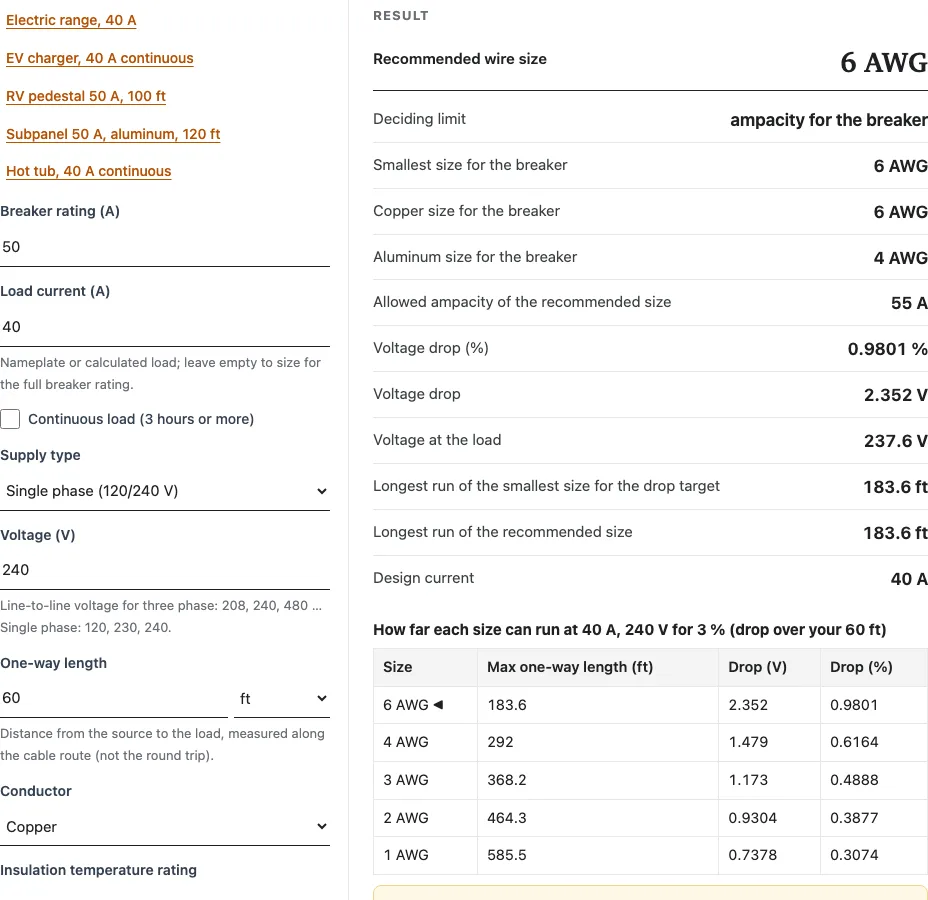
How to use the 50 Amp Wire Size Calculator
- Keep 50 in “Breaker rating (A)”, or type the rating printed on your breaker.
- Enter the nameplate or calculated current in “Load current (A)”. Leave it empty and the wire is sized for the full breaker rating.
- Tick “Continuous load (3 hours or more)” for loads such as an EV charger or a hot tub heater. The design current then becomes 125 % of the load.
- Pick the “Supply type” and enter “Voltage (V)”: 240 for most 50 A residential circuits, or the line-to-line voltage for three phase.
- Type the “One-way length” in ft or m, measured along the cable route from the panel to the load.
- Choose Copper or Aluminum under “Conductor” and the “Insulation temperature rating” printed on the cable, for example 60 °C for NM-B.
- Leave “Allowed voltage drop (%)” at 3 unless your project sets another limit.
- Open the advanced settings only when they apply: “Terminal temperature rating” (keep Auto unless the equipment is listed for 75 °C), “Ambient temperature” and “Current-carrying conductors in the raceway or cable”.
- Read “Recommended wire size” and “Deciding limit”, then the steps and warnings below the result.
The example buttons above the form load a range, an EV charger, an RV pedestal, an aluminum subpanel or a hot tub. “Copy result”, “Copy link” and “Print / save as PDF” keep the answer, and Reset restores the starting values.
What size wire do I need for a 50 amp breaker?
With the terminal setting left on Auto, the calculator answers 6 AWG in copper and 4 AWG in aluminum. Both sizes have an allowed ampacity of 55 A once the 60 °C terminal limit of NEC 110.14(C)(1) is applied, which covers the 50 A breaker. A longer run can still push the answer up a size.
The calculator checks the sizes in this order:
- The conductor must be protected by the breaker, so its allowed ampacity has to be at least 50 A (NEC 240.4 and 310.16).
- The insulation column gives the starting value, and the ambient factor (310.15(B)(1)) and the factor for more than three current-carrying conductors (310.15(C)(1)) reduce it.
- The terminal column caps the result. For copper 6 AWG the steps show 65 A in the 75 °C column, cut to 55 A by 60 °C terminals.
- Voltage drop at your load current is checked last, and the larger of the two sizes wins.
Why can both 6 AWG and 8 AWG be recommended for 50 amps?
The difference is the terminal rating. With Auto, copper 8 AWG fails because 60 °C terminals limit it below 50 A, so the tool picks 6 AWG. Set “Terminal temperature rating” to 75 °C, which is allowed only when the breaker and the equipment are listed for it, and 8 AWG copper passes at 50 A.
| Settings (50 A breaker, 40 A load, 240 V, 60 ft) | Copper | Aluminum |
|---|---|---|
| Terminal rating Auto | 6 AWG | 4 AWG |
| Terminal rating 75 °C (listed equipment) | 8 AWG | 6 AWG |
NM-B cable is a separate case: its 60 °C insulation keeps it in the 60 °C column (NEC 334.80), so 6 AWG NM-B is the minimum whatever the terminals are.
How far can you run 50 amp wire at 240V?
At a full 50 A load on 240 V, 6 AWG copper reaches about 147 ft one way before the drop passes 3 %. At a 40 A load it reaches about 184 ft. Beyond those distances the calculator moves up to 4 AWG copper because of voltage drop, not ampacity.
| 6 AWG copper, 240 V | One-way length | Voltage drop |
|---|---|---|
| 40 A load | 50 ft | 0.817 % |
| 40 A load | 60 ft | 0.98 % |
| 50 A load | 100 ft | 2.04 % |
| 50 A load | 150 ft | over 3 %, so 4 AWG at 1.93 % |
Voltage matters only here. The same 40 A over 50 ft drops 1.63 % at 120 V against 0.817 % at 240 V, while the ampacity answer stays 6 AWG.
Worked examples
| Input | Result |
|---|---|
| 50 A breaker, 40 A load, 240 V, 60 ft, copper 75 °C | 6 AWG (0.98 %) |
| 50 A breaker, 40 A load, 240 V, 30 ft, copper 75 °C | 6 AWG (0.49 %) |
| 50 A breaker, 40 A load, 240 V, 40 ft, copper 60 °C | 6 AWG (0.653 %) |
| 50 A breaker, 45 A load, 240 V, 150 ft, aluminum 75 °C | 4 AWG (2.85 %) |
| 50 A breaker, 40 A load, 120 V, 50 ft, copper 75 °C | 6 AWG (1.63 %) |
Calculated by the tool above; open it with the same values to see each step.
Questions, briefly answered
Is 8 gauge wire enough for 50 amps?
Not with the Auto setting. Copper 8 AWG has 50 A in the 75 °C column but only 40 A in the 60 °C column, and Auto applies 60 °C terminals to circuits up to 100 A. It passes only when the equipment is listed for 75 °C and the cable is not NM-B.
Is 8 AWG aluminum enough for 50 amps?
No. Aluminum 8 AWG stays below 50 A in every terminal setting the tool offers, so its aluminum answer is 4 AWG with Auto and 6 AWG with listed 75 °C terminals.
How far can I run 6 gauge wire at 50 amps?
About 147 ft one way at 240 V with a full 50 A load and a 3 % drop target. Change the load or the target and the “Longest run of the recommended size” row updates.
Will 12/2 wire carry 50 amps?
No. NEC 240.4(D) limits 12 AWG copper to a 20 A breaker, so it cannot be used on a 50 A circuit.
Can I use 6 AWG aluminum for 50 amps?
Only with terminals listed for 75 °C. Under Auto the 60 °C limit leaves it short of 50 A, so the tool gives 4 AWG aluminum. Aluminum also needs lugs and connectors marked AL/CU.
Is 3% voltage drop a requirement?
No. The 3 % for a branch circuit and 5 % in total come from informational notes in the NEC, which are advice rather than rules. You can change “Allowed voltage drop (%)” to any target.
What size wire do I need for a 50 amp EV charger circuit?
A charger drawing 40 A is a continuous load, and 40 A × 125 % = 50 A fits a 50 A breaker. The “EV charger, 40 A continuous” example gives 6 AWG copper at 0.98 % over 60 ft.
What about a true 50 amp continuous load?
It needs a larger circuit. 50 A × 125 % = 62.5 A is above the breaker, and the tool warns that the breaker would trip.
Related tools
- Wire Size for 30 Amp Circuit: for dryers, water heaters and 30 A RV hookups.
- Wire Size for 60 Amp Circuit: for 60 A subpanels and larger EV chargers.
- Wire Size Calculator: for any breaker or load, including watts and three phase.
- Wire Ampacity Calculator: to see how much current one wire size can carry under your conditions.
- Voltage Drop Calculator: to check the drop of a wire size you already have.
- Electrical Load Calculator: to find whether a new 50 A circuit fits your service.
- Conduit Fill Calculator: to pick the conduit for the conductors you chose.
- Wire and Cable Calculators: every wire sizing tool on the site.