
Aluminum to Copper Wire Size Converter
Find the copper or aluminum conductor with at least the same NEC Table 310.16 ampacity, and compare its cross-section and weight.
Pro calculator. The examples run free for everyone, with full results and steps; 3 results a month with your own numbers are free, then Pro. Always free: 9 calculators + 5 charts.
Calculates wire and electrical parameters per NEC 2023. Runs in your browser. Verify with your local code and a licensed electrician before you install.
Recent
Your last 10 settings, saved only in this browser. Nothing is uploaded.
How to use the Aluminum to Copper Wire Size Converter
- Choose the direction: aluminum to the equivalent copper size, or copper to the equivalent aluminum size.
- Select the size you have, from 12 AWG to 750 kcmil.
- Select the Table 310.16 temperature column that applies: usually 75 °C (most breakers and lugs above 100 A), 60 °C for NM-B cable and many small terminals, 90 °C only as the starting point for derating.
- Read the result: the smallest size of the other metal whose ampacity in the same column is at least the ampacity of your conductor, both ampacities, and how its cross-section and weight compare.
- For 14-10 AWG copper and 12-10 AWG aluminum, read the 240.4(D) note: the breaker limit, not the table ampacity, decides.
- Check that the lugs are marked for aluminum (AL7CU or AL9CU; CO/ALR on 15 A and 20 A devices) and confirm the size with your local code and a licensed electrician.
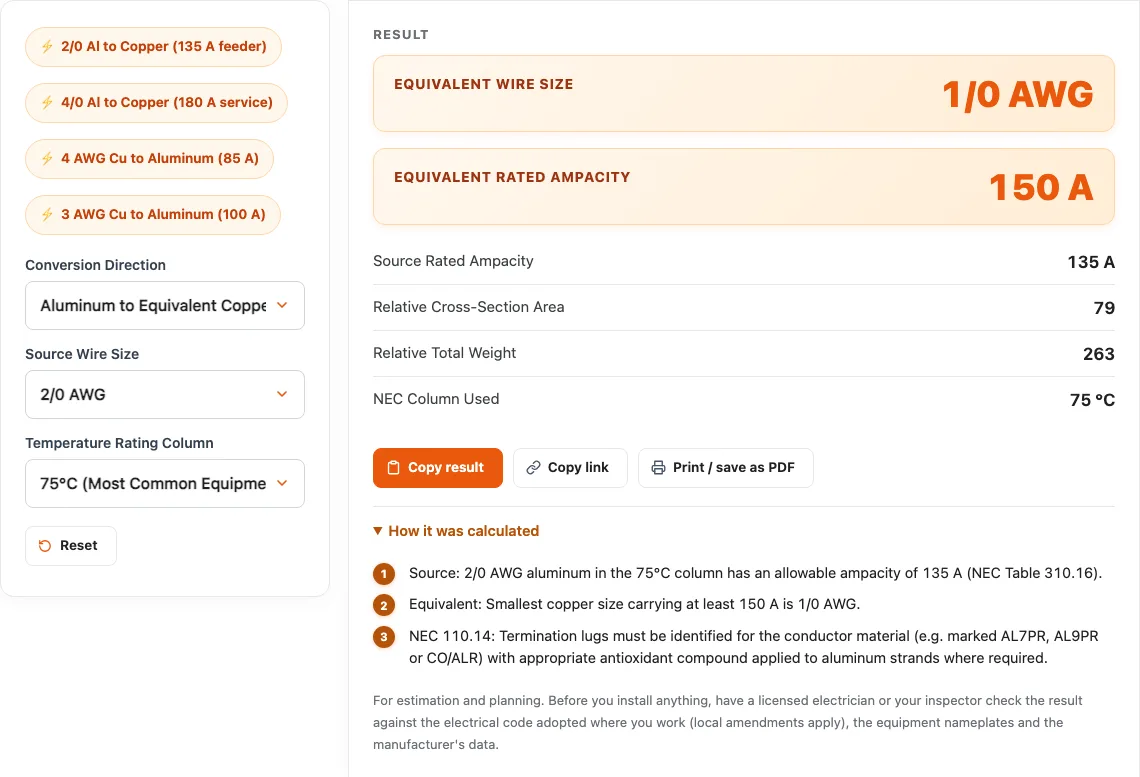
Example: 2/0 aluminum in the 75 °C column is rated 135 A. The smallest copper size with at least 135 A in that column is 1/0 AWG (150 A), so 1/0 copper can replace 2/0 aluminum. The 1/0 copper conductor has about 79 % of the cross-section of the aluminum one but weighs about 2.6 times as much. Going the other way, 3/0 copper (200 A) becomes 250 kcmil aluminum (205 A). The match is by ampacity only: the new conductor must still meet voltage drop, conduit fill and the terminal ratings of the equipment.
Technical Comparison: Aluminum Alloy vs. Copper Conductors
Understanding the metallurgical, thermal, and mechanical differences between modern electrical aluminum and copper is essential for code-compliant design.
Historical Context: Modern AA-8000 Alloy vs. 1960s Aluminum
A widespread misconception exists that aluminum wiring is unsafe. In the 1960s and 1970s, utility companies and builders installed utility-grade AA-1350 aluminum wire in 15A and 20A residential branch circuits. AA-1350 exhibited pronounced thermal creep, relaxing under screw terminals and oxidizing into high-resistance aluminum oxide, which led to overheated connections.
Aluminum building wire is now made from AA-8000 series alloy (ASTM B800/B801), which NEC 310.3(B) requires for solid 8-4 AWG and for the common stranded building-wire types from 8 AWG to 1000 kcmil. Modern AA-8000 alloy exhibits thermal expansion coefficients closely matching copper, resists creep, and maintains tight terminal connections under cyclical loads. Today, AA-8000 aluminum is the universally accepted standard for heavy residential service entrances and commercial feeders.
Equivalent Gauge Rules Across NEC Table 310.16
Because copper has lower electrical resistivity ($12.9,\Omega\cdot\text{cmil/ft}$ for copper vs. $21.2,\Omega\cdot\text{cmil/ft}$ for aluminum at 75 °C), aluminum requires more cross-sectional area to achieve equal ampacity:
- 100A Rating (75 °C): Requires 3 AWG Copper (100A) vs. 1 AWG Aluminum (100A).
- 150A Rating (75 °C): Requires 1/0 AWG Copper (150A) vs. 3/0 AWG Aluminum (155A).
- 200A Rating (75 °C): Requires 3/0 AWG Copper (200A) vs. 250 kcmil Aluminum (205A) or 4/0 Aluminum under residential dwelling service allowances.
Mechanical and Installation Trade-offs
- Weight: Aluminum has an elemental density of $2.70\text{ g/cm}^3$ compared to $8.96\text{ g/cm}^3$ for copper. An aluminum conductor of equal ampacity weighs roughly 40% to 55% of the copper one (for example 250 kcmil aluminum is about 45% of the weight of 3/0 copper), substantially reducing physical strain when pulling long feeders through conduit.
- Conduit Area: Because aluminum requires larger physical wire diameter, larger trade size conduit is often required to comply with the 40% maximum conduit fill rule in NEC Chapter 9 Table 1.
- Terminations: Aluminum conductors must only be installed in mechanical lugs marked AL7CU (rated for 75 °C copper/aluminum) or AL9CU (rated for 90 °C copper/aluminum). All connections must be torqued with a calibrated torque wrench per NEC 110.14(D).
Worked examples
| Input | Result |
|---|---|
| 2/0 Aluminum at 75 °C (135 A) | 1/0 AWG Copper (150 A, area 79 %) |
| 4/0 Aluminum at 75 °C (180 A) | 3/0 AWG Copper (200 A, area 79 %) |
| 4 Copper at 75 °C (85 A) | 2 AWG Aluminum (90 A, area 159 %) |
| 2/0 Copper at 75 °C (175 A) | 4/0 AWG Aluminum (180 A, area 159 %) |
Calculated by the tool above; open it with the same values to see each step.
Questions, briefly answered
Common questions regarding copper and aluminum conductor conversions and NEC Table 310.16 equivalencies:
Is aluminum wire as safe as copper wire?
AA-8000 series aluminum alloy conductors (required by NEC 310.3(B) for building wire) are code-compliant and standard for service entrances and feeders when they are terminated correctly. Modern aluminum alloys do not suffer from the thermal creep problems of 1960s wire. However, aluminum must be terminated using lugs marked AL7CU or AL9CU and torqued to manufacturer specifications.
How much larger does aluminum wire need to be compared to copper?
Under the 75 °C column of NEC Table 310.16, an aluminum conductor is typically one to two AWG sizes larger than an equivalent copper conductor. For example, a 100-amp circuit requires 3 AWG copper or 1 AWG aluminum; a 200-amp circuit requires 3/0 AWG copper or 250 kcmil aluminum.
Why do electricians prefer aluminum for large service feeders?
Aluminum usually costs much less than copper for large service-entrance and feeder conductors. In addition, aluminum of equal ampacity weighs roughly half as much as copper or less, making heavy cable pulls through long underground or attic conduits substantially easier and faster for installation crews.
Do I need anti-oxidant paste on aluminum wire terminations?
While modern AA-8000 aluminum alloys do not oxidize as aggressively as older alloys, most equipment manufacturers and electrical inspectors recommend or require an approved anti-oxidant compound (such as Noalox) on all stranded aluminum terminations. Always follow the manufacturer instructions printed on the equipment enclosure.