
EV Charger Wire Size Calculator
Determine minimum conductor gauge, breaker rating, ground wire and voltage drop for residential Level 2 EV charging stations per NEC 625.
Pro calculator. The examples run free for everyone, with full results and steps; 3 results a month with your own numbers are free, then Pro. Always free: 9 calculators + 5 charts.
Calculates wire and electrical parameters per NEC 2023. Runs in your browser. Verify with your local code and a licensed electrician before you install.
Recent
Your last 10 settings, saved only in this browser. Nothing is uploaded.
How to use the EV Charger Wire Size Calculator
- Select your EV charger charging level and continuous current rating from the dropdown options (standard residential Level 2 charging stations operate at 16A, 24A, 32A, 40A, or 48A on split-phase 240V power systems).
- Enter the one-way circuit run distance in feet measured along the complete raceway or cable route from the main service breaker panel to the charger wall station or NEMA receptacle location.
- Select your intended wiring method and conductor insulation: choose NM-B Romex cable (strictly limited to the 60 °C column per NEC 334.80), individual THHN or THWN-2 copper conductors in conduit (rated at the 75 °C terminal column), or aluminum SER cable (75 °C terminals).
- Specify your allowable maximum voltage drop threshold (common practice targets 3% or less for branch circuits; the NEC mentions this only in an informational note to 210.19, not as a rule).
- Review the calculated results panel: the calculator instantly evaluates the mandatory 125% continuous duty multiplier per NEC 625.42, selects the code-compliant conductor gauge from NEC Table 310.16, calculates the voltage drop and upsizes the wire if needed, and gives the equipment grounding conductor from NEC Table 250.122. Conduit size is not calculated: use a conduit fill calculator for that.
- Use the quick presets to test common scenarios such as a 40A plug-in charger or 48A hardwired wall connector, and click the copy buttons to export your calculations for electrical permitting and inspection.
Sizing Conductors for Electric Vehicle Charging Circuits
Level 2 electric vehicle supply equipment (EVSE) represents one of the largest single continuous electrical loads installed in residential garages and parking structures. Correct engineering requires balancing continuous thermal heating, terminal temperature limitations, and conductor voltage drop over distance.
The 125% Continuous Duty Rule (NEC 625.41 and 625.42)
The National Electrical Code defines a continuous load as any load where the maximum current is expected to continue for 3 hours or more. Because electric vehicle battery management systems draw steady maximum rated current throughout overnight charging sessions, NEC 625.42 makes EV charging a continuous load, and NEC 625.41 requires the overcurrent protective device (breaker) to be rated at least 125% of it; the branch circuit conductors need the same 125% (NEC 210.19).
Common residential EV charger ratings translate to specific circuit sizes:
- 16A Charger: Requires a 20A branch circuit breaker and conductors rated for at least 20 amperes.
- 24A Charger: Requires a 30A circuit breaker and conductors rated for at least 30 amperes.
- 32A Charger: Requires a 40A circuit breaker and conductors rated for at least 40 amperes (typically connected via NEMA 14-50 or 6-50 receptacles).
- 40A Charger: Requires a 50A circuit breaker and conductors rated for at least 50 amperes.
- 48A Charger: Requires a 60A circuit breaker and conductors rated for at least 60 amperes (must be hardwired per NEC 625.44, as plug-in receptacles are limited to 50A maximum).
Terminal Temperature Ratings and Cable Derating (NEC 334.80 & Table 310.16)
A frequent and hazardous error in EVSE installations involves misunderstanding conductor insulation temperature ratings. Standard circuit breakers and panel lugs are rated for 75 °C termination. While modern THHN wire is manufactured with 90 °C insulation, NEC 110.14(C) restricts operating ampacity to the 75 °C rating of the termination equipment.
Furthermore, when nonmetallic-sheathed cable (NM-B Romex) is installed, NEC 334.80 mandates that conductor ampacity must be determined using the 60 °C column of NEC Table 310.16 regardless of actual insulation rating. Under the 60 °C column:
- 6 AWG NM-B Copper has an allowable ampacity of only 55 amperes. This is insufficient for a 48A charger requiring 60A ampacity.
- 4 AWG NM-B Copper provides 70 amperes of allowable ampacity and is strictly required when using Romex for 48A EVSE.
- When individual THHN copper conductors in EMT or PVC conduit are run, the 75 °C column applies, allowing 6 AWG copper (rated 65 amperes) to supply a 48A charger.
Managing Long-Distance Voltage Drop
Excessive voltage drop during high-current vehicle charging reduces charging speed, increases thermal losses in walls, and can trigger onboard vehicle charger error faults. An informational note in NEC 210.19 suggests keeping branch-circuit voltage drop within 3% at full load (advice, not a requirement). At 240 volts, 3% drop equals 7.2 volts, delivering a minimum of 232.8 volts to the vehicle terminals. If long garage or detached workshop conduit runs exceed 80 to 100 feet, conductor gauge must often be upsized by one trade size above the minimum ampacity rating.
Worked examples
| Input | Result |
|---|---|
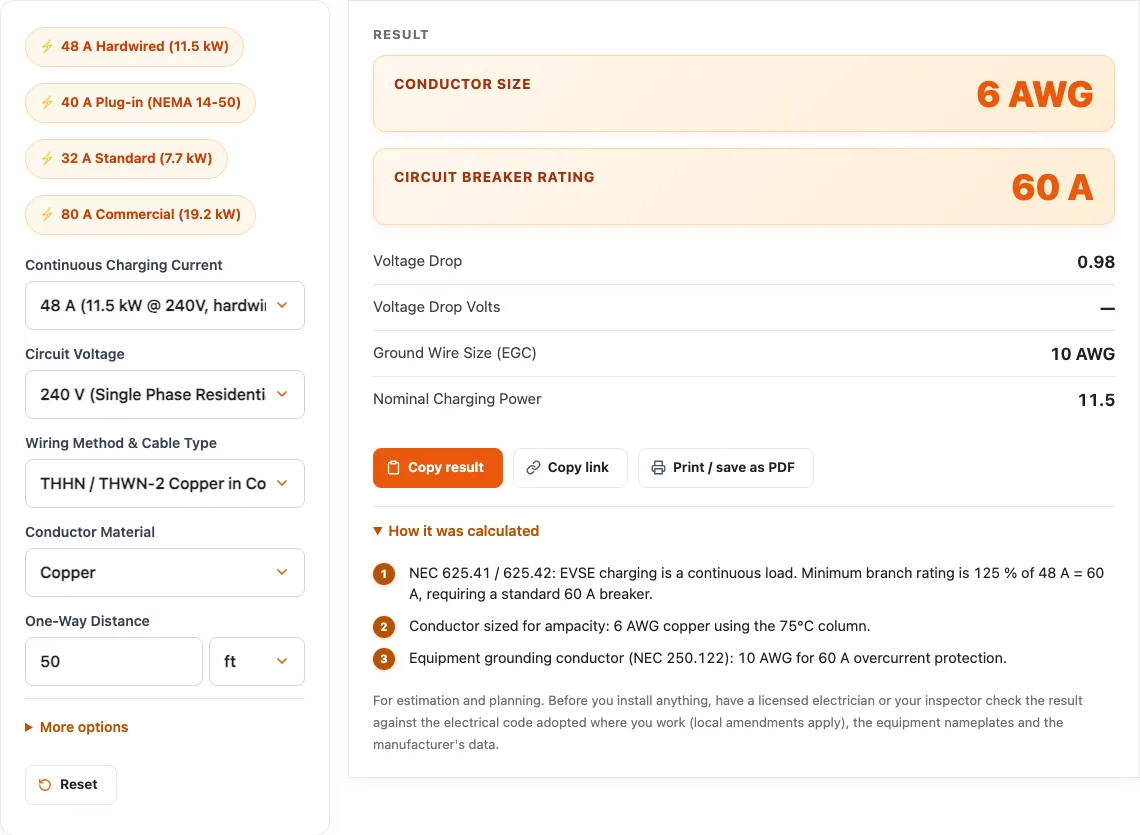
| 48 A at 240 V (50 ft) | 6 AWG Cu with 60 A breaker (0.98 % drop) |
| 40 A at 240 V (40 ft) | 6 AWG Cu with 50 A breaker (0.65 % drop) |
| 32 A at 240 V (60 ft) | 8 AWG Cu with 40 A breaker (1.2 % drop) |
| 80 A at 240 V (80 ft) | 3 AWG Cu with 100 A breaker (1.3 % drop) |
Calculated by the tool above; open it with the same values to see each step.
Questions, briefly answered
Common questions regarding electric vehicle supply equipment circuit sizing and installation standards:
Can I run a 48-amp EV charger with 6 AWG Romex cable?
No. National Electrical Code 334.80 explicitly restricts NM-B Romex cable to the 60 °C ampacity column of NEC Table 310.16. In the 60 °C column, 6 AWG copper is rated for 55 amperes, which is below the 60-ampere minimum required for a 48A continuous load (48A x 1.25 = 60A). You must either use 4 AWG Romex or run 6 AWG THHN conductors inside conduit where the 75 °C rating of 65 amperes applies.
Why does a 40-amp EV charger need a 50-amp circuit breaker?
Under NEC 625.42, vehicle charging is classified as a continuous load, and NEC 625.41 sets the breaker at 125% of it. Electrical panels and standard thermal-magnetic breakers are designed to operate continuously at no more than 80% of their faceplate rating. Multiplying 40A by 1.25 yields 50A, meaning a 50-amp circuit breaker is mandatory to prevent thermal nuisance tripping during long charging cycles.
Can I use aluminum conductors for an EV charger?
Yes, aluminum conductors (such as AA-8000 compact aluminum in conduit or SER cable) can be used if sized properly per NEC Table 310.16 (75 °C column) and terminated into mechanical lugs listed and rated for aluminum (marked AL7CU or AL9CU). Because aluminum has higher resistivity than copper, an equivalent EV circuit typically requires one to two AWG sizes larger (e.g., 4 AWG aluminum instead of 6 AWG copper). Ensure anti-oxidant paste is applied if required by lug manufacturer specifications.
Is a neutral wire required for an electric vehicle charging station?
Most hardwired Level 2 wall connectors (such as the Tesla Wall Connector or ChargePoint Home Flex) require only three conductors: Line 1, Line 2, and an Equipment Ground. They operate strictly at 240 volts and do not utilize 120V internal components. However, if installing a 14-50 receptacle for a portable mobile connector, a neutral conductor is required by standard NEMA 14-50 configurations.