
Grounding Electrode Conductor Calculator
Determine minimum copper or aluminum GEC size for building electrical services per NEC Table 250.66 and special electrode rules.
Pro calculator. The examples run free for everyone, with full results and steps; 3 results a month with your own numbers are free, then Pro. Always free: 9 calculators + 5 charts.
Calculates wire and electrical parameters per NEC 2023. Runs in your browser. Verify with your local code and a licensed electrician before you install.
Recent
Your last 10 settings, saved only in this browser. Nothing is uploaded.
How to use the Grounding Electrode Conductor Calculator
- Select the size of the largest ungrounded service-entrance conductor per phase (4 AWG to 1000 kcmil). For parallel sets, use the equivalent area of the sets per phase; where that is above 1000 kcmil, read Table 250.66 directly (over 1100 kcmil copper or 1750 kcmil aluminum needs 3/0 copper or 250 kcmil aluminum).
- Select the service conductor material, copper or aluminum.
- Select the GEC material. Aluminum or copper-clad aluminum may not touch masonry or the earth and, outside, may not end within 18 in (450 mm) of the earth (250.64(A)), so it cannot run to a rod, ring or concrete-encased electrode by itself.
- Select the electrode the conductor runs to: a metal water pipe or other electrode (full Table 250.66), a rod, pipe or plate only (250.66(A)), a concrete-encased electrode only (250.66(B)) or a ground ring only (250.66(C)).
- Read the Table 250.66 size and the required GEC after the 250.66(A)-(C) limits.
- Protect the conductor where it is exposed to physical damage (250.64(B)); a 6 AWG or larger conductor may run bare along the surface if it is not subject to damage. Confirm the result with your local code and a licensed electrician.
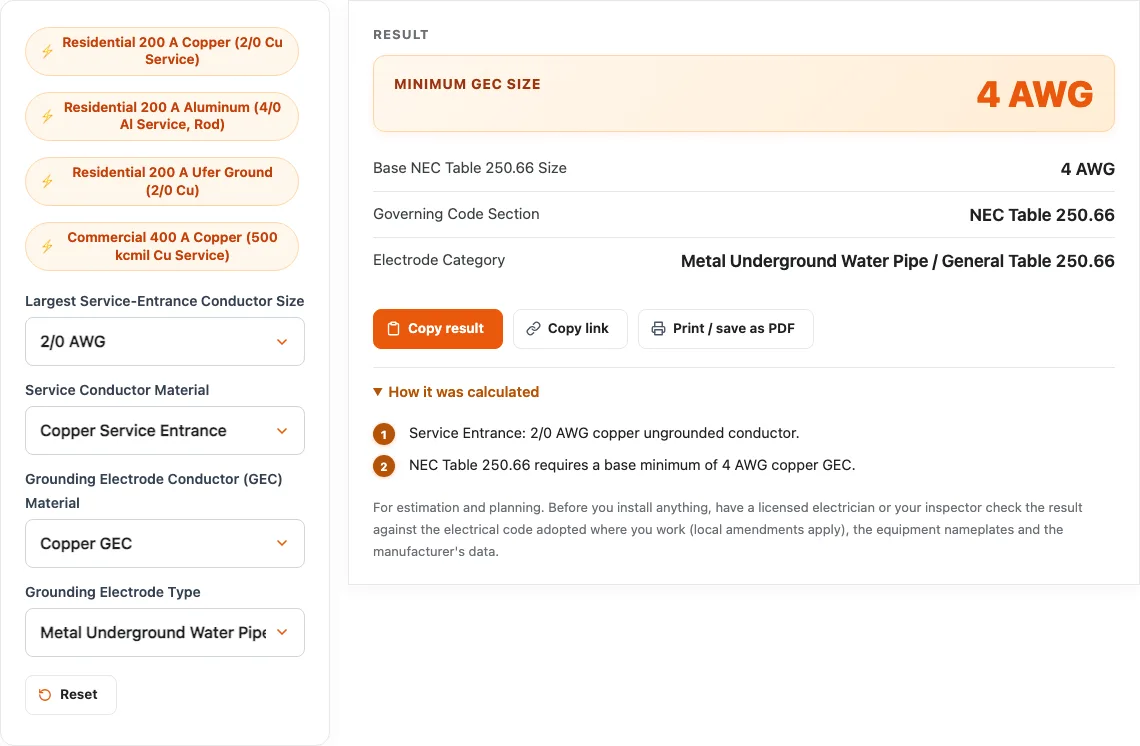
Example: a 200 A service with 4/0 aluminum conductors needs a 4 AWG copper GEC from Table 250.66, but when the conductor runs only to ground rods, 250.66(A) caps it at 6 AWG copper.
Sizing Service Grounding Electrode Conductors per NEC 250.66
The Grounding Electrode Conductor (GEC) establishes zero-voltage reference by bonding building electrical infrastructure directly to the earth. Sizing the GEC correctly ensures safe dissipation of lightning surges, utility transients, and unintentional high-voltage contact.
How Service Conductor Area Determines Base GEC Size
Under NEC Table 250.66, base GEC size depends entirely on the cross-sectional area of the ungrounded service-entrance conductors (or equivalent area for parallel conductors):
- Service Conductors 2 AWG or smaller copper (1/0 or smaller aluminum): Requires 8 AWG copper or 6 AWG aluminum GEC.
- Service Conductors 1 AWG to 1/0 copper (2/0 to 3/0 aluminum): Requires 6 AWG copper or 4 AWG aluminum GEC.
- Service Conductors 2/0 or 3/0 copper (4/0 to 250 kcmil aluminum): Requires 4 AWG copper or 2 AWG aluminum GEC (standard for 200A residential services).
- Service Conductors over 3/0 through 350 kcmil copper (over 250 through 500 kcmil aluminum): Requires 2 AWG copper or 1/0 aluminum GEC.
- Service Conductors over 1100 kcmil copper (over 1750 kcmil aluminum): Requires 3/0 AWG copper or 250 kcmil aluminum GEC.
When parallel conductors per phase are installed (common in commercial 400A to 1200A services), the total cross-sectional area of all parallel conductors per phase is summed before consulting Table 250.66.
Statutory Maximum GEC Limits for Specific Electrodes
A frequent area of confusion and unnecessary expense on construction sites is over-sizing GEC wires connected to ground rods or concrete footings. The code recognizes physical limitations in contact resistance between specific electrode geometries and surrounding earth:
- Rod, Pipe, or Plate Electrodes (NEC 250.66(A)): Where the GEC connects solely to a driven ground rod, steel pipe, or buried plate electrode, that portion of the conductor is never required to be larger than 6 AWG copper or 4 AWG aluminum wire, regardless of service size.
- Concrete-Encased Electrodes / Ufer Grounds (NEC 250.66(B)): Where the GEC connects solely to reinforcing steel or bare copper wire encased in concrete foundations (minimum 20 feet of 1/2-inch rebar or 4 AWG bare copper), the GEC is never required to exceed 4 AWG copper wire.
- Ground Rings (NEC 250.66(C)): Where connecting to a buried bare conductor encasing a building, the GEC does not need to be larger than the conductor used for the ground ring (minimum 2 AWG copper).
However, if the GEC connects to an interior metallic water piping system serving as an electrode or bonding jumper, Table 250.66 applies in full without these special caps.
Worked examples
| Input | Result |
|---|---|
| 2/0 Cu service, general electrode (Cu GEC) | 4 AWG Cu GEC (NEC Table 250.66) |
| 4/0 Al service, rod electrode (Cu GEC) | 6 AWG Cu GEC (NEC 250.66(A)) |
| 400 Cu service, concrete electrode (Cu GEC) | 4 AWG Cu GEC (NEC 250.66(B)) |
| 500 Al service, general electrode (Al GEC) | 1/0 AWG Al GEC (NEC Table 250.66) |
Calculated by the tool above; open it with the same values to see each step.
Questions, briefly answered
Common questions regarding service grounding electrode conductors and NEC Article 250 rules:
What size grounding electrode conductor is required for a 200A service?
For a standard 200-amp residential service using 2/0 AWG copper or 4/0 AWG aluminum service entrance conductors, NEC Table 250.66 requires a 4 AWG copper GEC to metallic water piping. However, if connecting solely to driven ground rods, NEC 250.66(A) limits the required copper GEC to 6 AWG. If connecting to a concrete-encased Ufer ground, NEC 250.66(B) specifies 4 AWG copper.
Can aluminum wire be used as a grounding electrode conductor outdoors?
Aluminum or copper-clad aluminum GEC conductors are subject to strict environmental restrictions under NEC 250.64(A). Bare aluminum conductors cannot be used where in direct contact with earth, masonry, or outdoor conditions within 18 inches of the earth. Where terminated outdoors, copper GEC wire is strongly preferred and universally accepted.
Does a 400-amp service need a larger ground wire to the ground rod?
No. Under NEC 250.66(A), the grounding conductor connected solely to driven ground rods is never required to be larger than 6 AWG copper, even on 400A, 800A, or larger services. This is because a driven ground rod has a high contact resistance with earth, rendering conductors larger than 6 AWG electrically ineffective for earth grounding.
What is the difference between a GEC and an equipment grounding conductor?
The Grounding Electrode Conductor (GEC) connects the electrical system neutral and main enclosure directly to the earth via ground rods, water pipes, or rebar. Its purpose is voltage stabilization and lightning dissipation. An Equipment Grounding Conductor (EGC) runs alongside circuit wires to bond metallic equipment frames back to the breaker panel, establishing a low-impedance fault clearing path to trip circuit breakers.