
Hot Tub Wire Size Calculator
Calculate conductor gauge, GFCI breaker and insulated ground size for residential hot tub and spa installations per NEC 680.
Pro calculator. The examples run free for everyone, with full results and steps; 3 results a month with your own numbers are free, then Pro. Always free: 9 calculators + 5 charts.
Calculates wire and electrical parameters per NEC 2023. Runs in your browser. Verify with your local code and a licensed electrician before you install.
Recent
Your last 10 settings, saved only in this browser. Nothing is uploaded.
How to use the Hot Tub Wire Size Calculator
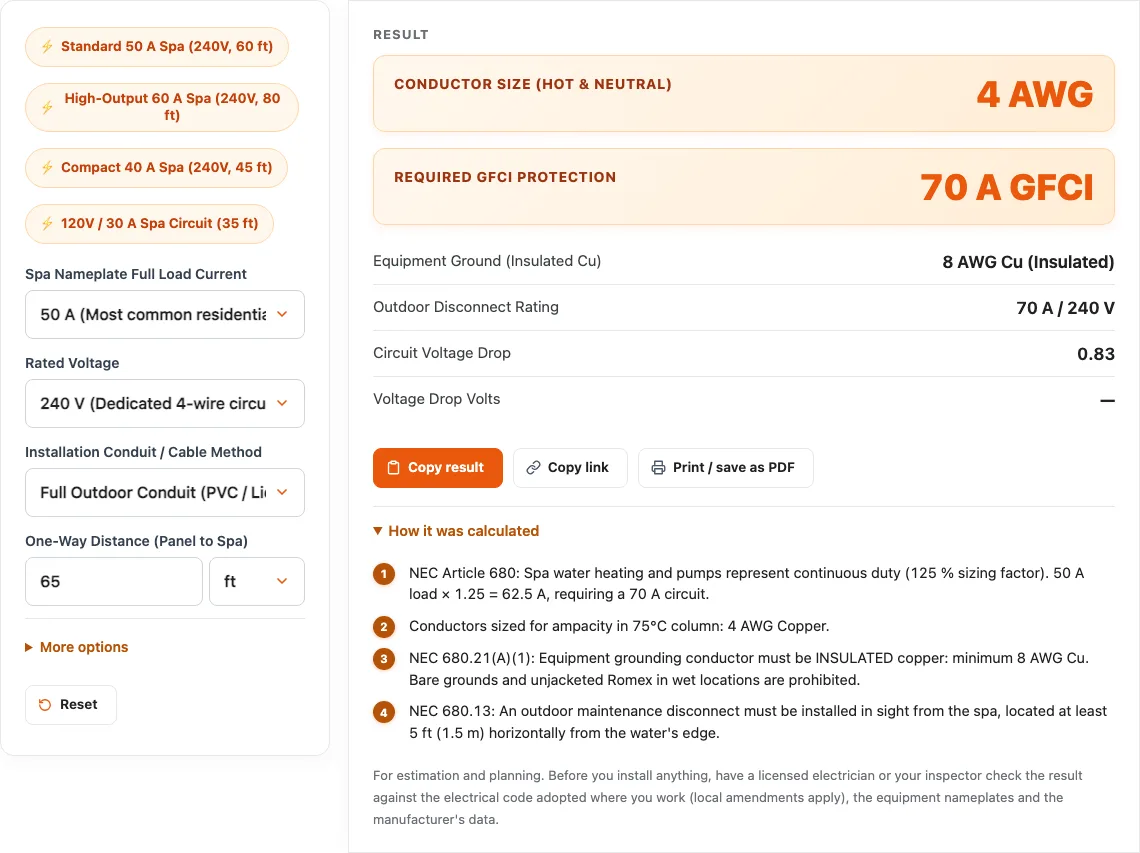
- Select the breaker size your hot tub’s nameplate or installation manual asks for (most residential 240V spas ask for 40A, 50A or 60A). The calculator uses it as is: the spa maker has already allowed for the continuous load, and a larger breaker than the nameplate maximum is never allowed.
- Enter the one-way circuit distance in feet from the main breaker panel through the exterior GFCI disconnect switch to the hot tub pack terminals.
- Select your wiring method and conduit type (standard installations utilize individual THHN/THWN-2 copper conductors in Schedule 40 PVC or liquidtight flexible nonmetallic conduit).
- Specify allowable voltage drop threshold (3% maximum recommended to maintain full electric heater heat output and pump motor longevity).
- Review the calculated results panel: the calculator determines the minimum conductor gauge for the hots and neutral and the insulated ground, and computes the voltage drop at 80% of the breaker rating. Conduit size is not calculated: use a conduit fill calculator for that.
- Verify external GFCI disconnect placement to ensure it meets both the minimum 5-foot clearance and direct line-of-sight requirements mandated by NEC 680.13.
- Ask your inspector which bonding applies to your spa: listed self-contained spas on or above grade often need no perimeter bonding (NEC 680.42(B)); other installations follow NEC 680.26 (8 AWG solid copper).
- Review the printed results with a licensed electrical contractor before purchasing materials.
Sizing Branch Circuits for Hot Tubs and Spas per NEC 680
Wiring an outdoor hot tub requires sizing the circuit for the spa’s nameplate breaker with rigorous water-safety provisions outlined in NEC Article 680 (Swimming Pools, Fountains, and Similar Installations).
50-Amp vs. 60-Amp Spa Circuit Requirements
Most self-contained hot tubs require one of two standard electrical configurations:
- 50-Amp Circuit: Allows simultaneous operation of the 4 kW electric heater and one pump on high speed. If a second pump engages, heater elements typically shed automatically. A 50A circuit requires 6 AWG copper conductors (hot and neutral) and a 10 AWG copper ground.
- 60-Amp Circuit: Permits simultaneous full operation of a 5.5 kW heater alongside multiple high-speed hydrotherapy pumps. A 60A circuit requires 4 AWG copper (6 AWG copper is rated only 55A in the 60 °C column that NEC 110.14(C)(1)(a) applies to circuits of 100A or less). Only when every termination is marked 75 °C may 6 AWG THHN in conduit (65A at 75 °C) be used.
The 4-Wire System and Insulated Ground Mandate
Nearly all modern hot tub electronic packs require a 120V/240V 4-wire connection:
- Line 1 (Hot): 120V to ground.
- Line 2 (Hot): 120V to ground (240V between Line 1 and Line 2 for heaters and 240V pump motors).
- Neutral: Dedicated return conductor for 120V control boards, ozonators, audio systems, and LED lighting.
- Insulated Equipment Ground: Under NEC 680.42(C), the equipment grounding conductor for a spa circuit must be copper and insulated (green), sized from NEC Table 250.122 and never smaller than 12 AWG. Bare ground wires (such as standard NM-B bare conductors) are strictly prohibited in outdoor conduit runs feeding spas.
Disconnect Switch Location and Emergency Shutoff (NEC 680.13)
The NEC mandates a dedicated maintenance disconnect switch (typically housed inside an outdoor weather-resistant GFCI spa panel):
- Must be located within sight of the hot tub.
- Must be readily accessible to occupants and service personnel.
- Must be installed at least 5 feet horizontally from the inside wall of the hot tub (unless separated by a permanent barrier) so bathers cannot reach it from the water.
- Disconnect switches must be rated for outdoor wet locations (NEMA 3R enclosure).
Worked examples
| Input | Result |
|---|---|
| 50 A Hot Tub at 240 V (65 ft) | 6 AWG Cu on a 50 A GFCI (10 AWG Cu (Insulated) EGC, 1.1 % drop) |
| 40 A Hot Tub at 240 V (45 ft) | 8 AWG Cu on a 40 A GFCI (10 AWG Cu (Insulated) EGC, 0.94 % drop) |
| 60 A Hot Tub at 240 V (80 ft) | 4 AWG Cu on a 60 A GFCI (10 AWG Cu (Insulated) EGC, 0.99 % drop) |
| 50 A Hot Tub at 240 V (140 ft) | 6 AWG Cu on a 50 A GFCI (10 AWG Cu (Insulated) EGC, 2.3 % drop) |
Calculated by the tool above; open it with the same values to see each step.
Questions, briefly answered
Common questions regarding hot tub electrical installations and NEC Article 680 safety standards:
Can I wire a hot tub with Romex (NM-B) cable?
Romex (NM-B) cable can only be run inside dry interior spaces of a home (such as from the basement main panel to the exterior house wall). NEC 334.12(B)(4) strictly prohibits NM-B cable outdoors or inside exterior conduits because moisture degrades the paper filler. At the exterior wall, you must transition to individual THWN-2 insulated conductors inside approved conduit. NM-B is allowed only for the dry interior part of the run (NEC 680.42(C)) and is sized from the 60 °C column; NM-B has a bare ground, so the outdoor part needs conductors with an insulated copper ground.
What size wire do I need for a 50-amp hot tub?
A 50-amp hot tub branch circuit wired with THHN/THWN-2 copper conductors in conduit requires two 6 AWG hot conductors, one 6 AWG neutral conductor, and one 10 AWG insulated copper ground wire. If using Romex inside the house, 6 AWG NM-B copper is rated for 55A at 60 °C and can supply a 50A breaker.
How far must the GFCI disconnect switch be from the hot tub?
Under NEC 680.13, the maintenance disconnect switch must be located at least 5 feet horizontally away from the inside water edge of the spa, but no more than 50 feet away, and must be clearly visible (in direct line of sight) from the hot tub.
Does an outdoor hot tub require equipotential bonding?
Self-contained portable spas that rest on or above grade with all electrical components enclosed under the perimeter skirt generally do not require perimeter ground bonding rings under NEC 680.42(B), provided they are listed as self-contained units. In-ground concrete spas, however, require full 8 AWG bare solid copper perimeter equipotential bonding grid installation.