
Solar PV Wire Size Calculator
Calculate minimum conductor size for photovoltaic source and output circuits applying NEC 690 irradiance and continuous duty factors.
Pro calculator. The examples run free for everyone, with full results and steps; 3 results a month with your own numbers are free, then Pro. Always free: 9 calculators + 5 charts.
Calculates wire and electrical parameters per NEC 2023. Runs in your browser. Verify with your local code and a licensed electrician before you install.
Recent
Your last 10 settings, saved only in this browser. Nothing is uploaded.
How to use the Solar PV Wire Size Calculator
- Choose the circuit: DC string (enter the string’s short-circuit current Isc from the module datasheet, STC; for parallel strings enter their total Isc) or AC inverter output (enter the inverter’s continuous output current).
- Enter the circuit voltage (string voltage for DC, grid voltage for AC).
- Under More options, enter the highest ambient temperature the conductors see and the number of current-carrying conductors in the raceway. For raceways on a roof less than 3/4 in. above it, add 33 °C to the ambient yourself (NEC 310.15(B)(2)).
- Enter the one-way circuit wire length in feet measured along the cable run from the rooftop solar array down to the inverter or rapid shutdown switchgear.
- Select conductor material: copper or aluminum.
- Review the results: the calculator applies both checks of NEC 690.8(B) (125% of the maximum current at the 75 °C terminal column, and the maximum current after the NEC Table 310.15(B)(1) temperature and conductor-count corrections on the 90 °C column), picks the fuse or breaker (NEC 690.9(B)) and shows the voltage drop (computed at the rated current you entered, a conservative figure).
- Verify that DC voltage drop remains within your selected target threshold (industry best practice recommends keeping voltage drop under 1.5% to 2.0% to prevent loss of harvested solar energy), and export the audit summary for system plan submission.
Photovoltaic Conductor Sizing Rules and NEC 690 Compliance
Designing wiring systems for rooftop and ground-mounted solar arrays demands meticulous attention to environmental extremes and specialized code sections that supersede standard commercial building wiring rules.
The 1.56 Compound Safety Factor (NEC 690.8)
In conventional electrical distribution, continuous loads require a 125% branch sizing multiplier. In photovoltaic generation systems, solar conductors face two distinct physical phenomena that require compounding safety margins:
- Irradiance Magnification (NEC 690.8(A)(1)): Field measurements prove that cloud-edge reflection and cold clear atmospheric conditions can push instantaneous solar panel output well above 1,000 W/m² nameplate STC ratings. The code accounts for this by defining maximum circuit current as module rated $I_{sc} \times 1.25$.
- Continuous Operating Duty (NEC 690.8(B)): Solar generation runs for hours at a time. Overcurrent protection and the conductor (before temperature correction) are sized at another 125% ($1.25 \times 1.25 = 1.5625$ × Isc); after temperature and conductor-count correction the conductor only has to carry 1.25 × Isc.
Consequently, a solar module string with a nameplate short-circuit current of 14.0 amperes needs a fuse of at least $14.0 \times 1.5625 = 21.875$ amperes (25 A standard) and conductors with at least 21.875 A at the 75 °C terminal column; after temperature and conductor-count correction they must still carry $14.0 \times 1.25 = 17.5$ amperes.
Rooftop Thermal Derating and Conductor Temperature Ratings
Conductors installed on building rooftops are exposed to intense radiant heat from direct sunlight and dark roofing materials. Photovoltaic source wiring must utilize conductors listed as single-conductor PV Wire or USE-2, rated for 90 °C wet applications and sunlight resistance.
When ambient air temperatures reach 95 °F to 110 °F (35 °C to 43 °C), NEC Table 310.15(B)(1) multiplies the 90 °C table ampacity by 0.96 (31–35 °C), 0.91 (36–40 °C) or 0.87 (41–45 °C). Raceways or cables on a rooftop less than 3/4 in. (19 mm) above the roof add 33 °C to the ambient (NEC 310.15(B)(2)). Proper design accounts for both ambient temperature derating and conduit fill adjustments simultaneously.
String Voltage Drop and Inverter Energy Harvest
Unlike alternating-current grid wiring where minor voltage drop primarily affects lighting, direct-current voltage drop on solar arrays directly dissipates harvested solar energy as wasted heat inside raceways. Solar engineers typically design DC string circuits to maintain voltage drop below 1.5% to 2.0% at peak maximum power point current (Imp), ensuring maximum kilowatt-hour generation reaches the inverter input terminals over the system lifespan.
Worked examples
| Input | Result |
|---|---|
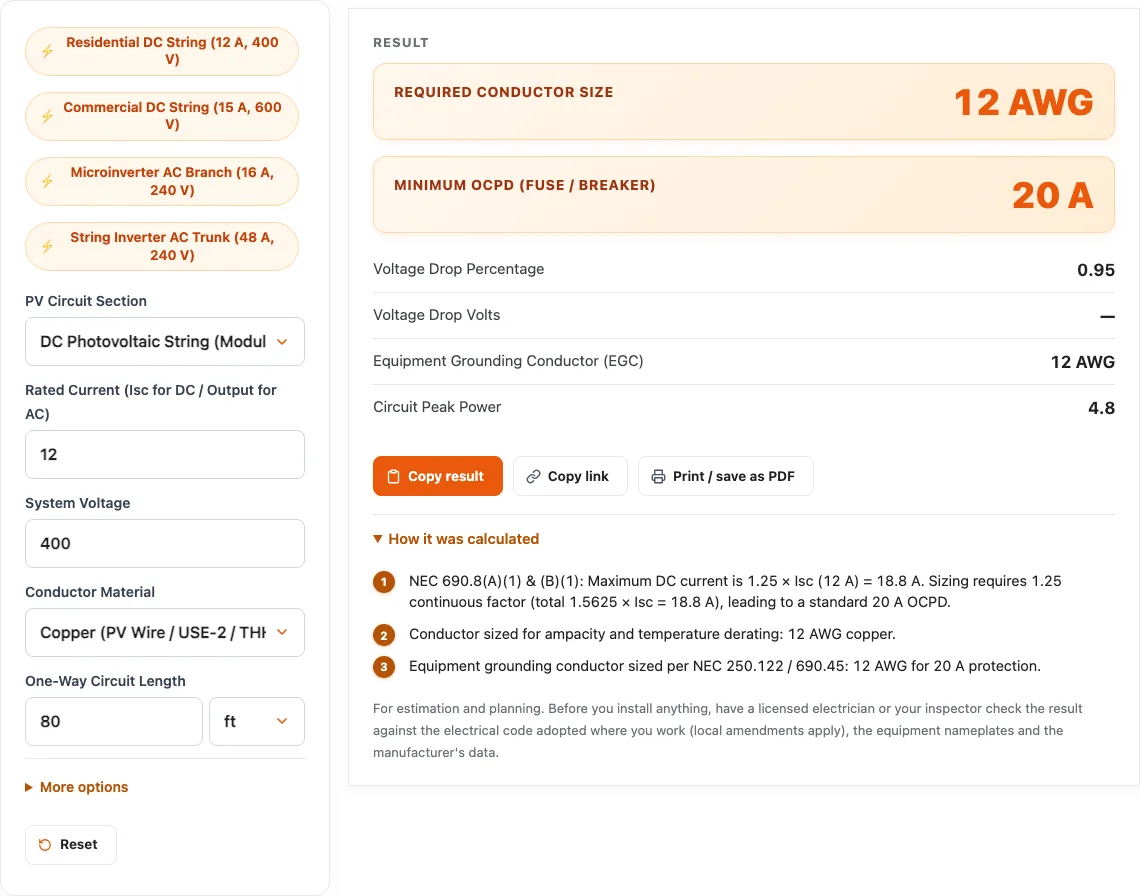
| 12 A, 400 V DC (80 ft) | 12 AWG with 20 A OCPD (0.95 % drop) |
| 15 A, 600 V DC (120 ft) | 10 AWG with 25 A OCPD (0.74 % drop) |
| 32 A, 240 V AC (50 ft) | 8 AWG with 40 A OCPD (1 % drop) |
| 48 A, 240 V AC (100 ft) | 4 AWG with 60 A OCPD (2 % drop) |
Calculated by the tool above; open it with the same values to see each step.
Questions, briefly answered
Common questions regarding solar photovoltaic string calculations and rooftop wiring codes:
Why do solar circuits require a 1.56 multiplier instead of 1.25?
Solar systems combine two distinct factors under NEC 690.8: an irradiance surge factor of 125% on module short-circuit current (Isc) due to cloud-edge lens effects, and an additional 125% continuous duty factor because solar generation runs for hours under peak sunlight. Multiplying these factors together ($1.25 \times 1.25$) yields 1.5625, sizing the fuse and the conductors’ terminal ampacity; the temperature-corrected check uses 1.25 × Isc.
Can standard THHN wire be used on solar panel arrays?
Standard THHN wire cannot be exposed directly outdoors on solar racking. Conductors connected directly to solar panel junctions must be listed as sunlight-resistant PV Wire or USE-2 with 90 °C wet ratings and heavy jacket insulation rated up to 1,000V or 2,000V DC. Once PV conductors enter an enclosed conduit run inside a building, THHN/THWN-2 conductors are permitted.
How does rooftop temperature affect solar wire size?
Rooftop surfaces absorb radiant heat and can elevate raceway temperatures well above ambient air temperature. Higher temperatures reduce the rate at which electrical wires can dissipate heat, lowering allowable conductor ampacity per NEC Table 310.15(B)(1). This temperature derating frequently requires upsizing solar string conductors from 12 AWG to 10 AWG or 8 AWG.
What is the maximum acceptable DC voltage drop in solar wiring?
While the NEC contains informational recommendations of 3% for branch circuits, the solar industry best practice is to design DC source circuits for no more than 1.5% to 2.0% voltage drop. Because solar energy cannot be recovered once lost to thermal line resistance, keeping resistance minimal pays substantial energy dividends over 25 years of array operation.