
Subpanel Wire Size Calculator
Calculate feeder wire gauge, equipment grounding conductor and voltage drop for residential subpanels per NEC 215 and 250.
Pro calculator. The examples run free for everyone, with full results and steps; 3 results a month with your own numbers are free, then Pro. Always free: 9 calculators + 5 charts.
Calculates wire and electrical parameters per NEC 2023. Runs in your browser. Verify with your local code and a licensed electrician before you install.
Recent
Your last 10 settings, saved only in this browser. Nothing is uploaded.
How to use the Subpanel Wire Size Calculator
- Enter your subpanel feeder circuit breaker rating in amperes (common residential subpanel disconnect sizes are 60A, 100A, 125A, 150A, or 200A).
- Enter the one-way feeder run distance in feet from the main distribution panel to the subpanel location along the actual conduit or cable pathway.
- Select conductor material: choose Copper (individual THHN conductors installed inside conduit) or Aluminum (AA-8000 series compact stranded SER cable or conductors in raceway).
- Select the wiring method: THHN/THWN-2 in conduit (75 °C), SER cable (75 °C terminals; the result warns with the 60 °C size if the cable runs through thermal insulation) or NM-B (60 °C).
- Set your allowable voltage drop target, typically 3% for feeders (an informational note in NEC 215.2 suggests it; it is not a rule). The drop is checked at 80% of the feeder rating.
- Review the calculated results panel: the calculator determines minimum feeder hot conductor gauge from NEC Table 310.16 (75 °C rating), selects the minimum equipment grounding conductor from NEC Table 250.122, and calculates the voltage drop. Conduit size is not calculated: use a conduit fill calculator for that.
- Check the neutral-ground separation notes: ensure the subpanel neutral busbar remains isolated (floating) from the metal chassis and that a separate equipment grounding busbar is bonded to the enclosure.
- Use the export and copy functions to retain complete documentation for building code officials and electrical permit plan reviews.
Engineering Feeder Circuits for Subpanels per NEC 215 and 250
Subpanels (distribution switchboards located downstream of the main service disconnect) serve detached garages, workshops, home additions, and finished basements. Because feeders carry combined current for multiple branch circuits, strict installation standards apply.
4-Wire System and Neutral-Ground Separation
Prior to modern electrical code revisions, older three-wire feeders allowed neutral conductors to serve as the equipment grounding path in existing outbuildings. Under current NEC 250.32, all new subpanel feeder installations must maintain an independent four-wire path:
- Two Ungrounded Conductors (Hots): Sized to carry full feeder ampacity.
- One Grounded Conductor (Neutral): Carries normal unbalanced return current. Must remain completely isolated from panel metal enclosure.
- One Equipment Grounding Conductor (EGC): Sized per NEC Table 250.122 to carry fault currents safely back to the main service trip device.
- Floating Neutral Bar: The green bonding screw or strap bonding the neutral bar to the subpanel chassis must be removed. Grounding busbars must be bonded to the metal enclosure.
Conductor Material Trade-offs: Copper THHN vs. Aluminum SER
For large subpanel feeders (100A and above), aluminum alloy conductors (AA-8000 series) represent the industry standard due to substantial cost savings:
- 100A Feeder: 100A copper requires 3 AWG THHN copper wire. Sized in aluminum, 1 AWG AA-8000 aluminum conductors are required. SER cable run through thermal insulation is limited to the 60 °C column (NEC 338.10(B)(4)(a) and 334.80), which makes it 1/0 aluminum.
- 60A Feeder: Requires 6 AWG copper (65A ampacity at 75 °C) or 4 AWG aluminum (65A ampacity at 75 °C).
- 200A Feeder: Requires 3/0 AWG copper or 250 kcmil aluminum conductors.
All aluminum terminations must be secured into mechanical lugs rated AL7CU or AL9CU torqued to manufacturer specifications with a calibrated torque wrench (NEC 110.14(D)).
Voltage Drop Considerations for Detached Outbuildings
When running feeder cables underground to detached structures such as detached garages, sheds, or agricultural barns, distances frequently exceed 100 to 250 feet. Conductor resistance can lead to noticeable voltage drop that dims lighting and stresses electric motors during startup. An informational note in NEC 215.2 suggests sizing feeders for no more than 3% voltage drop at the design load (advice, not a requirement). If feeder voltage drop exceeds 3%, upsizing conductors by one trade size maintains system performance and equipment reliability.
Worked examples
| Input | Result |
|---|---|
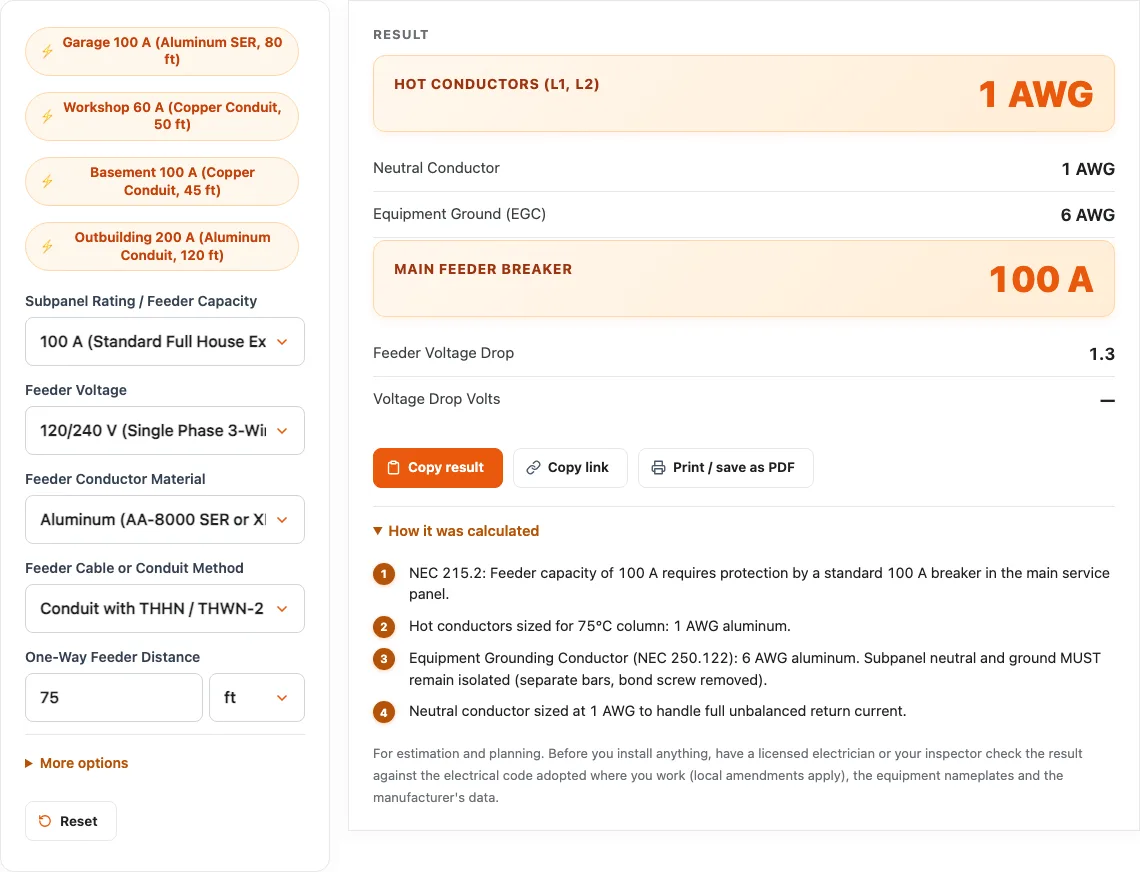
| 100 A subpanel at 240 V (75 ft, Al) | 1 AWG hot/neutral & 6 AWG ground (100 A breaker, 1.3 % drop) |
| 60 A subpanel at 240 V (50 ft, Cu) | 6 AWG hot/neutral & 10 AWG ground (60 A breaker, 0.98 % drop) |
| 125 A subpanel at 240 V (100 ft, Al) | 2/0 AWG hot/neutral & 4 AWG ground (125 A breaker, 1.3 % drop) |
| 200 A subpanel at 240 V (120 ft, Al) | 250 kcmil hot/neutral & 4 AWG ground (200 A breaker, 1.4 % drop) |
Calculated by the tool above; open it with the same values to see each step.
Questions, briefly answered
Common questions regarding subpanel installation rules and feeder wire calculations:
Can I bond the neutral and ground wires together in a subpanel?
No. Neutral and ground wires must only be bonded together at the main service equipment where the main bonding jumper is located. In a subpanel, the neutral busbar must be kept completely isolated (floating) from the metal enclosure. If neutral and ground are bonded in a subpanel, dangerous return currents will flow across the metal chassis and conduit, creating a severe electric shock hazard.
What size wire do I need for a 100-amp subpanel?
For a 100-amp subpanel feeder operating on 75 °C rated terminals, you need 3 AWG copper THHN conductors or 1 AWG aluminum conductors per NEC Table 310.16. If aluminum SER cable runs through thermal insulation, the 60 °C column applies (NEC 338.10(B)(4)(a)) and 100A needs 1/0 aluminum.
What size conduit is required for a 100-amp feeder?
For a 100-amp feeder consisting of three 1 AWG aluminum THHN conductors and one 6 AWG aluminum ground conductor, NEC Chapter 9 Table 1 allows maximum 40% conduit fill for three or more conductors. In Schedule 40 PVC or EMT conduit, a 1-1/4 inch conduit provides compliant fill and smooth cable pulling clearances.
Does a detached garage subpanel need its own grounding rods?
Yes. Under NEC 250.32(A), a subpanel installed in a detached building or structure requires its own grounding electrode system (often two driven ground rods at least 6 feet apart, NEC 250.53; not required when the building is supplied by a single branch circuit) bonded directly to the subpanel equipment grounding busbar, in addition to the 4-wire feeder grounding conductor coming from the main building panel.